




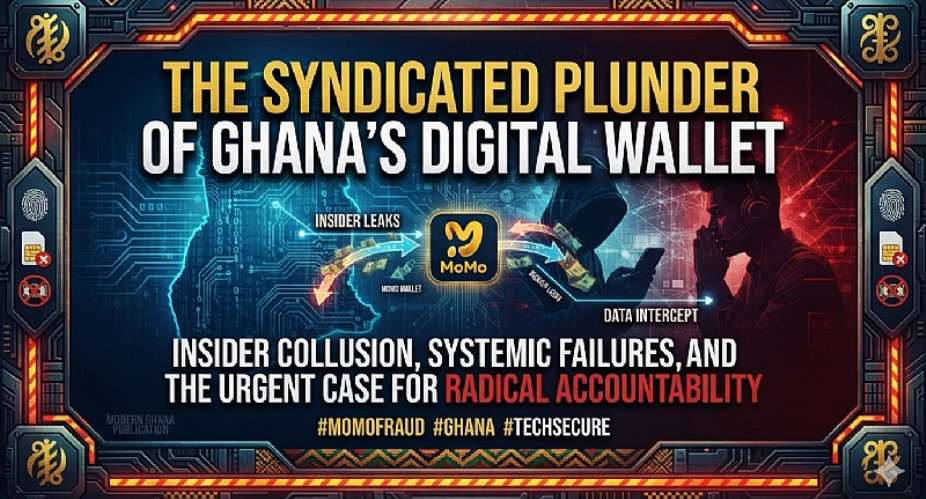
The meteoric rise of Mobile Money (MoMo) as the backbone of Ghana’s financial infrastructure has concurrently birthed a highly predatory, syndicated criminal economy. What was engineered as an instrument of financial inclusion has been weaponized into a conduit for systemic extortion, systematically draining the financial lifeblood of everyday citizens. As digital theft reaches catastrophic proportions, a profound public outrage has rightly boiled over, focusing directly on the structural vulnerabilities of telecommunications networks. The public suspicion is no longer a conspiratorial murmur but a well-founded indictment: Rogue telecom workers, specifically internal MTN staff and their compromised field agents, are the primary culprits actively leaking private subscriber data and collaborating with external syndicates to strip Ghanaians of their wealth.
Corporate public relations frameworks consistently shelter behind the defense that core cryptographic data, such as customer PINs, are electronically encrypted and visually inaccessible to staff. However, empirical law enforcement interventions and independent cyber-forensic reviews paint a far more damning reality. Investigative bodies like the Economic and Financial Crimes Office (EOCO) have repeatedly uncovered networks where corrupt MTN insiders, network administrators, and third-party contractors exploited high-level administrative privileges to bypass identity verification protocols, execute illicit SIM swaps, and harvest high-balance target lists. To preserve the integrity of Ghana's digital economy, we must move past passive consumer advisories and aggressively confront the mechanics of this syndicated plunder.
Empirical Case Studies: Anatomy of Modern MoMo Fraud Tactics
To understand the sophistication of these criminal enterprises, one must analyze the precise operational tactics deployed by syndicates, which exploit a lethal combination of human proximity and systemic gaps:
- The Proximity Harvest and Co-Conspirator Intercept: In a harrowing, real-life account that underscores the ruthlessness of these syndicates, a citizen deposited a substantial sum of money strictly earmarked for their father’s funeral. At the point of transaction, the operating vendor required the customer to state their mobile number aloud to process the cash loading. Standing directly behind the victim was an embedded co-conspirator, masquerading as a waiting customer. Within minutes of leaving the kiosk, the syndicate launched an aggressive follow-up call, claiming an administrative "deposit mistake" occurred and deploying high-pressure psychological manipulation to swiftly intercept the funds before the victim could process the deception.
- The Preemptive Administrative Lockout: Syndicates routinely acquire fresh registration logs via compromised database access. Armed with the victim’s name, national identity details, and approximate wallet balance, a fraudster poses as a "Head Office Compliance Officer." They contact the victim, declaring that their account is under immediate investigation for fraud and faces a permanent freeze. Panic-stricken, the victim is coerced into reciting an incoming SMS verification code (OTP) under the illusion of "verifying their identity," inadvertently granting the attacker full remote device authorization.
- Fraudulent SIM Swap Identity Theft: Criminal cartels systematically bypass strict Know-Your-Customer (KYC) frameworks by utilizing counterfeit or altered Ghana Cards. Using the identity of a high-net-worth target, a fraudster convinces a negligent or financially incentivized mobile agent to execute an immediate SIM card replacement. The legitimate user’s phone instantly drops to "No Service," completely blinding them to the digital environment while the criminal syndicate systematically drains the linked bank accounts and MoMo wallets in total silence.
Systemic Vulnerabilities: The Mechanics of the Fraud Ecosystem
- Insider Exploitation of Administrative Access: Rogue technical staff misappropriate high-tier database clearances to extract sensitive subscriber metadata, selling active leads to prison yards and specialized cyber-cabals.
- Agent Interface Manipulation: Rogue mobile money agents frequently exploit application loopholes to aggressively push unprompted "cash-out" authorization prompts to random customer devices, capitalizing on accidental confirmation presses.
- Ecosystem Identity Failures: Weak physical verification at decentralized vendor points allows bad actors to present fraudulent physical documents without real-time, automated biometric cross-referencing against the national identification registry.
- Corporate Information Asymmetry: Occasional system breaches and external network penetrations expose baseline subscriber data, arming external syndicates with the precise contextual details required to execute highly convincing phishing operations.
Hardline Regulatory Mandates: Penalties the Bank of Ghana and NCA Must Impose
To dismantle this cartel, regulators must cease treating mobile money fraud as a mere consumer-care issue. The Bank of Ghana (BoG) and the National Communications Authority (NCA) must wield their statutory powers to impose punitive legal and financial penalties that force telecommunication giants to police their internal staff:
- Strict Corporate Liability and Vicarious Liability Fines: Regulators must legally hold MTN Ghana financially accountable for the actions of their staff. If an internal audit or police investigation proves an MTN employee or contractor facilitated an unauthorized SIM swap or leaked data, the NCA must levy an automatic statutory fine of at least 500,000 Penalty Units against the corporation.
- Mandatory Criminal Prosecution and Minimum Sentencing: The practice of quietly dismissing rogue workers to protect brand reputation must be criminalized. Legislation must mandate that any telecom employee caught compromising customer data faces immediate prosecution under the Cybersecurity Act, carrying a non-commutable minimum custodial sentence of 10 to 15 years in prison.
- Forfeiture of Assets for Compromised Insiders: The state must aggressively pursue the financial gains of internal saboteurs. Any MTN worker convicted of aiding MoMo fraud must have all personal bank accounts, landed properties, and assets seized under anti-money laundering and proceeds-of-crime laws to directly compensate the victims.
- Compulsory Victim Compensation Funds: The Bank of Ghana must force telecom operators to establish an escrowed Customer Indemnity Fund. When a user loses money due to proven corporate negligence or internal insider collusion (such as an unauthorized SIM swap executed at an MTN branch), the telecom provider must be legally mandated to refund the victim’s full stolen balance within 48 hours, plus interest.
- Revocation of Operational Licenses for Negligent Agents: The NCA must implement a three-strike rule for decentralized vendor kiosks. Any mobile money agent point of sale caught executing transactions without live, state-verified biometric checks must face immediate, permanent revocation of their operating license and blacklisting across all networks.
Deflationary Action Checklist for Consumers
- Enforce Total Numeric Privacy: Never state your phone number or account details aloud at a public vending kiosk; insist on typing the digits directly into the agent’s terminal or utilization of secure QR code architectures.
- Treat Network Blackouts as Financial Emergencies: If your mobile device experiences an abrupt, unexplained loss of network connectivity ("No Service"), assume an unauthorized SIM swap is actively in progress and immediately freeze your account using an alternative device.
- Repudiate Outbound Telephonic Solicitations: Legitimate telecommunications providers operate strictly via centralized, invariant numbers—such as MTN Ghana’s exclusive customer support line, 0244300000. Treat any standard 10-digit mobile number claiming official status as an absolute threat.
- Establish Complex Security Credentials: Reject easily calculated PIN structures like sequential combinations (1234), birth years, or repetitive strings (0000), which are highly vulnerable to basic brute-force social engineering.
- Withhold All Verification Tokens: Under no operational circumstance will a legitimate network engineer, bank official, or regulatory auditor require you to verbally disclose a MoMo PIN or an SMS-delivered One-Time Password (OTP).
The pervasive plague of Mobile Money fraud in Ghana cannot be solved by hollow corporate denials or by placing the entire burden of vigilance onto the consumer. It requires an aggressive, unyielding restructuring of institutional accountability that targets the enemy within. While MTN and other telecommunication giants must clean their houses, harden their digital perimeters, and legally crush internal saboteurs, the Ghanaian public must adopt an attitude of radical digital skepticism. A mobile money wallet must be treated with the exact same security posture as an iron-clad bank vault. Only through an uncompromised alliance of strict regulatory enforcement, severe criminal penalties for insider collusion, and absolute user skepticism can Ghana reclaim its payment channels and protect the sovereignty of its digital economy.
Emergency Regulatory Escalation Channels
- Corporate Customer Care Operations: Dial 100
- Cyber Security Authority (CSA) Incident Command: Call or Text 292
- National Communications Authority (NCA) Regulatory Bureau: Dial 0800-110-110
✍️ Submitted by:
Retired Senior Citizen
For and on behalf of all Senior Citizens of the Republic of Ghana 🇬🇭
Teshie-Nungua
[email protected]


 Niger coup attempt: 'Russians saved the day' analyst tells RFI
 IGP decorates officer promoted for saving lives during Aboso fire
 Kumasi Inner Ring Road to close for six hours on September 6 for GRIDCo power tr...
 Eastern region: Seven killed in galamsey pit collapse at Asamang Tamfoe
 Anti-corruption fight has so far yielded positive results – PTAAM-Africa
 I've not done anything to embarrass myself, family or NPP – Afenyo-Markin reject...
 ‘Complete falsehood’ – Dr Srem-Sai rejects OSP claim of AG collaboration snub
 Police arrest six suspected members of armed robbery syndicate in Ashanti Region
 AU welcomes Sudanese-Sudanese dialogue initiative to end conflict
 ‘I was alone when it mattered most’ – Victoria Hamah opens up on painful past

