




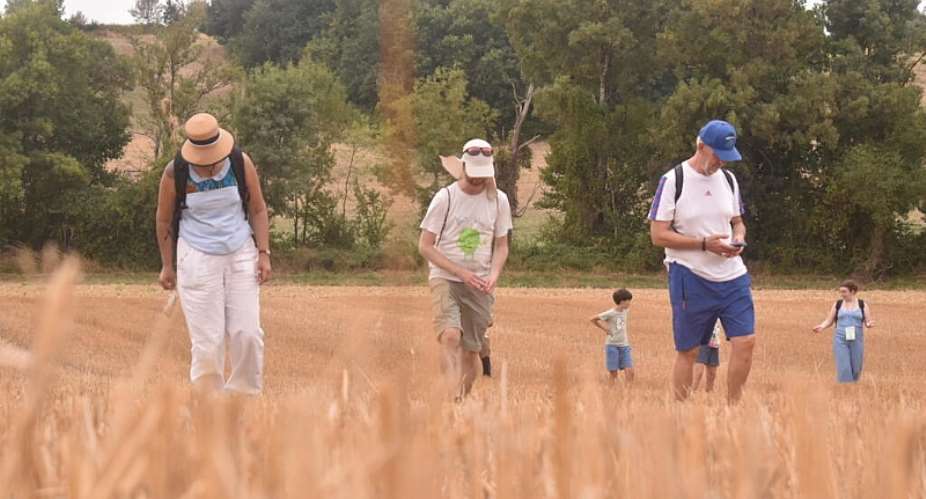
At the Fleurance Astronomy Festival in south-west France, 50 volunteers have gathered across four freshly cut fields of wheat. The group, kitted out in caps, rucksacks and trainers, includes space enthusiasts as well as families with young children.
The volunteers have been told that a meteorite fell to Earth during the night, just a few hundred metres from where they are standing.
“We saw a huge flash of light at an altitude of 30 kilometres, then the fireball broke into many pieces. The aim is to find them,” said planetary scientist Sylvain Bouley, who is leading the search.
This meteorite hunt is actually just an exercise, a fact the volunteers are aware of. An hour before the public arrived, Bouley hid 20 meteorite fragments across the fields. The group then split into four teams and began searching.
The task quickly proves tougher than it first appears. The fragments are no bigger than a dice and the search area covers about five hectares.
“When we have to find a two-centimetre stone over such a large area, we need members of the public – citizens who've learned how to observe,” Bouley said. “So the aim is to train people all over France so we can call on them when a real meteorite falls to Earth.”
That is not a hypothetical scenario. In February 2023, a 650-kilogramme fireball broke apart over Normandy and scattered around 100 fragments across an area seven kilometres wide.
Within hours of the impact, Bouley and his team had gathered 200 volunteers to search the area. Several pieces were found. A meteorite fragment about two centimetres across and weighing around 10g, found by a participant.
Onlookers stunned as flaming meteor streaks across skies of Brittany
'Fan of rocks'
The apprentice hunters in Fleurance are hoping to do the same. Their search involves two hours of walking in closely spaced lines, eyes fixed on the ground.
Aurélie has joined the exercise with her daughter Abygaëlle, an energetic little girl who describes herself as a “fan of rocks”.
“I'm a very big collector,” Abygaëlle says, making her mother laugh.
“She has a whole shelf in her bedroom,” her mother says, suggesting the collection has become somewhat overwhelming.
So far, Abygaëlle has found only “pretty rocks” rather than meteorites. She thinks she knows how to tell them apart.
“Meteorites don't have too many holes, whereas other rocks have very deep holes,” she says.
The reality is a little more complicated.
“A meteorite has a black fusion crust, caused by the heating of the rock through compression and friction as it enters the atmosphere," Bouley explains. "It also has flat, rounded and fairly clean surfaces that can be distinguished from rocks that have been there for some time. They might look like meteorites, but they aren't.”
The possibility of finding a meteorite only to discover that it is an ordinary rock makes the search demanding. After an hour of careful observation, none of the meteorites has been found.
The teams turn around and begin searching in the opposite direction, led by Claire Loubière, one of the supervisors. A physics and chemistry teacher at a school in the Paris region, Loubière says she was excited by the citizen science project.
“It's great to think that we've helped a scientist move forward with their research. It's not at all the image of the researcher alone in their laboratory or out in the field," she explains. "You realise that it's a field open to everyone, including 10-year-olds who can find rocks that are useful to science." Adults and children take part in the hunt for meteorites.
Scientists unearth meteorite from the birth of the solar system
Clues from space
The first find is eventually made by 10-year-old Emmanuel, to applause from his group. He immediately puts the fragment into their bag.
Brigitte Zanda, the astrophysicist who first recovered the fragment – dated to 4.56 billion years old – says it could provide information about the origins of the universe.
“Most meteorites come from small bodies that have changed very little since the formation of the solar system and were therefore present when the sun was forming," Zanda explains. "Until we've analysed a new meteorite, we can't know whether it might have incredible information to teach us."
Involving members of the public has become increasingly important because the number of meteorites recovered in France has fallen sharply over the past 200 years.
"We found 45 during the 19th century, but only nine during the 20th century," Zanda says. Yet the number of impacts remains stable, at about two to three per year in France and several tens of thousands worldwide each year.
“To find a meteorite, you have to see it fall,” Zanda says. “But our lifestyles have changed. We look at the sky less than we used to because fewer of us live in the countryside. And television and smartphones also distract us from the stars.” The 364-kg Mont Dieu meteorite, found in the Ardennes region in 2010, is 4.65 billion years old and one of the largest ever found in France. Sold for €51,000 at auction, the owner refused to let it go, considering the price too low.
Russia says thwarted smuggling of giant meteorite to UK
Watching the skies
Some of the search work is now automated. In 2014, Zanda and Bouley created the FRIPON programme – a network of about 100 cameras installed at observatories, universities and museums. The cameras monitor the sky day and night to detect meteorite falls.
Since then, similar networks have been established across Europe as well as in Africa.
After two hours, the organisers signal the end of the hunt. Not all the hidden meteorites have been found. Fortunately, Bouley and his teams had recorded the exact location of every fragment they had hidden, so the remaining pieces can be recovered.
At the end of the day, all the participants – including those who found nothing – leave with a meteorite and a certificate of authenticity.
Abygaëlle and her mother Aurélie found two fragments.
“We'll be able to add them to our collection, but these ones will have a special value,” Aurélie says with a smile.
Abygaëlle already knows where they will go: “On the shelves of the bookcase in the living room.”
This article has been adapted from the original version in French by Baptiste Coulon.
► Looking up: Hunting stars and nebulae from the peaks of the French Alps
► Looking up: French radio enthusiast captures ISS signals from his garage


 'Some NPP members did not vote in 2024 election because I left NPP' – Alan Kyere...
 How €225 million cocaine from Ghana traced to fugitive Dutch drug kingpin based ...
 'Galamsey remains an existential threat' – Gyampo demands more action
 'I’m like Akpeteshie, I don’t need adverts to win' – Hawa Koomson storms home tu...
 'Excessive bail conditions must be reviewed' – GBA President
 Ketu South: Four-year water crisis deepens hardship in Agbozume
 Show evidence of higher operating costs to justify fare hike – NPA CEO to transp...
 Four Ghanaians arraigned over alleged €225 million cocaine shipment to France
 Agbogbloshie: Police kill suspected robber, recover AK-47, 186 rounds of ammunit...
 DVLA opens 29 new offices in 18 months; 62 offices nationwide - CEO


