




What additional questions arise when a software project is considered for wider or sustained use?
Completing a functioning software system may represent a substantial technical achievement. When software is intended for wider or sustained use, technical decisions must also account for intended users, operating conditions, organisational requirements and responsibilities for ongoing operation and support.
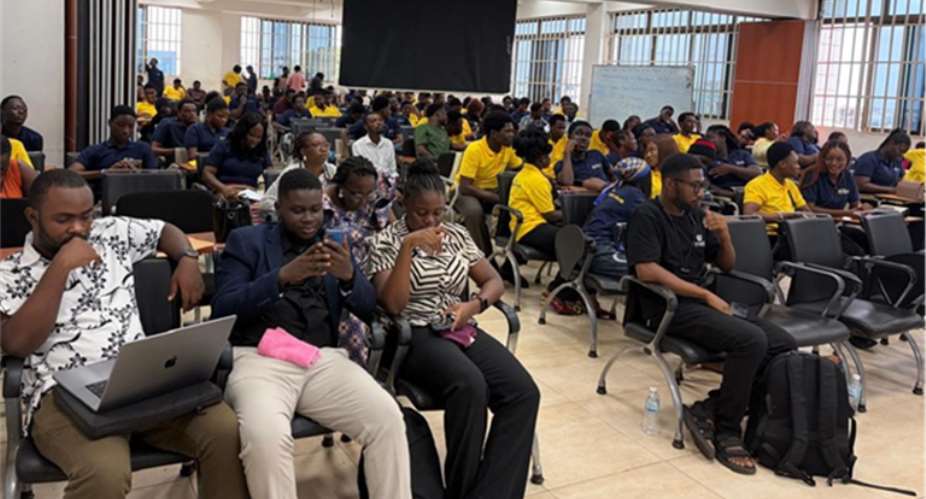
On 24 April 2026, the University of Professional Studies, Accra (UPSA), through the UPSA Developers Hub, organised an academic–industry engagement with the Meltwater Entrepreneurial School of Technology (MEST) Africa under the theme “Software Engineering to Career and Entrepreneurship.” The programme attracted more than 300 participants from different academic levels and programmes and addressed technology careers, client solutions, product development and entrepreneurship.
Problem Definition, Requirements and Feasibility
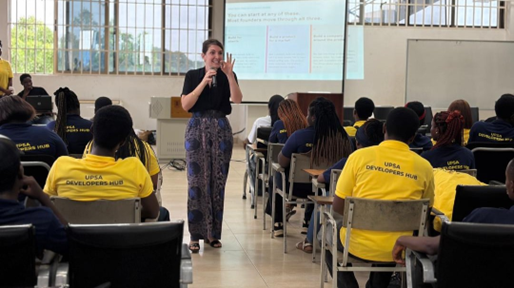 Emily Fiagbedzi addressing participants during the engagement.
During the engagement, Emily Fiagbedzi, AI Startup Program Director at MEST Africa, encouraged participants to begin with an identifiable problem experienced by a specific person or group and consider how their existing technical skills could help address it. She distinguished among developing solutions for clients, creating products for markets and building companies around those products.
Viewed through a software engineering lens, that emphasis distinguishes understanding a problem from specifying a software response. Examining the problem involves establishing what is happening, whom it affects and why intervention may be warranted, including whether software is an appropriate response. Requirements engineering encompasses the elicitation, analysis, specification, validation and management of requirements concerning what the software must do, the qualities it must exhibit and the constraints under which it must operate. The IEEE Computer Society’s Guide to the Software Engineering Body of Knowledge (SWEBOK) V4.0 identifies Software Requirements as a distinct knowledge area. Feasibility assessment considers whether the proposed solution is practicable within the technical, operational, organisational and resource constraints relevant to its intended context.
 A cross-section of participants during the engagement.
Evidence, Product Scope and Quality
Product assumptions should be tested against evidence, while relevant decisions may need to be revisited as new evidence emerges. Prototype evaluation can generate evidence about functional behaviour and user interaction. Functional testing examines whether implemented functions behave as specified, while observation and usability evaluation can reveal interaction or workflow issues. Pilot use can expose contextual issues in representative operating conditions. Operational use can generate support records, usage patterns and performance data that reveal recurring failures, unexpected behaviour, gaps in requirements and priorities that need reconsideration.
When software is intended for use across multiple organisations or user groups, scope decisions can become more complex. A system designed around one organisation’s processes may contain assumptions that do not transfer readily elsewhere. Product development therefore involves deciding which requirements should be common, which should be configurable and which should fall outside the product scope.
The consequences of quality decisions can become more significant when software must support sustained use, accommodate change or serve multiple user groups or organisations. ISO/IEC 25010:2023 defines a nine-characteristic product-quality model that provides a reference for specifying, measuring and evaluating the quality of ICT and software products.
Quality decisions involve trade-offs. Greater configurability can increase flexibility while adding complexity. Higher availability targets can entail additional architectural, infrastructure and operational costs. Security controls can alter usability and workflow. Rapid delivery can create longer-term costs when expedient technical decisions create technical debt that remains unmanaged.
A minimum viable product (MVP) deliberately limits initial scope while retaining the engineering considerations relevant to its intended use. The nature and significance of security, privacy, reliability and ethical considerations vary with affected users and operating context; regulatory obligations also depend on sector and jurisdiction.
Careers, Entrepreneurship and Professional Practice
Olufemi Adewumi introduced MEST Africa and provided an overview of its entrepreneurship training, startup support and investment activities across Africa.
 Olufemi Adewumi, MEST Africa. Photo supplied by MEST Africa.
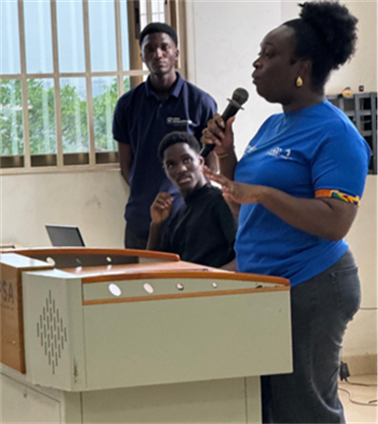 Rhema Andah presenting on technology career pathways.
Rhema Andah examined technology career pathways, discussing evolving digital-skills expectations, portfolios and micro-credentials, and entry pathways such as internships and junior roles. Participants in MEST’s Ghana Remote and Online Work (GROW) programme complemented the discussion with firsthand accounts of their pathways into technology roles.
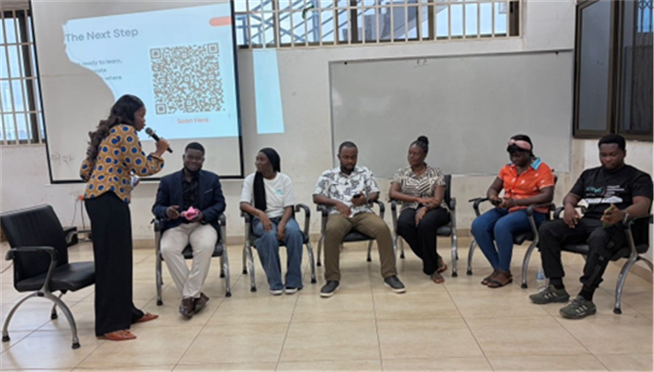 Owusua Amoo-Acheampong leading a panel discussion on technology entrepreneurship.
Owusua Amoo-Acheampong of MEST Africa presented the MEST AI Startup Program, outlining its structure, application process and candidate requirements. She explained AI MVP development and pitching during the training phase, with selected startups progressing to incubation, market validation and preparation for investment. She then facilitated a panel discussion on diverse pathways into technology entrepreneurship.
Taken together, these contributions illustrate different contexts in which software expertise may be applied: addressing internal organisational needs, delivering solutions for clients, developing products for markets and building technology ventures. These contexts can overlap, but each introduces a different combination of technical and organisational responsibilities, with commercial considerations arising where relevant.
Software development in professional settings is often collaborative and may involve designers, data professionals, infrastructure and security specialists, product professionals and domain experts. Effective collaboration across these roles depends on communication, coordination and sound technical judgement. Professional practice also involves accountability for decisions and continuing professional learning.
 Some members of the MEST Africa team at the conclusion of the engagement.
Implications for Computing Education
Developing students’ capacity to design, build and test software remains fundamental. Computing education can also create opportunities for students to work with evidence from users and use, reason about product scope and quality, and consider organisational constraints and professional responsibilities. Such considerations may not arise fully within the boundaries of an individual project. Wider or sustained use does not reduce the importance of sound engineering; it broadens the evidence that must inform technical decisions, the responsibilities those decisions carry and the professional judgement required to defend them.
 Dr. Augustina Dede Agor with some members of the MEST Africa team and representatives of the UPSA Developers Hub executive and organising teams at the close of the engagement.
Acknowledgement
I sincerely thank the University of Professional Studies, Accra (UPSA), for providing the institutional setting for the engagement, and MEST Africa for accepting the invitation and contributing to the programme. I am particularly grateful to Emily Fiagbedzi, Olufemi Adewumi, Rhema Andah and Owusua Amoo-Acheampong for their contributions. I also thank William Offei Nyanteh for his coordination support, together with the other MEST Africa contributors and GROW participants. I acknowledge the UPSA staff who supported the programme, the UPSA Developers Hub executive and organising teams, and participating members.


 Stop the Sermon Before the Engine Starts: Why Ghana Regulates Preaching on Movin...
 Don’t let speed of information become your judgement — Chief Justice tells new l...
 ‘Big Push’: Government assures contractors of prompt payments
 GES to develop plan to recover teaching time lost during teachers’ strike – Clem...
 Fire guts Kumasi Central Market near Aboabo Station
 'All human emotions': French astronaut Sophie Adenot's first words since returni...
 French astronaut recounts 'astonishing' emotions after return to Earth
 India's 'cockroach' movement chief detained ahead of major protest
 CSA rejects FBI claims, insists Ghana led cybercrime operation
 Govt suspends enforcement of ban on preaching in moving vehicles


