




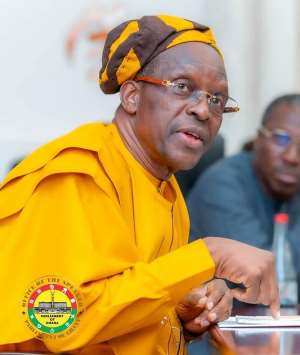
Ghana’s political conversation after President John Dramani Mahama will inevitably turn to succession. When that discussion properly begins, it should not be reduced to popularity contests, political slogans, factional calculations or who has the loudest supporters. The presidency of Ghana is too important for experimentation. Experience, character, institutional knowledge, judgment and a demonstrable record of public service must matter.
One personality whose record deserves serious national examination is the Rt. Hon. Alban Sumana Kingsford Bagbin, Speaker of Parliament. I have written about Speaker Bagbin several times in the past, particularly about his stewardship of the difficult Eighth Parliament, his parliamentary reforms and his approach to constitutional and institutional questions. Looking again at his record today, I believe there are compelling reasons why his name deserves to feature prominently whenever the post-Mahama leadership question is eventually opened.
This is not merely because Speaker Bagbin has spent many years in politics. Longevity alone cannot qualify anyone for the presidency. What makes his case interesting is the extraordinary range of political, legislative, executive and institutional experience accumulated during more than three decades of Ghana’s Fourth Republic.
1. A product of the entire Fourth Republic
Speaker Bagbin was first elected to Parliament in the 1992 general election and entered the First Parliament of the Fourth Republic in January 1993. He remained an MP continuously until January 7, 2021, giving him an exceptional 28-year parliamentary career before becoming Speaker. His journey therefore runs virtually parallel to the history of Ghana’s present democratic dispensation.
That matters. Ghana does not merely need political ambition at the highest level. It needs people who understand how the state actually works, how governments succeed and fail, how Parliament functions, how opposition politics differs from governing, and how democratic institutions must negotiate competing interests without breaking the country apart.
Bagbin has witnessed Ghanaian democracy from the front row since 1993. Very few active political figures can claim comparable institutional memory.
2. He has experienced power from almost every side
Bagbin’s political résumé is unusually broad. He has served as Minority Leader, Majority Leader, Minister for Water Resources, Works and Housing, Minister for Health, Second Deputy Speaker and ultimately Speaker of Parliament.
This is significant because national leadership requires more than expertise in one corner of government. A President must understand Parliament, the Executive, political parties, public administration, policy implementation and the realities of opposition.
Bagbin operated from both sides of the parliamentary aisle. He knows what it means to exercise governmental authority and what it means to scrutinise that authority. He has been a minister defending government policy, a parliamentary leader managing government business, an opposition leader demanding accountability and a Speaker expected to protect the institution of Parliament itself.
That breadth is difficult to manufacture overnight.
3. The Eighth Parliament tested him severely
When I wrote in October 2024 that Speaker Bagbin had significantly transformed the Eighth Parliament, I did so because that Parliament was unlike anything Ghana had experienced previously. The 2020 elections produced 137 NDC MPs and 137 NPP MPs, with an Independent MP becoming pivotal to the formation of the Majority. Speaker Bagbin therefore inherited an institution in which almost every major decision had the potential to generate political confrontation.
The situation demanded patience, firmness, procedural knowledge and political judgment. There were controversial votes, fierce disagreements, walkouts, constitutional disputes and moments when parliamentary tension spilled directly into national political debate.
Whether one agreed with every ruling of Speaker Bagbin or not, it is difficult to deny that he became a central stabilising figure in one of the most complicated Parliaments Ghana has experienced.
Presidential leadership will similarly involve difficult choices. A leader cannot expect applause from everybody every morning. Sometimes the job requires the courage to decide, explain the decision and withstand political pressure.
4. He has shown an appetite for institutional reform
My January 2024 article on Parliament’s Citizens’ Bureau highlighted another aspect of Bagbin’s leadership that should not be overlooked. Under his Speakership, Parliament sought to strengthen engagement between the legislature, civil society organisations and ordinary citizens through the Citizens’ Bureau.
The underlying principle is important. Ghanaian democracy cannot survive indefinitely as an elite conversation among politicians in Accra. Citizens must understand Parliament, influence governance and feel that democratic institutions belong to them.
Bagbin’s broader Speakership has also emphasised parliamentary autonomy, accountability and institutional development. His public leadership profile identifies democracy strengthening, citizen participation, accountability and stronger parliamentary institutions among the priorities associated with his tenure.
A future President will need precisely that kind of institutional thinking. Ghana’s development problems cannot be solved simply by announcing another collection of projects. Strong institutions ultimately matter more than strong personalities.
5. He is already familiar with presidential politics
Bagbin is not a stranger to presidential ambition. He contested the NDC presidential primary in 2019 against John Dramani Mahama and other respected party figures. Mahama overwhelmingly won that contest, while Bagbin finished third with 2,301 votes.
Losing an election does not end a political career. In some cases, it provides experience, perspective and humility. Bagbin subsequently went on to become Speaker of Parliament in 2021 and was elected again as Speaker of the Ninth Parliament on 7 January 2025.
The more important question today is therefore not what happened in the 2019 primary. It is whether the Bagbin of today presents a substantially different political proposition from the candidate delegates assessed seven years ago.
His years as Speaker have certainly added another major chapter to his record.
6. Experience should count in the post Mahama conversation
Ghana has reached a stage where the presidency should not be treated as political apprenticeship. The problems facing the country are simply too serious. Economic transformation, unemployment, corruption, environmental destruction, galamsey, climate vulnerability, education, health, technology and institutional reform require leadership that understands both politics and governance.
This is where Bagbin’s strongest argument lies. He does not need to learn Parliament. He does not need an introduction to Cabinet government. He does not need lessons on opposition politics, parliamentary leadership, constitutional tensions or the delicate relationship between Ghana’s democratic institutions.
He has lived these realities for decades.
That does not mean his record should escape scrutiny. Any person seeking Ghana’s highest office must be subjected to rigorous questioning about economic management, job creation, technology, youth aspirations, national cohesion, corruption, environmental governance and the future direction of the country. Experience must be accompanied by a credible programme for tomorrow.
The succession debate should be about tested leadership
President Mahama currently carries the mandate of Ghanaians, and the priority of the governing NDC must remain the success of his administration. Indeed, the NDC Council of Elders has already instructed members to refrain from premature presidential campaigns until the party officially opens the process. That institutional discipline should be respected.
But political history does not stop moving. At the appropriate time, the NDC and Ghana will inevitably confront the question of who is capable of carrying national leadership beyond the Mahama era.
When that legitimate conversation begins, Rt. Hon. Alban Sumana Kingsford Bagbin should not be assessed as merely another political name. His record should be placed on the table and examined seriously.
From MP to Minority Leader, from Majority Leader to Cabinet Minister, from Second Deputy Speaker to Speaker of two successive Parliaments, Bagbin has travelled through almost every important corridor of Ghanaian political leadership.
Ultimately, the decision will belong to the appropriate democratic processes and, eventually, to Ghanaian voters. But one principle should guide the search for leadership after Mahama: Ghana cannot afford to experiment endlessly with its presidency. Competence, experience, judgment, integrity and tested public service must count.
By those measures, the record of Rt. Hon. Alban Sumana Kingsford Bagbin deserves serious national attention.
Dr. John-Baptist Naah
Researcher/Lecturer, AI Engineer & Opinion Columnist
jeanlebaptist-at-yahoo.co.uk


 Surrogacy: Supreme Court judge warns of citizenship and inheritance challenges f...
 Ghana has a surrogacy law, but… - Supreme Court Justice
 Ghana faces challenge to persuade Brics it deserves a seat at the table
 Stop the Sermon Before the Engine Starts: Why Ghana Regulates Preaching on Movin...
 Don’t let speed of information become your judgement — Chief Justice tells new l...
 ‘Big Push’: Government assures contractors of prompt payments
 GES to develop plan to recover teaching time lost during teachers’ strike – Clem...
 'All human emotions': French astronaut Sophie Adenot's first words since returni...
 French astronaut recounts 'astonishing' emotions after return to Earth
 India's 'cockroach' movement chief detained ahead of major protest



Comments
He is too plase