




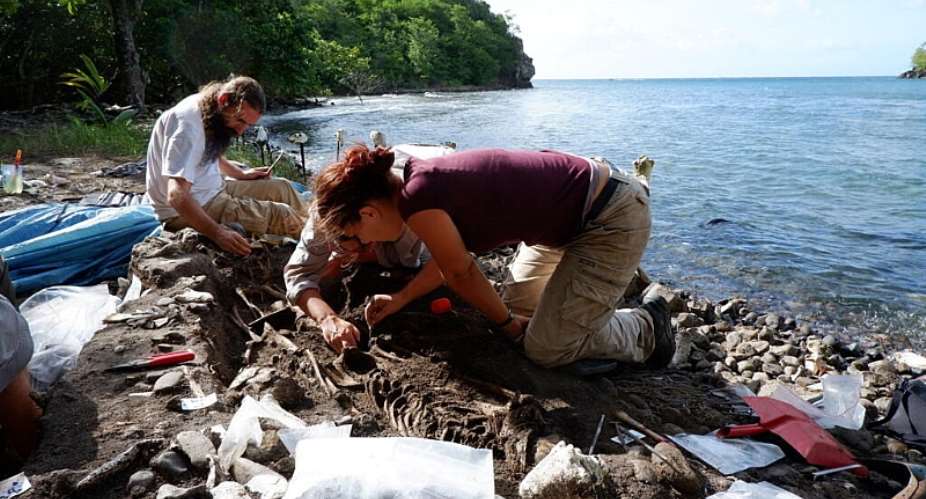
In Saint-François, a town on the eastern tip of Guadeloupe, human remains have been appearing for several years on Raisins-Clairs, one of the island's best-known beaches.
The popular tourist destination is also home to a cemetery for enslaved people.
France's National Institute for Preventive Archaeological Research, Inrap, identified 48 graves there during excavations in 2013 and 2014. Researchers believe the cemetery may still contain hundreds more, dating from roughly the 17th to the 19th centuries.
But the cemetery was probably much larger in the past before parts of it were lost to the sea.
“On aerial photographs from the 1950s, you can see that the cemetery was in the forest. Now it is disappearing into the sea. We are seeing a very significant retreat,” Jérôme Rouquet, an archaeo-anthropologist at Inrap, told RFI.
“We struggle to estimate how many graves have already been lost.”
How slavery money built the Élysée, France's presidential residence
Accelerating erosion
As waves eat away at the coastline, long-hidden burial sites are gradually exposed and destroyed.
“The sea creates a small ledge that cuts into the buried graves,” explained Patrice Courtaud, a retired archaeo-anthropologist and scientific adviser to the documentary Buried Memories.
“If erosion comes from the east, the feet are carried away first, then it moves up towards the skull.”
Each grave lost to the sea takes with it evidence that could help researchers better understand the lives of enslaved people and how they were buried.
But the loss is not only archaeological. These sites are also places of remembrance.
“For local communities, this goes beyond archaeology because it touches on the memory of the people buried here,” said Inrap archaeologist Thomas Romon. “There are archaeological concerns, but there are memorial ones too.”
France confronts enduring legacy of slavery, 25 years on from Taubira Law
In many cases, the same forces now threatening these cemeteries were also responsible for revealing them. Storms and cyclones exposed human remains that had lain hidden for centuries.
Courtaud began working on slave cemeteries in the late 1990s, after Hurricane Luis uncovered bones and possible graves at Anse Sainte-Marguerite, a coastal site near the town of Le Moule in Guadeloupe.
The Anse-Bellay cemetery in Martinique was discovered in 2007 after Hurricane Dean.
Similar discoveries have been made elsewhere in France's overseas territories. On Réunion, a French island in the Indian Ocean, Cyclone Gamède exposed human remains on the coast near the town of Saint-Paul in 2007.
Excavations later linked the remains to a former slave cemetery near Saint-Paul that has also been weakened by waves and storms.
Pressure on these burial grounds is not new, but it is increasing.
“This acceleration of coastal erosion is leading to the irreversible destruction of all these sites,” Rouquet explained.
Rising sea levels and increasingly violent tropical storms are contributing to the erosion, pushing coastlines back at “a frightening speed”.
Data from coastal observatories points in the same direction.
In Guadeloupe, significant stretches of beaches and low-lying sandy coastlines are retreating by several tens of centimetres each year, with some storms causing losses of three to five metres.
Not all of Martinique's coastline is affected, but on 40 percent of monitored beaches the shoreline is retreating by more than 50 centimetres a year.
French sons of slave traders and enslaved unite to seek a path to justice
Loss and discovery
For many years, beaches in the French Antilles were viewed mainly as tourist destinations. Now, archaeological research shows that slave owners also used them as burial grounds.
“Beaches were land that could not be farmed. That is why some enslaved people were buried there,” Courtaud said.
“There was no historical evidence showing that enslaved people were buried on beaches. Archaeology following marine erosion is what allowed us to establish that.”
Despite saltwater, wave action and disturbance from living organisms, many graves continue to provide valuable information.
“We found coffin remains. The wood and the nails were preserved on graves that may be between 250 and 300 years old,” Rouquet said.
The human remains were also relatively well preserved, allowing researchers to document burial practices and learn more about the individuals themselves.
Genetic and isotopic analyses currently under way could provide further insight into where they came from and the conditions in which they lived on plantations.
France votes unanimously to abolish Code Noir, a colonial-era slavery law
Protecting the graves
Several measures are being considered to preserve what remains of these archaeological sites.
Since May, the Saint-François town hall has installed markers to inform visitors and prevent people from walking over graves.
“These markers allow anyone arriving at the site to understand that they are entering a protected archaeological area,” deputy mayor Barbara Camier told Guadeloupe La 1ère, a regional broadcaster.
At the same time, projects such as sea walls are being considered to reduce the impact of the waves.
A different solution has already been implemented at Anse-Bellay in Martinique, put forward by a citizens' group called Kolektif Anse-Bellay.
“These were people who came to observe the excavations, realised the true memorial value of the archaeological remains and demanded that the site be made a sanctuary,” Romon said.
After excavations were completed, the remains were transferred to the group with authorisation from the prefecture, the French state's regional authority, so they could be reburied in a memorial monument in 2023.
The site now serves as a place of remembrance for enslaved people whose traces had been deliberately erased by colonists.
Saint-François is only one example of a much wider challenge facing archaeologists in Guadeloupe.
Speaking at a conference in 2024, Jean-François Modat, the regional curator of archaeology, warned that 160 archaeological sites across the territory are under threat.
“About 15 of them are already disappearing into the sea,” he said. Some may be protected through local initiatives, but not all of them.
“We know we will not be able to protect everything and that we will have to choose what we save, what we study and what we allow to disappear.”
This story has been adapted from the original version in French by Yann Le Ny.


 'Contrary to law': US judge strikes down Trump's 75-country visa ban
 GoldBod’s gains must be weighed against full cost to Ghana – Prof. Bokpin
 ‘Afenyo-Markin’s smear campaign against me is about extortion’ – Sammy Gyamfi
 August 22: Cedi sells at GHS12.30 on forex market, GHS11.13 on BoG interbank
 There is a deliberate smear campaign against GoldBod from Minority – Sammy Gyamf...
 ‘If GoldBod wants credit, it must accept blame for losses’ – Dr Owusu Sarkodie
 Akosombo control system to be restored next month – Energy Minister
 ‘Temporary Akosombo system not very robust’ – Energy Minister on recent power ou...
 Mike Ocquaye Jr reacts to Adwoa Safo’s reported return to NPP Dome-Kwabenya race
 Foreign Affairs Ministry urges Tijjaniya pilgrims to Senegal to travel by air ov...

