




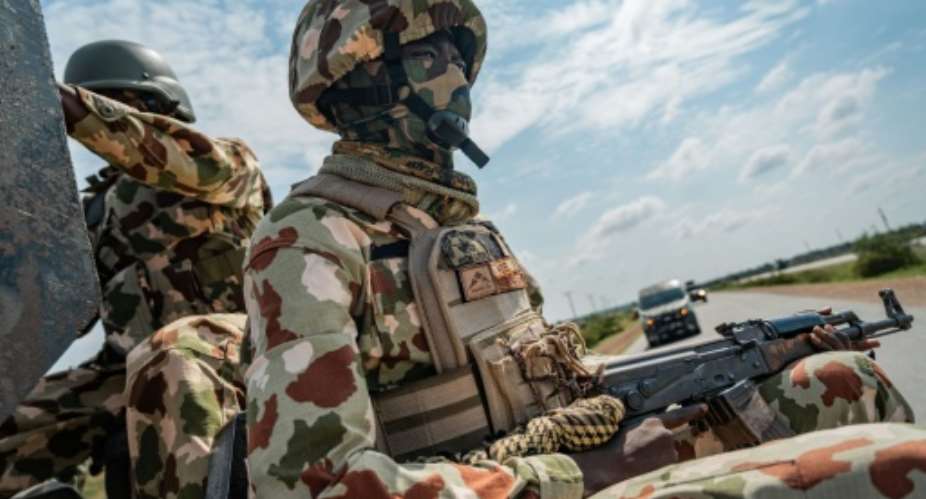
Jihadists kidnapped and killed scores of people in an attack during Friday prayers in central Nigeria's Niger state, survivors and lawmakers told AFP Saturday, though some were able to escape during a clash with rival militants.
Africa's most populous country is battling a 17-year insurgency by jihadist groups, which have made mass abductions a key tactic -- including the 2014 kidnapping of hundreds of schoolgirls in the town of Chibok.
The insurgency is concentrated in the northeast, though Friday's attack was near the western border with Benin, an area that has seen increased activity by local armed groups and militants from the neighbouring Sahel as the conflict has splintered.
"Soon after finishing the normal Friday prayer, the armed group of Lakuwara, in their hundreds, wielding guns, knives and machetes, began to attack us," said Jibril Ahmad, who survived the attack on Dikera village, in the Borgu local government area.
"They slaughtered some of our people, saying we are not practicing the true teachings of Islam," Ahmad said.
The nearby village of Binzi was also hit, Ahmad and federal representative Jafaru Mohammed told AFP.
Lakurawa is a shadowy group that some researchers have linked to Islamic State Sahel Province. ISSP is active in Burkina Faso, Mali and Niger.
Amid the violence, another jihadist group, known as Mahmuda, intervened and clashed with the Lakurawa fighters, Ahmad and Mohammed said.
"Many of us have escaped, while they were busy trying to confront" the Mahmuda fighters, Ahmad said.
Mohammed told AFP that "some members of the Mahmuda group were against the doctrine of the Lakurawa and when they heard of what the Lakurawa were doing they fought them."
"But as of now many of our people have been slaughtered and many have been kidnapped and taken into the bushes," he said.
Neither had a firm toll Saturday morning in the immediate aftermath.
Police in Niger state said they were aware of the kidnapping, but had not received reports of anyone killed.
Millions made from kidnappings
In August last year, the Nigerian government claimed it had "dismantled" Mahmuda and another group, Ansaru, with the arrest of their leaders.
Though jihadist violence in Nigeria has declined since its peak around a decade ago, during the height of jihadist group Boko Haram's insurgency, the military and police remain overstretched as they face multiple, sometimes overlapping conflicts.
Northwest and central Nigeria, where jihadists have been making inroads, are also awash with non-ideological "bandit" gangs that raid villages, conduct kidnappings and "tax" farmers and miners.
The United States military launched strikes against jihadist targets in the northwest late last year.
Meanwhile, Boko Haram and Islamic State West Africa Province remain powerful in the northeast.
Farmers and herders clash over land in the centre of the country, while a separatist conflict simmers in the southeast.
Kidnappings have become a multimillion-dollar industry for criminal groups in Nigeria -- conducted by small gangs and transnational jihadist groups alike.
Despite laws against paying ransom, both the families of victims and the government have been accused of making payments.


 My government will justify the trust Ghanaians have placed in NDC – Mahama
 Hundreds of thousands of Czechs protest in Prague over public media funding plan
 Miguel Angel Felix Gallardo, architect of Mexico’s drug trade, dies aged 80
 Elon Musk, Uber co-founder join calls to reinstate Jensen Huang as Nvidia chief
 Cape Verde's President Jose Maria Neves re-elected: provisional election results
 Nearly 2,200 migrants reach Spain's Canary Islands in two days
 Polls close in Cape Verde with incumbent president favoured to win
 Yemen's Houthis advance on Aden as government forces retreat to defend their cap...
 Mahama Commissions GH¢148.4m Cashew Factory, Creating 1,500 Jobs in Techiman
 21-year-old Ghanaian man stabbed to death in north London


