




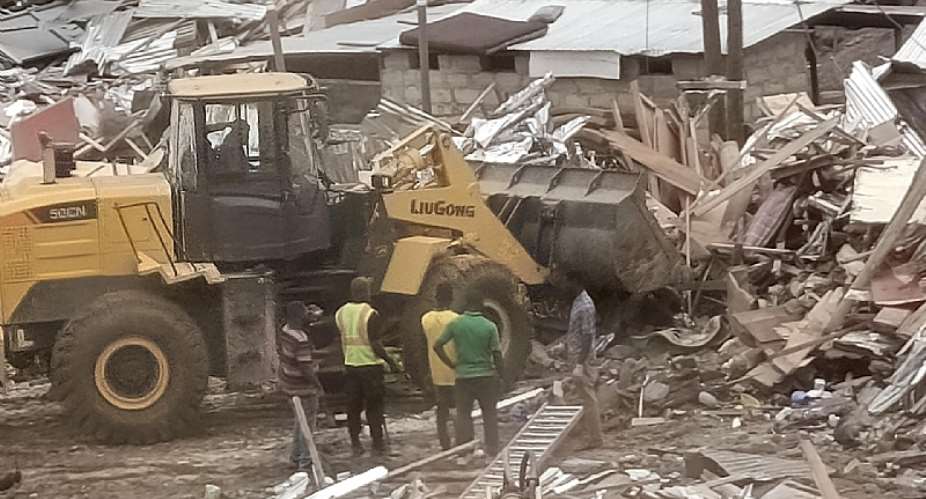
Across Ghana, efforts are underway to restore order to our cities. Informal traders are being removed from roadsides and pavements, structures obstructing drains and waterways are being demolished, and public spaces are being reclaimed. These interventions are necessary. No properly managed city can allow roads, pedestrian walkways, drainage systems and waterways to be occupied without consequences.
However, the current exercise also exposes a deeper problem in Ghana’s approach to urban management. We have developed a habit of allowing disorder to grow for years and then responding dramatically when the consequences become impossible to ignore. The bulldozer has almost become a substitute for effective urban planning.
A house built on a waterway does not appear overnight. Construction takes weeks or months. Materials are transported to the site, foundations are laid, walls are raised, roofs are installed, and electricity and water may eventually be connected. In many cases, people occupy such buildings for years before authorities suddenly declare them illegal and order their demolition.
The same pattern occurs with informal trading. A major pavement does not become a market in one day. It usually begins with a few traders. Others gradually join them. Temporary tables become permanent stalls, commercial vehicles begin stopping nearby, customers gather, and before long an entire public space has been transformed into a trading area. Authorities often tolerate the situation until congestion, sanitation problems or public pressure forces them to act.
This is where Ghana must look beyond the immediate offender and examine the institutions responsible for preventing urban disorder.
Citizens certainly have responsibilities. Nobody should knowingly build on a waterway, obstruct a drainage channel or occupy a road reservation. Traders cannot assume that every pavement or roadside is available for commercial activity simply because customers are there. Property developers must also respect planning and building regulations.
But responsibility cannot end with the citizen.
Metropolitan, municipal and district assemblies have planning departments, building inspectors and enforcement officers. Ghana has institutions responsible for land-use planning, roads, drainage, environmental protection and public safety. When illegal development continues openly for months or years, institutional failure becomes part of the problem.
This is particularly important where authorities may have collected property rates, business operating fees or other charges from people occupying spaces later declared illegal. The state cannot appear to tolerate or benefit from an activity for years and then behave as though it has only just discovered its existence.
This contradiction goes to the heart of the argument I made in my article, “Broken Cities: Who’s Behind Ghana’s Urban Chaos?” https://redfame.com/journal/index.php/aef/article/view/8209
Ghana’s urban disorder cannot be attributed to one group. It is produced through the interaction of citizens, local authorities, political actors, planning institutions, businesses, transport operators, traditional authorities and other stakeholders. When these actors fail to perform their responsibilities, disorder becomes embedded in the urban system.
The current demolitions and decongestion exercises should therefore not become another temporary campaign. They should mark a fundamental change in how Ghana manages its cities.
Demolition may sometimes be unavoidable, particularly where buildings obstruct waterways, threaten public safety or contribute to flooding. But demolition should be the last stage of enforcement, not the normal method of urban management.
Prevention is cheaper, fairer and more effective.
Stopping an illegal building at the foundation stage is far easier than demolishing a completed house years later. Preventing ten traders from occupying a pavement is more manageable than removing five hundred after an informal market has developed around them. Keeping a drainage channel clear is cheaper than dredging it after flooding has destroyed homes and businesses.
This is why Ghana must move from reactive urban management to preventive urban governance.
Planning regulations must be enforced from the beginning. Building inspections must be regular. Stop-work orders must actually mean stop work. Assemblies must clearly identify areas where trading is permitted, restricted or prohibited. Where traders are relocated, alternative spaces must be economically viable and connected to transport and customers.
There must also be consequences for public officials who knowingly ignore violations or improperly facilitate developments that contradict planning regulations. Accountability cannot apply only to the person whose structure is eventually demolished. Institutions and officials entrusted with protecting public space must also be accountable for what they permit, tolerate or fail to prevent.
Political interference is another part of the problem. Urban regulations cannot be strictly enforced under one administration and relaxed under another. Neither should enforcement disappear because elections are approaching or because affected groups are politically influential.
A drainage channel does not know whether the government is NDC or NPP. Floodwater does not recognise party colours. A blocked pavement is dangerous regardless of who occupies it.
Ghana therefore needs continuity in urban governance beyond the four-year political cycle.
There is also an important human dimension. When authorities allow people to invest their savings in structures or establish livelihoods in prohibited areas for many years before intervening, enforcement becomes socially painful and politically difficult. Families lose property, traders lose income, communities are disrupted, and government spends public resources correcting a problem that should have been prevented much earlier.
This cycle benefits nobody.
The government's current attempt to restore order should therefore be supported, but it must go beyond demolition and decongestion. The real measure of success will not be how many structures are pulled down or how many pavements are cleared. Success will be whether those same problems are prevented from returning.
Ghana cannot continue allowing disorder, tolerating it until it becomes a crisis, spending public money to remove it, and then allowing the same conditions to develop again.
A well-managed city should not require repeated dramatic clean-up exercises. Order should be maintained continuously through planning, monitoring, enforcement and civic responsibility.
The bulldozer can remove an illegal structure, but it cannot repair weak institutions.
Unless Ghana addresses the institutional failures that allow illegal construction, uncontrolled trading and misuse of public space to develop in the first place, we will continue demolishing yesterday’s mistakes while quietly creating tomorrow’s.
The lesson from our broken cities is therefore simple: urban order must be built through prevention, not periodically restored through demolition.
Dr. Isaac Yaw Asiedu
Author of Shifting Mindsets for Sustainable Development in Africa: A Political Economy Perspective and “Broken Cities: Who’s Behind Ghana’s Urban Chaos?”


 'I did not communicate my intended position well' — Nii Lante Vanderpuye apologi...
 Ex-Pakistan PM Imran Khan returned to jail after hospital checks
 UN holds second informal straw poll for next leader
 We are working to restore normal tax payment processing on Ghana.gov — GRA assur...
 GoldBod cannot escape scrutiny over $1.7bn DGPP loss — Kofi Tonto
 Education Ministry orders reinstatement of BOGISS student after alleged sexual a...
 Stop recording intimate moments — Malik Basintale advises Ghanaian youth
 France, Germany, UK and Italy slam Israel's 'E1' West Bank settler project

