




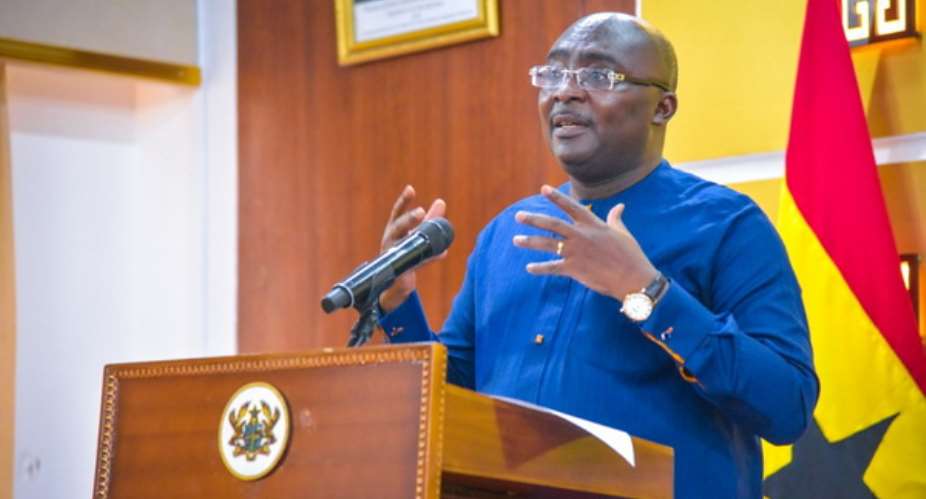
On 1 October, Abuja switches on the system Accra built nine years earlier. Dr Mahamudu Bawumia has been vindicated by the continent's largest economy. The question now is why the government that mocked the idea has done nothing with the asset it inherited.
On 1 October 2026, the Federal Republic of Nigeria will begin rolling out its National Digital Alphanumeric Postcode System.
Every addressable building in all 774 local government areas will receive an eleven-character, GIS-enabled code anchored to its precise coordinates. It replaces a numeric postcode scheme dating from 1986 that Nigerians never used. The Minister of Communications, Innovation and Digital Economy, Dr Bosun Tijani, calls it foundational digital public infrastructure. The Postmaster General of NIPOST, Tola Odeyemi, describes it as the location half of a national identity system: the National Identification Number establishes who, the postcode establishes where.
NIPOST puts the cost of Nigeria's addressing gap at between ₦50 billion and ₦80 billion every year in failed and missed deliveries alone. The Federal Executive Council approved the framework in March. Security agencies, the emergency services and the data protection commission have all been brought into the design.
Every Ghanaian should read that paragraph twice, because it is a summary of an argument Dr Mahamudu Bawumia made in this country in 2017 — and was called a fraud for making.
The Record of What Was Said
On 18 October 2017, Ghana launched GhanaPostGPS. It divided the entire territory into five-metre squares and gave each one a permanent alphanumeric address: a regional letter, a district letter, an area code, a unique identifier. AK-039-5028 is the Kumasi Main Post Office. GA-184 is where the Kwame Nkrumah Memorial Park sits.
Nigeria's own official postcode portal now advertises the coming system as the first GIS-enabled, building-level addressing system on the African continent. It is not. Ghana was there nine years earlier, and Nigeria's own history proves the point: Abuja first proposed a digital postcode in 2009 and could not deliver it. In 2017 — the very year Ghana went live — NIPOST was reduced to signing a partnership with a British start-up, what3words. In 2018 it launched an Address Verification System and a Digital Addressing System. Neither survived. By 2020 Google's Plus Codes had drifted in to fill the gap. It took a Federal Executive Council decision this March to finally give the project the political mandate it had lacked for seventeen years.
Seventeen years of Nigerian hesitation. Nine years of Ghanaian head start. That is the scoreboard.
Now recall what the then-opposition said about it here at home.
The digital address system was called a hoax. It was called a scam. Civil society voices demanded that Dr Bawumia apologise to Ghanaians for misleading them. NDC commentators told the country that the app was useless, that it was repackaged free technology, that the money was wasted, that it was proof of NPP extravagance. That line was repeated on radio, in Parliament and on every platform available, year after year, and it was politically profitable.
There is no ambiguity about who was right.
The Federal Government of Nigeria has just spent seventeen years of institutional effort, a Federal Executive Council approval and the full weight of its digital economy ministry to acquire the thing our critics said was worthless. Dr Tijani has called it potentially the most significant achievement of his tenure. That is the “hoax.”
The Idea Was Never the App
Here is what the critics missed then and are still missing now, and it is worth stating precisely, because it is the actual content of Dr Bawumia's vision.
The argument was never that a mobile application would transform Ghana. The argument was that a state cannot formalise an economy it cannot locate. You cannot deliver a parcel, dispatch an ambulance, verify an identity, underwrite a mortgage, register a business, collect a property rate, target a social intervention or police a neighbourhood in a country where every location is described as “turn left at the mango tree, past the blue kiosk.”
Address is not a convenience. Address is a precondition. It sits underneath identity, underneath payments, underneath property, underneath revenue. Get it wrong and every layer you build above it wobbles.
That is why Dr Bawumia sequenced the digitalisation agenda the way he did — Ghana Card, digital address, mobile money interoperability, then services on top. It is a coherent thesis about how a developing economy modernises. And it is precisely the thesis Nigeria has now adopted, in public, in writing, with NIPOST explicitly pairing the postcode to the NIN because Abuja has worked out that identity without location is only half a system.
Anyone can copy an app. What is being vindicated here is not software. It is a way of thinking about the state.
And What Has This Government Done With It?
Which brings us to the uncomfortable part.
Ghana holds a nine-year lead over Nigeria on the single most important piece of digital public infrastructure either country will build this decade. Nine years. That lead is a national asset, paid for by Ghanaian taxpayers, and it is depreciating in real time.
Independent research published this year, reviewing eight years of implementation, reached a conclusion that should trouble anyone in the Ministry of Communication, Digital Technology and Innovations. GhanaPostGPS, the researchers found, had produced little that could confidently be called success. And among the reasons identified was one that lands squarely in this government's lap: a change of government that left the platform without champions.
Without champions. Not sabotaged. Not repealed. Simply abandoned to drift, because the men who spent eight years telling Ghanaians the system was a scam could hardly walk into office and make it their flagship.
Consider what has not happened since January 2025.
There has been no national integration mandate requiring banks, insurers, utilities and couriers to accept and store a digital address as a primary field. There has been no published fix for emergency dispatch — the single most compelling justification for the entire system, and one that researchers found was not functioning for the Ambulance Service. There has been no official developer portal, leaving Ghanaian software engineers to reverse-engineer unofficial endpoints to build on their own country's addressing layer. There has been no white paper, no roadmap, no ministerial statement to Parliament setting out what this administration intends to do with the National Digital Address System at all.
The Minister has found time and voice for Starlink's physical presence, for SIM re-registration, for spectrum. Those are real issues. But not one of them is foundational in the way that addressing is foundational, and the contrast with Abuja is now impossible to ignore. While Ghana's digital address system waits for someone to remember it exists, Nigeria has run a validation exercise across twelve states, piloted in Bwari, convened the security and emergency agencies in a formal workshop before launch, negotiated tiered data access with its data protection commission, and begun assembling a developer ecosystem.
Nigeria is doing the institutional work. Ghana did the visionary work and then stopped.
The Partisan Trap
Let us name the mechanism honestly, because it is the real story.
This government cannot advance GhanaPostGPS without conceding that Dr Bawumia was right. Every cedi invested in integration, every regulatory directive making the digital address mandatory in banking, every functioning ambulance dispatch is an admission that the “hoax” was national infrastructure all along.
So nothing is invested. Nothing is directed. Nothing is fixed. A nine-year strategic advantage is allowed to rot because acknowledging it would be politically inconvenient.
That is not governance. That is a party protecting its old talking points at the country's expense — and the cost is not borne by the NPP. It is borne by the koko seller who still cannot verify a business address to access credit, by the family whose ambulance cannot find the house, by the Ghanaian e-commerce firm losing margin on failed deliveries while Nigerian competitors prepare to route on a national grid.
What Must Now Happen
The Minority in Parliament should put a direct question to the Minister for Communication, Digital Technology and Innovations, and it should be a short one:
What is the government's plan for the National Digital Address System, and when will it be laid before this House?
Three answers should be demanded:
1. Integration with consequences
Every regulated financial institution, utility and licensed courier should be required to accept and store the digital address as a primary field, with the Bank of Ghana, the NIC, the PURC and the Postal and Courier Services Regulatory Commission auditing compliance. Compliance without integration is what produced eight wasted years.
2. Emergency dispatch, fixed and certified
The National Ambulance Service, the Ghana Police Service and the Fire Service should be able to resolve a digital address to a dispatch instruction, and the Ministry should publish the certification.
3. Open the platform
An official, documented, publicly available API. Ghana's developers should not be reverse-engineering their own government's infrastructure.
4. Export the expertise
Ghana has nine years of operational experience with the exact problem Nigeria — and after Nigeria, the whole of ECOWAS — is about to face: mapping is easy, adoption is brutal. That experience is an exportable asset. Ghana Post and the Ministry should be selling advisory services into Abuja, Abidjan, Freetown and Monrovia. Instead, we will watch Nigeria learn our lessons at its own expense and then sell the finished model back to the region as an African first.
The Verdict
On 1 October, when Nigeria switches on its digital postcode and the continent applauds, Ghanaians should be clear about two things.
First: a Ghanaian leader saw this nine years before Africa's largest economy did, executed it, and absorbed years of ridicule for it. Whatever one thinks of Dr Mahamudu Bawumia's politics, the record on this question is now closed. He was right. His critics were wrong. Abuja has settled the argument.
Second: being right in 2017 is worth nothing if the country is governed in 2026 by people who would rather let a national asset decay than admit whose idea it was.
Vision built the system. Only follow-through can make it work. Ghana has had one and is still waiting for the other.
Nana Kofi Oppong-Damoah is a strategic advisor and founder of Pipeline Technologies Africa and Qwantum Strategies. He writes on artificial intelligence, energy, technology policy and pan-African development.
 'Some NPP members did not vote in 2024 election because I left NPP' – Alan Kyere...
 How €225 million cocaine from Ghana traced to fugitive Dutch drug kingpin based ...
 'Galamsey remains an existential threat' – Gyampo demands more action
 'I’m like Akpeteshie, I don’t need adverts to win' – Hawa Koomson storms home tu...
 'Excessive bail conditions must be reviewed' – GBA President
 Ketu South: Four-year water crisis deepens hardship in Agbozume
 Show evidence of higher operating costs to justify fare hike – NPA CEO to transp...
 Four Ghanaians arraigned over alleged €225 million cocaine shipment to France
 Agbogbloshie: Police kill suspected robber, recover AK-47, 186 rounds of ammunit...
 DVLA opens 29 new offices in 18 months; 62 offices nationwide - CEO


