




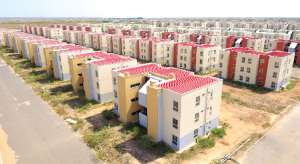
As one drives through Ghana, traversing its endless streets, roads and pathways, there is a common sight: vibrant trade.
On one street, there are hawkers selling along the roadside, food vendors preparing meals, market women and men making sales. On another one may witness artisans working with their hands, apprentices learning trades, merchants moving goods, and creatives offering their work to the public. The vibrant spirit in Accra, for example, is fuelled by the energetic and hardworking efforts of a diverse multitude of people.
Yet, when we consider the lives of these fellow citizens, a major question arises: To which home do they go when the sun sets? To some, this may seem like an obvious question, one that doesn’t need an answer. Surely, they all have a home. A family house. A rented room. A compound. Somewhere they can lay their heads at night. But when we delve deeper, we begin to see that the answer is not so simple.
The young person who enters a trotro every morning to begin an apprenticeship has to return somewhere. The merchant who spends the day moving goods has to return somewhere. The food vendor who wakes before dawn and works until evening has to return somewhere. Hence the question is not simply whether they have somewhere to sleep; it is whether they have a home.
Ghana's housing crisis is not new, nor is it unique, as housing shortages are a global challenge. Yet its scale remains substantial: Ghana's latest official Housing Profile places the country's quantitative housing deficit at approximately 1.8 million units, alongside an estimated need for approximately 5.7 million additional rooms in urban areas. What is increasingly important, however, is not merely acknowledging the shortage, but asking whether we have developed a sufficiently comprehensive strategy for addressing it. That strategy must house citizens and preserve our cultural heritage. It must facilitate communion and unity and respond to the way Ghanaians actually live. And most importantly, it must provide homes that are adequate, dignified, healthy and excellently designed.
Ghana's own National Housing Policy recognises adequate housing as a fundamental objective and calls for sustainability and resilience to be incorporated into housing development. The country's housing profile similarly identifies the need for affordable, decent and adequate housing across different economic groups. The challenge, therefore, is not that Ghana has never articulated the need for better housing. The challenge is translating that aspiration into a housing system that works at the scale and speed required.
What Exactly Is a Home Befitting for a Ghanaian?
When addressing the housing crisis, one of the first questions we must ask is: What exactly constitutes a home befitting for a Ghanaian? Is it simply four walls and a roof? Or should a home provide indoor plumbing, adequate electrical infrastructure, appropriate ventilation, natural light, safe access and spaces that allow for rest, work, family life and dining? These should not be treated as luxuries. They are fundamental conditions of dignified living.
This is where architects, urban planners, engineers and other built-environment professionals become essential to the national conversation. It is apparent that in this nation, the role of architects must extend beyond the drawing of plans for residential or commercial purposes into the construction of a radical national housing and urban design strategy. Government needs architects at the table when these major questions are being considered and, in some cases, to prompt attention to the dangers of passivity regarding home security and even environmental hazards, not merely after policy has already been determined and a building needs to be designed.
The Architects Registration Council itself recognises the profession's role in promoting sustainable development, access to decent housing, affordability, local building materials and improved construction standards. Architecture is therefore not simply about producing beautiful buildings. It is about establishing the spatial, environmental and social conditions through which people live. In this respect, Ghana needs a revolution.
The Problem With Calling Everything "Affordable"
Another question must be asked about affordability. If Ghana's housing shortage is substantial, can the answer simply be to call homes "affordable" when market forces still place many of them beyond the reach of ordinary Ghanaians?
The challenge is reflected in the financing gap. The National Homeownership Fund has indicated that about 60 percent of Ghanaians require some form of financial intervention to purchase a home. Affordability, therefore, cannot exist only on a developer's price sheet. The first step of affordability assessment is a candid review of the earnings of those whose determined endeavours keep the country moving from merchants to mates. This will expose the harsh reality of home ownership in Ghana and whether it is out of the reach of the majority. A viable approach would be to establish a national affordability framework in which the cost of housing, whether through rent or mortgage payments, does not exceed 50 percent of annual household income. This approach, coupled with diligent investigation of earnings, will create a framework for what constitutes ‘affordable’. With a tiered approach to home pricing classification, citizens can identify which earning group they are part of and assess what is affordable for them.
Cost grows when material choices are not made properly. A house may have a lower purchase price but impose significant costs on its occupants through poor orientation, inadequate ventilation, excessive heat gain, inefficient appliances, poor insulation, or high energy consumption. As a result, we as a people need to come face to face with our perception of quality. Does a concrete home without adequate waterproofing painted white have greater quality than a rammed earth/ brick home that can last a millennium without painting or much
upkeep, helping regulate the interior home temperature? These conversations will help assess the material production pipelines that will ensure the next generation can also live in homes they can afford.
The proliferation of the concrete home has allowed construction to happen quickly and at scale. Concrete itself is not the sole problem. The problem arises when construction becomes detached from sustainable design strategies. When a house is poorly oriented, poorly ventilated, and designed without consideration for the Ghanaian climate, the occupant eventually pays the price. The home that was supposed to provide respite becomes another avenue of expenditure.
Electricity bills increase. Air-conditioning becomes necessary. Maintenance costs accumulate. Water damage appears where adequate detailing was ignored. We must therefore stop defining affordability solely by the initial cost of construction. A truly affordable home must also be affordable to live in.
We Need to Know What We Are Buying
As one assesses the industry as a whole, another dimension of the housing crisis that deserves greater attention is revealed: the position of the buyer. In Ghana, buyers can enter the housing market without always having the information necessary to distinguish between adequate housing, genuinely high-quality housing, and substandard construction marketed as something more.
A home can be called "luxury" while being situated beside a large open gutter. It can be marketed as a premium residence while having inadequate road access. It can carry an impressive price while lacking proper insulation, ventilation or water-management systems. For this reason, the knowledge and position of the buyer must be improved. Ghana needs a clearer national system for communicating housing quality. Imagine a National Home Guide or housing classification framework that gives buyers a straightforward way to understand what they are purchasing.
A system with established grade categories: Grade A- Excellent, Grade B- Good, Grade C-Adequate, and Grade D-Below Standard, based on measurable standards covering structural quality, plumbing, ventilation, sanitation, energy performance, accessibility, environmental performance, and spatial adequacy.
The objective would first be to empower the buyer to know what their money should buy in a home. It would be to give citizens information. A buyer should be able to know what constitutes adequate housing, what constitutes premium housing, and what falls below acceptable standards. In the long run, this will expose developers who are treating their buyers with contempt and pricing high but delivering low. In a market where a person's life savings may be committed to a home, knowledge is protection.
Local Materials and a Different Construction Model
We cannot address Ghana's housing crisis without discussing local materials and local capacity. If we require hundreds of thousands of additional homes, perhaps the solution is not simply to import more materials, increase conventional construction and hope that market forces eventually solve the problem.
We should also ask how housing construction itself can become an engine for employment, skills development and ownership. One possibility is the creation of a national corps of builders and engineers producing the building material and constructing the homes.
Ghana is full of young people, artisans, labourers and tradespeople who are passionate about construction and yearn for opportunities to work. Rather than seeing them only as labour within a fragmented construction industry, we could consider a model in which they become part of a coordinated national workforce dedicated to building homes.
The idea is simple but ambitious: people contribute their labour, skills and expertise toward building housing, while mechanisms are created through which those participating in the programme can gain a stake in the homes being produced. A worker who helps construct homes should not have to remain permanently excluded from homeownership. Could we develop a system in which participation in building Ghana also creates a pathway toward owning a home in Ghana? The answer is a vehement yes. A worker who has been part of the construction of one or two national mega-estates is afforded a decent home for their efforts.
Such an approach would begin to connect three problems that are often treated separately: unemployment, housing and skills development.
Housing Must Preserve Who We Are
Housing is not simply an economic question. It is also a cultural one. Ghanaian homes should not be produced as though they exist in isolation from Ghanaian society. Our architecture has historically reflected community, climate, family and social interaction. Courtyards, verandas, shaded spaces, transitional areas and communal settings were not accidental features; they reflected ways of living.
As we build for the future, we should not lose those qualities in the pursuit of speed. The housing strategy we need should preserve cultural heritage while fostering innovative approaches to housing development. We should be able to produce homes with modern plumbing, reliable electricity, good sanitation and excellent environmental performance while still creating spaces that reflect and foster Ghanaian life. This is where architecture becomes more than construction. It becomes a means of translating identity into the future.
The Government Needs Architects at the Table
The housing crisis ultimately requires coordinated action. Government has an essential role in setting standards, creating policy, improving infrastructure, facilitating land and housing finance, supporting innovation and protecting the public. But government cannot solve the housing question alone. The private sector cannot solve it alone. Developers cannot solve it alone. And architects cannot solve it alone.
There is a clarion call to action for collaboration between government, architects, urban planners, engineers, developers, financial institutions, traditional authorities, communities and citizens. Recent national discussion already recognises the need for affordable and
climate-responsive housing, greater use of innovative building technologies and stronger collaboration across the housing sector.
What is needed now is sustained implementation. Housing strategies must survive political cycles. They must be measurable. They must respond to different income groups. They must
account for the realities of our cities and towns. And they must recognise that housing is not merely a collection of buildings; it is infrastructure for human life. The opportunity, therefore, is not simply to build more houses. It is to build better systems for housing.
Every morning, millions of Ghanaians leave their homes to participate in the economy. They sell, build, teach. Trade, drive, create, learn, and work. In essence, they keep Ghana moving. And every evening, they return somewhere. The question we must ask as a nation is whether that place gives them what a home should. Does it give them rest, dignity, and protect their health? Does it provide a safe place for their families? Does it allow them to recover from the demands of the day and prepare for the next? Does it give them a sense of belonging? These questions are pertinent because citizens do not simply need buildings. They need homes that are theirs.
They need homes that allow them to rest, homes that protect them from the elements, homes that do not punish them with unnecessary energy costs, homes that reflect their culture, and homes that give them the comfort and dignity to return to the hustle and bustle of life each morning.
The housing crisis, therefore, should not only be measured by how many houses Ghana is missing. It should also be measured by the quality of the homes we are creating, the people who can afford them, the environments in which they are situated, and the lives they enable. The question must expand from "How many houses do we need?" to "What kind of homes do Ghanaians deserve and what kind of nation must we build to ensure all citizens have a dignified home?"
As citizens, as leaders, as builders, this is not a responsibility we must shy away from; it is our duty to address this issue head-on and comprehensively. For the lives of the next generation are dependent on the bold foundations we lay today.

 'Some NPP members did not vote in 2024 election because I left NPP' – Alan Kyere...
 How €225 million cocaine from Ghana traced to fugitive Dutch drug kingpin based ...
 'Galamsey remains an existential threat' – Gyampo demands more action
 'I’m like Akpeteshie, I don’t need adverts to win' – Hawa Koomson storms home tu...
 'Excessive bail conditions must be reviewed' – GBA President
 Ketu South: Four-year water crisis deepens hardship in Agbozume
 Show evidence of higher operating costs to justify fare hike – NPA CEO to transp...
 Four Ghanaians arraigned over alleged €225 million cocaine shipment to France
 Agbogbloshie: Police kill suspected robber, recover AK-47, 186 rounds of ammunit...
 DVLA opens 29 new offices in 18 months; 62 offices nationwide - CEO


