




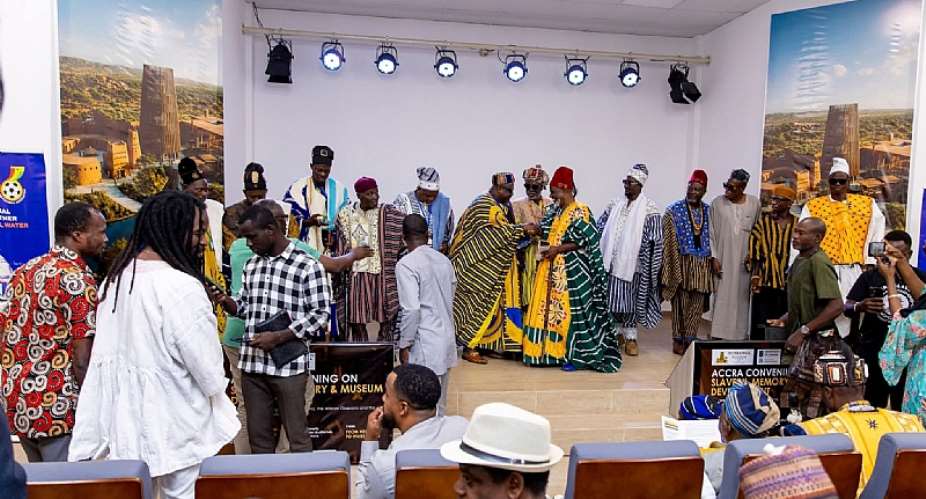
Scholars, traditional leaders, cultural practitioners, diaspora representatives and development advocates have gathered in Accra for a major conversation on slavery, historical memory, healing and the role of heritage in driving development in Ghana and the African diaspora.
The Accra Convening on Slavery, Memory and Museum Development, organised by the Deyaanga Museum Initiative in partnership with the Institute of African Studies at the University of Ghana, was held on Friday, August 14, 2026, at the West Africa Genetic Medicine Centre Auditorium, University of Ghana, Legon.
Held under the theme “Retrospection, Healing & Repair: Ghana, the African Diaspora and the Future of Afro-Diasporic Development,” the convening also focused on the sub-theme “From Heritage to Investments.”
The event sought to move conversations about slavery beyond remembrance and toward healing, reconciliation, diaspora reconnection and practical development opportunities, particularly for communities in Northern Ghana that were historically affected by slave raiding.
According to the organisers, the initiative is linked to the proposed Museum of Healing and Reconciliation in Northern Ghana, which seeks to document the histories of slave raiding, resistance and colonialism while creating a platform for education, research, dialogue and engagement between Ghanaian communities and the African diaspora.
The organisers say the museum will place greater emphasis on the experiences of inland communities where people were captured, resisted slave raids and endured displacement, complementing existing narratives that have often focused heavily on coastal departure points.
The museum's founder and Executive Director, Emmanuel John Agangzesum Awine, a PhD candidate in the History Department at Johns Hopkins University researching slavery, colonialism and public history, said the project is intended to redefine how these histories are remembered.
“This is not a museum of chains. It is a museum of shields,” Awine said, stressing the project's focus on resistance, dignity, memory and resilience.
The Museum of Healing and Reconciliation describes itself as a public history, research and community-engaged initiative based in Northern Ghana. Its work includes documenting oral histories, archival records, architecture and community memories associated with slave raiding and resistance.
The Accra convening brought together prominent voices from Ghana, Africa, Europe and North America, including banker and development advocate Chief Alhassan Andani, Paramount Chief Nana Kobina Nketsia V, John Leerdam of the Dutch National Slavery Museum, Dr Edward C. Bush of Cosumnes River College in California, Vincenza Mazzeo of the University of Toronto and Professor Eric Kyere of Indiana University.
Other participants included former Upper East Regional Minister and African heritage scholar Professor Ephraim Nsoh Avea, historian Professor Rebecca Shumway of the University of Wisconsin-Milwaukee, historian and cultural preservationist Deah Berry Mitchell, Pan-African advocate Bernard A. Mornah and social advocate Benjamin A. Anyanah. Journalist and legal practitioner Samson Lardy Anyenini moderated the discussions.
A major focus of the discussions was how historical heritage can become a foundation for contemporary economic and social development.
The organisers argue that heritage can provide opportunities for investment, cultural tourism, research, education and partnerships between communities in Ghana and the African diaspora.
The initiative also seeks to position Northern Ghana as an important centre in global conversations on slavery, reparative justice, heritage and African-diasporic engagement.
According to the organisers, community engagements are central to the museum project. The initiative has conducted fieldwork in communities including Navrongo, Bongo, Mirigu, Zeccoo and communities in southern Burkina Faso to document oral histories and listen to affected families about how their histories should be preserved and presented.
The organisers say the community-based approach is intended to ensure that the proposed museum is shaped by the experiences and perspectives of the communities whose histories it seeks to preserve.
The Accra event therefore served as a platform to connect historical memory with contemporary conversations around identity, reconciliation, investment and development.
The Deyaanga Museum Initiative says its broader objective is to transform memory into action by creating practical pathways for reconciliation, heritage development and stronger partnerships between Ghanaian communities and the African diaspora.
The convening forms part of a broader effort to ensure that the histories of inland Ghanaian communities affected by slavery are documented, preserved and incorporated into national and international conversations about Africa's past and its future.


 Ms. Emelia Affi Agbenyo must honourably resign as new EC Deputy Chairperson to p...
 Why have US-Ukraine relations soured ahead of the midterms?
 Govt to meet Free Zones Authority, Trade Ministry over Customs Act concerns
 Kojo Bamba was never my driver or bodyguard — Nana B
 Ekow Assafuah petitions OSP to probe alleged World Cup visa facilitation irregul...
 Africa attracting wrong waste management solutions – GAIA report
 Summon Kofi Adams, GTA boss over 2026 World Cup visa scandal — NPP tells Parliam...
 Obuasi SHS headmaster accused of sexual abuse is NDC constituency secretary – Ma...
 Family demands answers over death of 14-year-old student at Abomosu STEM SHS
 Osahen Afenyo-Markin reflects on loneliness of public service, says survival is ...


