




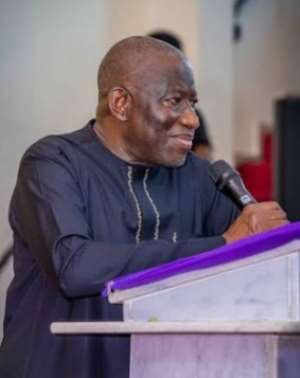
Former Nigerian President Goodluck Jonathan has commended the Independent National Electoral Commission (INEC), security agencies, and the people of Osun State for the conduct of the state's August 15, 2026 governorship election, won by incumbent Governor Ademola Adeleke of the opposition Accord Party. Jonathan's remarks, contained in a statement issued in Abuja on Tuesday, August 18, 2026, paired praise for the process with a pointed warning about a practice he says increasingly threatens Nigerian democracy and one that observers say is far from unique to Nigeria.
What Jonathan said
While commending the overall conduct of the election, Jonathan raised concern over what he described as the growing practice of serving governors, senior political office holders and party leaders descending on states during off-cycle elections with large entourages and heavy security details. He warned that the increasing deployment of political power and government influence during elections was capable of creating an atmosphere of apprehension, intimidation and undue pressure on voters, and cautioned that the practice should not be allowed to become normalized in Nigeria's electoral system. Jonathan called on the National Peace Committee to convene a national stakeholders' engagement to establish clear boundaries and acceptable standards for the conduct of political actors during off-cycle elections.
His comments came alongside those of former Senate President and PDP Board of Trustees Chairman, Senator Adolphus Wabara, who described Adeleke's victory as a triumph of the people's will over what he called federal might, intimidation and political overreach, commending Osun voters for resisting pressure to abandon their preferred candidate
The Osun result
Adeleke, who first won the Osun governorship in 2022 on the platform of the Peoples Democratic Party (PDP) before defecting to the Accord Party in December 2025, secured re-election with 511,067 votes 50.8 percent of the 1,005,800 votes cast defeating the ruling All Progressives Congress (APC) candidate, Bola Oyebamiji, who polled 444,815 votes. INEC data showed Adeleke won 19 of Osun's 30 local government areas despite the APC entering the contest with the full weight of federal incumbency and party structure behind it. The election drew 15 candidates in total, with the African Democratic Congress's Najeem Salaam placing a distant third.
The scale of the defeat, inflicted on a governing party with considerable federal resources, has prompted broader analysis of how the APC came up short in a state it had actively targeted for recapture and it is this dynamic, an opposition figure withstanding federal pressure, that gives Jonathan's warning its immediate context.
A recognisable pattern across West Africa
Jonathan's intervention lands within a wider and increasingly documented regional pattern. Analysts tracking West African democracy have observed that governors increasingly see alignment with the ruling party less as an ideological choice and more as a strategy for political survival, given that Nigeria's federal government exercises enormous influence over security agencies, anti-corruption bodies, and financial flows to states. That dynamic, commentators warn, risks pushing the country toward what one analysis termed a gradual consolidation of power that could produce de facto one-party dominance, with the electoral playing field becoming uneven long before voters cast ballots.
The concern is not confined to Nigeria. Regional democracy trackers have identified a common thread across West Africa in 2025 and 2026: governments of differing political stripes elected and military alike converging on a shared toolkit to manage political opposition, whether through constitutional engineering, defamation and cybercrime statutes, party suspensions, or outright dissolution of coalitions. The specific mechanisms vary by country, but the underlying logic, incumbents choosing legal, security, and administrative tools over open electoral competition, is described as remarkably consistent across the region.
Ghana offers a contrasting, if imperfect, data point. The country's 2024 transition, alongside similar peaceful transfers in Botswana, Mauritius and Senegal, has been held up as part of a wave of incumbent-party losses that reinforced Ghana's reputation as a comparative democratic success story in the region. Yet Ghana has not been entirely insulated from the same anxieties Jonathan raises about Nigeria: domestic debate has intensified in 2025 and 2026 over a possible third-term bid for President John Dramani Mahama, testing the country's constitutional term-limit provisions even amid its democratic credentials.
Why the pattern matters
What connects Jonathan's specific complaint, federal officials descending on opposition-controlled states with heavy security to influence local elections, to the broader regional trend is a shared concern about the erosion of a level electoral playing field, even in countries that continue to hold genuinely competitive, internationally observed elections. Nigeria's own off-cycle election calendar, with the Federal Capital Territory Area Council polls, the Ekiti governorship election in July, and now Osun in August 2026, has repeatedly tested this dynamic ahead of the more consequential 2027 general elections, where the ruling APC's dominance over Nigeria's state governments will face its most significant scrutiny yet.
Whether Jonathan's proposed National Peace Committee engagement produces enforceable standards, or simply another round of well-intentioned recommendations, may say as much about the durability of West Africa's democratic institutions as any single election result.
This report draws on statements reported by The Sun (Nigeria), and reporting from Channels Television, Premium Times, Vanguard, The Guardian (Nigeria), Legit.ng, Dataphyte, Africa Center for Strategic Studies, africasacountry.com, African Arguments, ModernGhana.com, and Carnegie Endowment for International Peace.
Mustapha Bature Sallama medical Science communicator, Private Investigator, Criminal Investigation and Intelligence Analysis,United States Institute of Peace (USIP), [email protected] +233555275880
References
The Sun (Nigeria). "Jonathan warns: Govs' show of force threatens democracy." August 19, 2026. https://thesun.ng/jonathan-warns-govs-show-of-force-threatens-democracy/
Channels Television. "Accord's Adeleke Wins Osun Governorship Election, Returns For Second Term." August 16, 2026. https://www.channelstv.com/2026/08/16/imole-de-accords-adeleke-wins-osun-governorship-election-returns-for-second-term/
Premium Times. "UPDATED: #OsunDecides2026: INEC declares Accord's Ademola Adeleke winner of governorship election." August 2026. https://www.premiumtimesng.com/news/top-news/903305-updated-osundecides2026-inec-declares-accords-ademola-adeleke-winner-of-governorship-election.html
Dataphyte Insight. "Osun Governorship Elections 2026: Ademola Adeleke announced winner, returns for second term." August 2026. https://www.dataphyte.com/topic/elections/osun-governorship-elections-2026-ademola-adeleke-announced-winner-returns-for-second-term
Legit.ng. "Osun Election 2026: 5 Major Lessons Accord Party's Adeleke Taught APC." August 2026. https://www.legit.ng/politics/1725463-osun-election-2026-major-lessons-accord-partys-adeleke-taught-apc/
Vanguard News. "Accord expresses confidence in Adeleke's re-election, urges neutrality." August 2026. https://www.vanguardngr.com/2026/08/accord-expresses-confidence-in-adelekes-re-election-urges-neutrality/
The Guardian (Nigeria). "Osun election: Adeleke clinches Accord Party ticket, confident of reelection." December 2025. https://guardian.ng/politics/osun-election-adeleke-clinches-accord-party-ticket-confident-of-reelection/
Wikipedia. "2026 Osun State gubernatorial election." https://en.wikipedia.org/wiki/2026_Osun_State_gubernatorial_election
africasacountry.com. "No president will save Nigeria." July 2026. https://africasacountry.com/2026/07/no-president-will-save-nigeria
African Arguments. "Nigeria's Road to Undemocratic Elections in 2027." May 5, 2026. https://africanarguments.org/2026/05/nigerias-road-to-undemocratic-elections-in-2027/
ModernGhana.com. "Democracy under siege: how West African governments are closing in on opposition parties." July 17, 2026. https://www.modernghana.com/news/1511340/democracy-under-siege-how-west-african-governmen.html
Carnegie Endowment for International Peace. "Africa's Democratic Kaleidoscope: Trends to Watch in 2026." January 2026. https://carnegieendowment.org/research/2026/01/africa-democracy-protest-elections-coups
TRT Afrika Hausa. Original brief. https://www.trtafrika.com/hausa/article/30d8ff0f2020


 US fears wider Middle East escalation after Houthi attack Riyadh
 Pop star Ed Sheeran calls Gaza situation “unjustifiable” amid controversy
 'We have spent 60years arguing about Nkrumah and rather less time doing what he ...
 Judge recounts attempted MoMo scam on him moments after jailing scammer
 'Systemic failure due to NACOC removal from port inspections' – Inusah Fuseini o...
 Police uncover alleged network behind Ghana Jollof videos
 NACOC says cocaine suspects were under surveillance for up to two years
 Suhuyini assures Accra-Kumasi Expressway won’t miss December 2028 deadline
 Foreign Affairs Ministry releases 200-page RTI response on GH¢49.7m South Africa...
 Chartered flights account for GH¢27.18m of South Africa evacuation cost


