




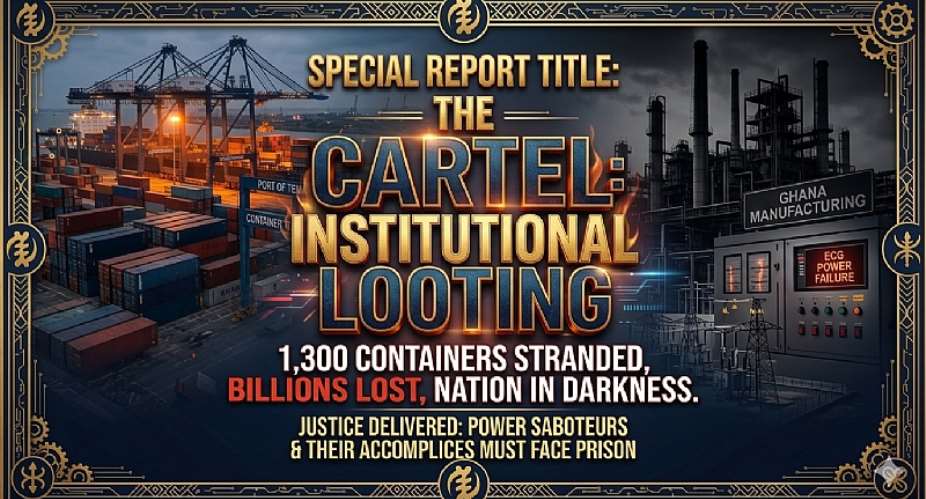
For far too long, the ordinary Ghanaian has borne the suffocating brunt of unstable power—enduring ruined small businesses, spoiled food, and astronomical electricity bills. While honest citizens work tirelessly to pay their utility bills, a deep-seated structural rot within the upper management of the Electricity Company of Ghana (ECG) has compromised the nation's energy security. The recent investigative findings regarding the disappearance of over 1,300 utility containers at the Tema Port are not just a failure of oversight; they represent an economic crime against the state. This article provides a comprehensive overview of the scandal, outlines key institutional failures, details the severe macroeconomic fallout on industry, and explicitly demands that political leaders like Alexander Afenyo-Markin, Samuel Dubik Mahama, and all other implicated officials suffer the full legal penalties, including swift prosecution and jail time.
The Mechanics of the Scandal
An independent ministerial and state security audit unearthed a highly coordinated web of financial irregularities that crippled public distribution infrastructure:
- The Vanishing Inventory: ECG records logged 2,491 incoming containers filled with high-value grid transformers, substations, and essential electrical cables. A strict physical recount at port stacks could only verify 1,134 units, meaning roughly 1,357 containers vanished into thin air.
- Deliberate Clearing Delays: Top management deliberately halted weekly deposits to clearing accounts. This forced the cargo to sit past the 60-day window, moving them onto the Uncleared Cargo List (UCL) and triggering massive penalties.
- Astronomical Financial Burden: The gross operational negligence left the Ghanaian taxpayer saddled with a staggering GH₵909 million in direct port demurrage fees and an overall liability footprint of GH₵1.5 billion.
- Bypassing Procurement Laws: Rather than using competitive bidding, uncertified and unlicensed firms like Mint Logistics Ltd were awarded single-sourced clearing contracts worth tens of millions of cedis.
- The Corruption Loophole: Insiders point to a "rot" where stranded containers were deliberately pushed to cheap customs auctions, bought by proxy firms, and then shockingly resold right back to ECG at hyper-inflated prices.
The Human and Economic Cost: Sinking Factories and Lost Man-Hours
This is not a victimless crime. The failure to clear these 1,300+ containers directly blocked crucial transformer upgrades, creating a direct catalyst for the severe power rationing and unannounced outages seen across the country. The economic consequences on businesses and factories include:
- Millions of Lost Man-Hours: Industrial enclaves in Tema, Kumasi, and Accra have faced erratic power schedules. This has forced factories to halt assembly lines mid-shift, resulting in an estimated loss of over 12 million production man-hours annually as workers sit idle waiting for the grid to stabilize.
- Devastating Manufacturing Losses: Without grid infrastructure components stuck at the ports, local manufacturing plants have seen production capacities plunge by 40%. Major local factories are spending up to GH₵150,000 weekly on diesel generation just to keep basic operations running, completely erasing their global competitiveness.
- Small Business Collapse: Cold store operators, tailors, tech hubs, and barbers are closing down at alarming rates. While ECG aggressively cuts off local small businesses over minor debts, its internal malfeasance has triggered a devastating domino effect that threatens the livelihoods of hundreds of thousands of ordinary citizens.
- Energy Sector Financial Bleeding: Compounding the operational failure, ECG recorded a staggering after-tax loss of GH₵2.52 billion for the 2025 financial year, proving that the utility provider is being run into the ground while top management overspent its 2023 procurement budget by billions of cedis.
The Central Figures and the Buck Stops with Leadership
No matter how many political speeches are made to shift blame, public accountability dictates that those steering the ship must face the music:
- Samuel Dubik Mahama (Former Managing Director, ECG): As the chief executive officer during this period, he oversaw a historic GH₵7.3 billion structural budget overrun in 2023. Bypassing standard procurement protocol and allowing essential infrastructure to sit and rot at the port constitutes a clear case of causing willful financial loss to the state, for which he must be held criminally liable.
- Alexander Afenyo-Markin (Former Board Chairman, ECG): While he has publicly deflected blame onto an "internal customs cartel", these massive systemic institutional deficits occurred directly under his board's leadership. A board chairman cannot claim ignorance while billions of cedis in national property evaporate.
Key Recommendations & Practical Suggestions
To truly clean up the energy sector and restore public confidence, the state must transition from issuing passive investigative reports to executing active, aggressive judicial prosecutions:
- Fast-Track State Prosecutions: The Attorney General's office must actively process the investigative dockets and bring forward immediate, high-profile criminal trials. There must be zero political shields for high-ranking party figures.
- Enforce Jail Penalties: If found guilty of gross negligence, embezzlement, or procurement collusion, Afenyo-Markin, Samuel Dubik Mahama, and complicit Directors must face prison sentences to serve as a real deterrent to future public officials.
- Asset Seizure and Cash Recovery: State anti-graft bodies must freeze the personal accounts and corporate assets of all implicated clearing agents, third-party buyers, and corrupt port syndicates to fully recover the state’s multi-billion cedi liabilities.
- Independent Procurement Restructuring: Completely dissolve any overlapping structures within ECG's Procurement and Premises directorates. Qualified, independent procurement specialists must control utility assets rather than politically influenced appointees.
Ghana cannot achieve economic stability, preserve industrial jobs, or ensure consistent electricity while public officials treat critical energy infrastructure like a personal feeding trough. The missing container scandal is a direct test of the Ghanaian justice system's integrity. If ordinary citizens are jailed for minor economic infractions, then powerful elites like Mahama and Afenyo-Markin must not be allowed to walk free behind a wall of bureaucratic excuses and political finger-pointing. The days of "create, loot, and share" must come to an end. For Ghana to move forward, those who caused this multi-billion cedi disaster must wear the prisoner's uniform, face the full extent of the law, and find their final destination behind bars.
✍️ Submitted by:
Retired Senior Citizen
For and on behalf of all Senior Citizens of the Republic of Ghana 🇬🇭
Teshie-Nungua
[email protected]


 Afenyo-Markin’s GoldBod criticisms are just smear campaign to fold and oil their...
 No financial information was hidden from Auditor-General – Sammy Gyamfi replies ...
 Agbodza tells Tema Roundabout–Tetteh Quarshie Interchange contractor to work day...
 Chairman Wontumi's bail application adjourned to October 15
 Agbodza begins nationwide inspection of key road projects
 Afenyo-Markin's claims on DGPP lacked facts and common sense — Sammy Gyamfi
 August 19: Cedi sells at GHS12.25 on forex market, GHS11.05 on BoG interbank
 NIA clarifies Ghana Card fees, says Prestige Centre is optional
 Former NPP officials must explain why they took monies for contracts they did no...
 Nigeria election campaign begins as voters grapple with inflation crisis

