




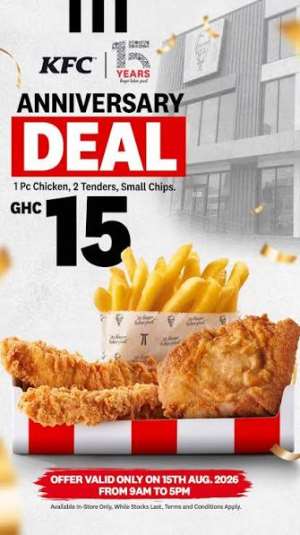
Yesterday, social media was full of images I still can’t get out of my head.
People in unimaginable queues, snaking around KFC branches across the country. I saw it with my own eyes in the late afternoon, driving through Kumasi. At Bekwai Roundabout. At Sokoban. Grown adults, students, families, standing for hours in the sun. Later I watched videos of staff at one branch using a water hose to “control” the crowd.
The promo was simple: cheap fried chicken and chips. That was all it took to bring a country to a standstill.
And then came the backlash. A section of Ghanaians asked, with genuine confusion and some anger: “Why the fuss? Why queue like this for foreign food? Don’t we have better things to do?”
I read the comments, and then I sat with my thoughts. Because my mind immediately went somewhere else.
To the waakye seller at the corner who wakes at 3am. To the chop bar in my neighbourhood where aunties serve banku and light soup with their bare hands and their whole hearts. To Daavi, the gari-and-beans seller. To the kenkey seller who balances a pan on her head. To the Hausa kooko seller whose porridge has carried students through exams for decades.
How many of us eat fried chicken and French fries for breakfast, lunch, or supper? How many of us grew up with ice cream and burgers as “normal” food? Very few.
Scarcity breeds curiosity. And needless curiosity has no respect for time, or for human dignity. When something that felt impossible becomes suddenly affordable, the brain doesn’t think about queues or humiliation. It thinks: “This is my chance.”
I wasn’t surprised by the queues. I’m one of the middle class who saw the videos and understood immediately. Because I’m from the valley of scarcity, and I’m still climbing to the hill of abundance. I know what it feels like to not be able to afford certain basics. And I know how the brain resets when those basics are made available at a price you can finally touch.
We compare, condemn, and forget
I’ve spent a few years in the catering space. I’ve seen it firsthand.
The impatience. The way we are quick to compare and condemn local brands to foreign ones. “The chicken is not as crispy.” “The service is slow.” “The place is not air-conditioned.” We compare a 5-year-old Ghanaian food joint to a 70-year-old global corporation and act shocked when it doesn’t measure up.
At the same time, we discuss graduate unemployment every week on radio and social media. But we are not supporting or promoting the very micro, small, and medium enterprises that could absorb those graduates. We want jobs, but we won’t buy from the person creating them.
We forget the levels of poverty, illiteracy, miseducation, and foreign influence that are thwarting our development. We forget that a significant majority of our people are still struggling for the necessities of life - including protein, including chicken. So when it shows up cheap, people will crawl for it.
We were taught there’s only one seat at the table
But the KFC queues are not just about hunger. They’re about mindset.
When we see our own win, we feel threatened instead of inspired. When we see someone doing what we want to do, we go all lengths to tear it down instead of learning from them. We gatekeep information. We hoard connections. We treat every person who looks like us as competition instead of family.
Worse still, there’s a collective expectation that we should start small and remain small. So those who dare to be big get hated into perpetual failure, while those who agree to remain small are hailed into mediocrity.
This didn’t come from outside. We did this to ourselves.
We were taught scarcity instead of abundance. We were taught that one of us getting it means less is available to us. Somehow we were handed a system - through colonialism, through bad governance, through broken institutions including religion - that taught us there is only room for one of us at the top. Only one seat at the table. Only one voice that gets heard. Only one brand that should lead an industry.
So we fight each other for that one spot instead of building our own table.
Meanwhile, other communities are investing in each other. They are passing wealth, contracts, and customers between each other. They understand that one person winning does not mean another person loses.
And us? We celebrate the failures of one another. We make entertainment of it. We record, we post, we drag. Then we wonder why generational wealth never sticks in our homes.
The whole pie requires something most of us won’t give
The whole pie requires a lot. It requires collaboration. It requires trust. It requires the security to let someone else be great in the room without it threatening who you are.
Most people will never taste the whole pie because they can’t get past the part where someone else wins too.
I want to see us win together. Not one of us. All of us.
But that requires trust. Trust that another Black man’s success does not diminish yours. Trust that collaboration is not weakness. Trust that we are stronger together than we’ve ever been apart.
Stop fighting over the slice. Let’s build a bigger table.
We need to trust that there is enough pie for everyone willing to put in the work and bake.
So why won’t we build our own chains?
Look around. “Food joints” are spreading in every corner. But while others are developing restaurant chains with systems, training, branding, and franchises, we appear to be interested only in modernising - or perhaps just rebranding - the age-old, single-location, roadside food business.
Why won’t everybody be head over heels for foreign brands when our local ones have remained behind gutters, with no signage, no receipts, no customer service training, and no plan to scale beyond the owner’s two hands?
The problem is not that KFC is foreign. The problem is that we have not decided to build our own KFC.
Our problem is not primarily a resource problem. It is a unity problem. A collaboration problem.
It has roots in how we were brought up. In the structure of our communities. In the nature of our institutions. It has undertones in colonialism and imperialism. And it is an offshoot of centuries of being taught to compete for crumbs.
Until we change how we see each other, the probability is high that we’ll keep passing the same crumbs around while everybody else eats the whole pie.
Yesterday wasn’t about chicken.
It was about us.
And if we are honest, the queue will only end when we decide to do big things together. It will end when we decide to polish what we have and commit to ensuring that the majority of our people maintain and heighten their taste for what is Ghanaian and African. It will end when our people think entrepreneurially and do not stop at remaining small. It will end when we appreciate the reality that nothing is actually free. If you are not paying for it, someone else is paying. If no one is paying, then the cost is not liquid cash but rather you - your time and dignity.


 AMA directs closure of shops, markets for October 3 National Cleanup Day
 ‘We will resist it’ – NUGS kicks against proposed 26% UG accommodation hike
 ‘Fake’ – EOCO denies GH¢50m bail report on Baffour Awuah
 ‘The NPP I seek to lead will stand by every member’ – Boakye Agyarko
 ‘Keeping Baffour Awuah in custody serves no purpose’ – Boakye Agyarko tells EOCO
 GACL announces enhanced security screening at Accra International Airport
 Pursue drug kingpins, not political opponents — Afenyo-Markin tells EOCO
 Over 130 courts are without magistrates – JUSAG President
 We demand immediate, unconditional release of Baffour Awuah from EOCO custody – ...
 COMAC gives Finance Ministry 14-day ultimatum to suspend new fuel tax rule


