




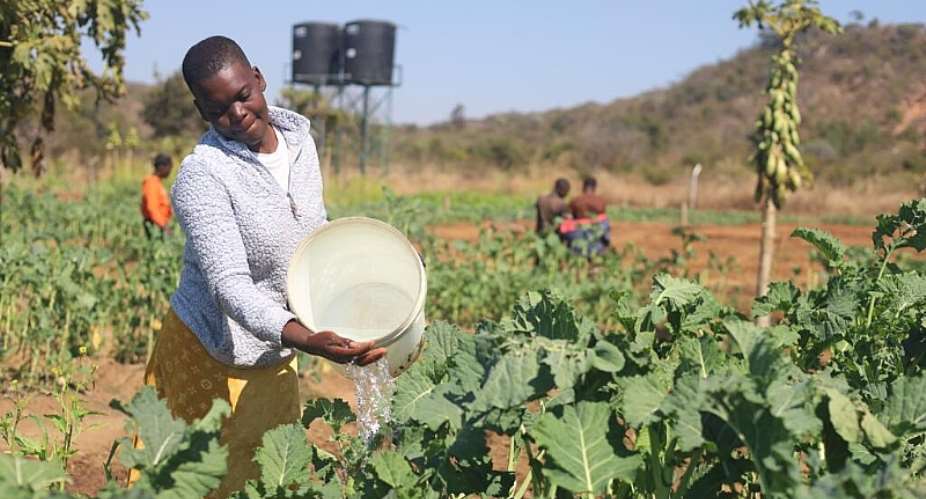
After sunrise over Chitiyo village in eastern Zimbabwe, Berita Numbi is already in her usual spot.
She is watering vegetables grown in elevated, bounded plots of soil in her portion of the community garden just outside Mutare, the country's third-largest city.
Three years ago, this would not have been possible in winter, as the rivers in her area are seasonal.
The newly established garden has a solar-powered borehole that supplies piped water throughout the year.
“We no longer worry about water,” says the 32-year-old, who has lived in this farming community all her life.
Known as Mutekwatekwa Community Garden, the site is shared by 50 farmers who started planting tomatoes, onions, peas and fruit trees in 2023.
Zimbabwe is betting on such gardens to boost food security, improve nutrition and empower locals.
The southern African country is targeting 35,000 boreholes in rural areas, with a government plan to install one solar-powered borehole in each of the country's villages. An aerial view of Mutekwatekwa community garden in Chitiyo village, Mutare, in eastern Zimbabwe.
Drought resilience
Numbi says during droughts, she uses the money from selling vegetables to other villagers and the market in nearby Mutare to buy maize, Zimbabwe's staple food.
“The garden is helpful during drought for family consumption. When crops fail at home, we use proceeds from the garden to buy maize and sorghum,” she says.
Zimbabwe has been experiencing recurring droughts over the past decade, worsened by climate change.
The recent punishing El Nino-induced drought hit the country in late 2023, triggering massive crop failures, water shortages and severe food insecurity for millions of people. The government declared the drought a national disaster in April 2024.
Meteorologists predict that another El Nino drought will occur in the 2026-27 agricultural season. Berita Numbi uses the earnings from selling vegetables she grows in the community garden to pay for food and schooling for her children.
Delilah Takawira, country director for Care Zimbabwe, an NGO that supported the establishment of Mutekwatekwa Community Garden, says nutrition gardens have proven one of the most reliable pathways to food security in drought-prone districts.
“They solve the problem that undermines rain-fed farming: water,” she says.
“Anchored on solar-powered boreholes, small dams, spring water, and drip systems, the gardens produce nutrient-rich vegetables year round, including through dry seasons when fresh produce is otherwise scarce.”
Numbi uses the money she earns from selling vegetables to feed and clothe her four children and pay their school fees.
Takawira says a garden is a source of food and income as well as an entry point into community finance.
“That layering is what builds genuine resilience,” she says.
In Zimbabwe, community seed banks are reviving indigenous crops
Village ownership
Chitiyo villagers participated in the construction of their community garden.
The village head donated land to the community while the villagers provided labour and contributed money for seeds.
“We gathered $500 from the farmers to buy seeds,” says Senior Chitiyo, who acts as a secretary for the community project.
“We all own the garden. Everything is done as a community, from accessing markets to planting.”
Takawira says this is to ensure that the project remains sustainable beyond donor funding.
The United States funded the Takunda programme, which established 126 nutrition gardens for about 241,000 people, including Mutekwatekwa, from 2020.
But the project, which was supposed to run until 2027, was disrupted by the foreign aid cuts imposed by US President Donald Trump when he took over in 2025. Local farmer Winnet Samu tends crops at the community garden in Mutare.
Harare goes green: capital city leads Zimbabwe's climate fight
Chitiyo says the villagers pay $320 a year to an insurance company that will fix the solar-powered borehole if it breaks down.
Winnet Samu, another farmer, says she received training before planting anything in the garden.
“I attended a training session about livestock production, poultry and agriculture held for farmers in the community. But I settled for the garden,” says the 28-year-old mother of four.
Fellow farmer Numbi says she is now working to set up a solar-powered garden at her farm, inspired by what she has learnt from Mutekwatekwa Community Garden.
“I am trying to replicate what I learnt here on my farm,” she says.


 Wontumi’s lawyers want Exim Bank case treated as civil, not criminal
 Mahama to cut sod for Accra Convention Centre project – Kwakye Ofosu
 Mahama administration committed to stamping out cybercrime – Sam George
 Ghana joins International Big Cat Alliance to strengthen wildlife conservation
 Africa must strengthen strategic positioning amid global power shifts – ECOWAS
 PAC grills GHS over transport officer who allegedly sold seven state vehicles wi...
 Pentecost Church elder was arrested over GH¢200,000 fraud case, not kidnapped – ...
 Banning preaching in vehicles will not succeed, we will even preach at the back ...
 Banks threaten to suspend new loans to public sector workers over Controller rep...


