




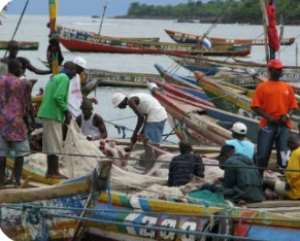
China's maritime strategy is raising growing concerns: illegal fishing, overfishing, a lack of transparency regarding its fleets, and control over port infrastructure.
A Massive Fleet Accused of Plundering African Waters
China has the world's largest deep-sea fishing fleet. In several African countries, its vessels are regularly accused of engaging in illegal, unreported, and unregulated (IUU) fishing, in violation of national laws and international agreements.
The methods denounced are well known:
Fishing without a license or beyond authorized quotas;
Turning off AIS transponders to evade surveillance;
Undeclared catches;
Use of destructive techniques such as bottom trawling.
For West Africa, where millions of people depend on small-scale fishing for their livelihoods, the cost is enormous: nearly $9.4 billion in losses each year, not to mention the accelerated depletion of fish stocks.
The Refusal to Be Transparent
In June 2026, Beijing refused to sign the Mombasa Declaration, an international agreement launched at the 11th Our Ocean Conference in Kenya and aimed at strengthening the fight against illegal fishing through greater transparency regarding licenses, vessel owners, and catches. Sixteen countries including seven African nations: Cameroon, the Gambia, Ghana, Guinea, Liberia, the Republic of the Congo and Somalia adopted the declaration.
This refusal comes as several African countries have chosen to join the initiative. This decision is a blatant admission by China regarding the illegal activities of its fleet. While private companies sometimes act without their country's consent, in this case, it is the Chinese government itself that is refusing to sign the declaration, demonstrating that it is aware of and covering up the activities of its companies.
African Ports Under Influence
Beyond fishing, China controls or finances a significant portion of Africa's port infrastructure. Chinese companies are involved in the construction, modernization, or management of dozens of strategic ports along the Atlantic and Indian coasts.
This presence offers Beijing a major logistical advantage:
Supplying fishing fleets;
Maintaining vessels;
Privileged access to major trade routes;
Strengthening its maritime and strategic influence.
This presence now extends beyond a purely economic framework and is part of a long-term strategy to exert influence.
Maritime Sovereignty Under Pressure
Faced with this growing power, several African states are stepping up their controls. South Africa, for example, intercepted four Chinese-flagged trawlers the Zhong Yang 231, 232, 233 and 239, owned by Shenzhen Shuiwan Pelagic Fisheries after they entered its exclusive economic zone off the KwaZulu-Natal and Eastern Cape coasts without authorization, repeatedly switching their AIS transponders on and off in the process . The vessels were fined roughly $24,000 and released after payment.
But the challenge remains immense. Enforcement capabilities remain limited in the face of an industrial fleet with significant financial and logistical resources.
Beyond fishing alone, control over African maritime spaces is now at stake. Through resource exploitation, control of port infrastructure, and geostrategic assertiveness, China is gradually expanding its footprint in African waters, at the risk of permanently weakening the economic sovereignty of coastal states.
Mustapha Bature Sallama.
Medical/ Science Communicator,
Private Investigator, Criminal investigation and Intelligence Analysis.
International Conflict Management and Peace Building.USIP
[email protected]
+233-555-275-880
References
Africa Defense Forum "South Africa Cracks Down on IUU Fishing by Foreign Trawlers." https://adf-magazine.com/2026/04/south-africa-cracks-down-on-iuu-fishing-by-foreign-trawlers/
DefenceWeb "South African authorities fine four Chinese fishing vessels over illegal entry." https://defenceweb.co.za/border-security-2/south-african-authorities-intercept-fine-chinese-fishing-vessels-over-illegal-entry/
Africa Defense Forum "China Refuses to Sign Agreement to Combat Illegal Fishing." https://adf-magazine.com/2026/07/china-refuses-to-sign-agreement-to-combat-illegal-fishing/
The Official Blog of Amb. David H. Shinn citing Oceana's "Sixteen Countries Adopt Mombasa Declaration to Advance Fisheries Transparency and Combat Illegal Fishing." https://davidshinn.blogspot.com/
Department of Forestry, Fisheries and the Environment (South Africa) "DFFE and SAPS Tactical Team intercept four Chinese-flagged fishing vessels for unauthorised entry into South African waters." https://www.dffe.gov.za/mediarelease/fishingvesselsintercepted
Africa Defense Forum "Questions Surround Chinese Trawlers Fined, Released in South Africa." https://adf-magazine.com/2026/05/questions-surround-chinese-trawlers-fined-released-in-south-africa/


 ‘We treat galamsey with kid gloves compared to other situations’ – A Rocha Ghana
 Ghana ‘missed the boat’ in galamsey fight under President Akufo-Addo – Senyo Hos...
 Judiciary to employ 127 magistrates to fill vacancies
 Government to suspend GH¢1 D-Levy on diesel for two months
 Russia launches major attack on Ukraine’s energy grid, causing power cuts
 EU talks deportations as five nations seek migrant centre in Africa
 Trump renews calls for former Federal Reserve chief Jerome Powell's resignation
 Paramount takeover of Warner Bros. Discovery clears legal hurdle
 Marsh hails improvements after Australia win final one-day international
 British PM alleges there are 'strong indications' Iran was involved in Fairford ...


