




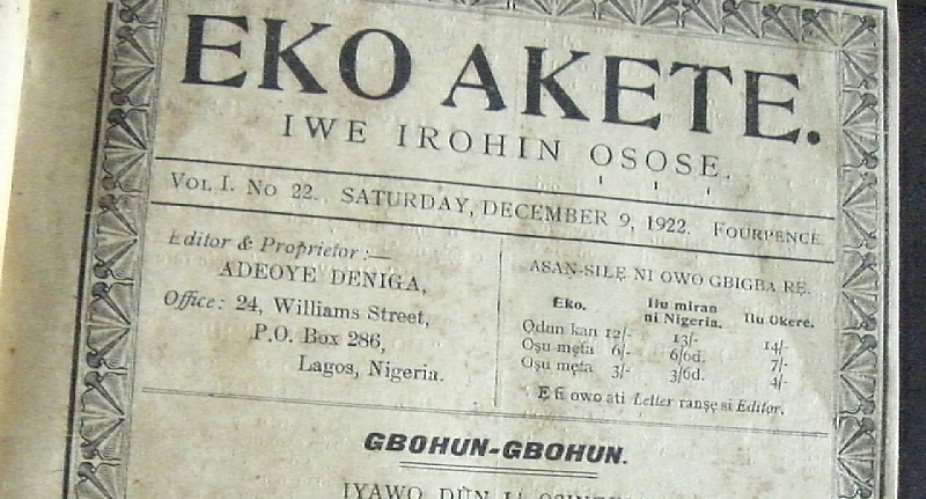
In Lagos in the 1910s and 1920s a new market of readers was emerging who wanted to express themselves in their own languages. Despite the dominance of colonial English print culture, entrepreneurs increasingly started using printing presses for mainstream Yoruba-language newspapers, books and pamphlets.
A new book by cultural anthropologist Karin Barber explores what was printed, and also how and why. We asked her about her study.
What's the history of the printing press in Lagos?
Lagos was a thriving commercial port on the coast of west Africa well before the imposition of British colonial rule in 1861. The printing press was brought to the region by Christian missionaries in the mid-1800s. At the inland mission station at Abeokuta, the Church Missionary Society published translations of Christian texts, and pioneered the first Yoruba newspaper, Iwe Irohin, from 1859 to 1867.
But in Lagos, the press was in the hands of independent entrepreneurs, not missionary organisations, from the beginning. The first Lagos printing press was established in 1862 and others quickly followed. Most of what they printed up to the early 1900s was in English, read only by a small, highly educated elite.
This was because after colonisation, English had become the language of government, administration, secondary education and international commerce as well as Christian worship. And the core of the early elite were “returnees” who had been liberated from the slave trade, converted to Christianity, and educated in English before making their way back to their Yoruba homeland. For some, English came more easily than Yoruba.
Some of the elite did have an interest in Yoruba literature, and in the late 19th century the Lagos presses published several books in Yoruba: proverbs, riddles, divination poetry and popular oral poetry, which members of the educated elite collected and wrote down. But this was a very small part of the Lagos print output of the time.
In the 1910s, however, a new potential readership had emerged – people who had attended elementary school and were literate in Yoruba, the language of everyday life for the majority of Lagos citizens.
They provided a new market and a new audience for a local, Yoruba-language print culture. Growing opposition to colonial policies made ordinary people eager to engage in political commentary and debate, while the flourishing oral street culture of Lagos primed them to enjoy new Yoruba-language genres in print.
What kind of material was being printed in Yoruba and why?
In the 1910s there was a major expansion of the Yoruba print sphere with the publication of a number of remarkable books on the history of Yoruba cities including Lagos, Abeokuta and Ibadan.
Then in the 1920s there was an explosion of newspaper production, in both English and Yoruba. Five Yoruba weekly papers were launched one after the other, starting with Adeoye Deniga's Eko Akete in 1922. This was a small format, 8-page paper (soon expanding to 16 pages). It featured editorials, news snippets, political and social commentary, a serialised history of Lagos, small and full-page adverts, topical poems and songs, letters to the editor and much else.
Most of the news in the Yoruba-language papers was local, though the editors did reprint or summarise articles from the British press. They were read mainly by people who had been to elementary school and were literate in Yoruba but less so in English. All the Yoruba papers also carried English segments to attract readers not fluent in Yoruba. And they even reached non-literate people who would ask friends and neighbours to read parts of the paper aloud to them.
The print explosion was not confined to newspapers. Yoruba-language books and pamphlets on local history, religion, social issues and poetry poured out.
You call it an experimental era?
Yes, this was an experimental era for Yoruba print. There was the potential new readership, more familiar with oral forms of expression than written ones. There was the heated politics in which radical members of the elite such as Herbert Macaulay, now known as “the father of Nigerian nationalism”, allied with the Lagos traditional ruler and the market women and others to launch campaigns against the colonial government's policies.
There was religious and social change, as immigrants from the hinterland flooded in. New forms of Islam and Christianity sought to gain a foothold, and traditional deference to elders and male heads of households seemed to be fading.
All this combined to make the Yoruba-language print entrepreneurs try out ways of addressing and capturing a new, varied and sometimes volatile readership. Most of the newspaper items talked directly to the reader and used witty and innovative allusions to popular sayings, songs and narratives.
They combined written genres familiar in the English-language press with genres drawn from Lagos street life, such as topical and satirical songs, anecdotes and oral history.
This mixture inspired new genres, such as the famous narrative The Life-story of Me, Segilola, told in the voice of an ageing “good-time girl” looking back on her scandalous past with a mixture of repentance and glee. It appeared in the form of weekly letters from Segilola to the editor of the weekly newspaper Akede Eko, I.B. Thomas (who actually wrote it himself) over nine months in 1929-30.
A newspaper was also an ideal space to try out new styles of writing, because much of the material appeared in series, such as advice columns to young women, or satirical dialogues between characters representing (in disguise) well-known figures in Lagos society. If one series didn't catch on it could be quietly dropped.
But it wasn't only the newspapers that were experimental: the books and pamphlets of this period were also doing something new. An important stimulus to experimentation was bilingualism. Yoruba and English texts coexisted in print, and copied and quoted each other all the time.
What do you hope readers will take away?
I hope readers will get a sense of the vitality of the print culture pioneered by Yoruba entrepreneurs. This was not a scene of great authors and international recognition – that came later, thanks, in part, to these efforts.
In the late 1930s, D.O. Fagunwa would introduce a new style of Yoruba-language fiction set in rural villages and magical forests. His rich, rolling, “deep” Yoruba became an inspiration for subsequent writers. There would be an upsurge of Yoruba-language writing after Nigerian Independence in 1960, resulting in one of the richest and most extensive African-language literary traditions in the continent.
The Lagos writers of the 1910s and 20s were less celebrated, and much of what they wrote has been forgotten. But they were part and parcel of everyday life in a rapidly transforming city and the way they wrote captured its vitality and its impulses and idioms.
They made creative use of popular street culture to establish a new print world. This was an early moment in an ongoing history of invention. The experiments with genre and language continue: today, you can hear English, Yoruba and Nigerian Pidgin being creatively mixed in popular music genres such as Afrobeat, fuji and rap, as well as in Nollywood films and fiction blogs.
This history suggests that while British colonialism imposed English as Nigeria's official language, it had no way of controlling what people did with it, even at the height of colonial rule. And it also shows that Yoruba-language creativity, far from being part of some unchanging “traditional culture”, was actually the main driver of textual innovation and experimentation in the print sphere and beyond.
Karin Barber has received funding from the UK academic research funders the AHRC, the ESRC and the British Academy. She is a member of the Labour Party (UK).
By Karin Barber, Emeritus Professor of African Cultural Anthropology, University of Birmingham

 President Mahama sets 2028 deadline for completion of Upper East Regional Airpor...
 Upper East Airport to open region to investors, boost economic activity — Mahama
 NDC will not take lessons from NPP on economy — Joyce Bawah
 Man seen assaulting suspect at police station not a member of Hajj Board — Pilgr...
 Police gun down two suspects, arrest one over Labone GCB robbery attempt
 Ofankor crash: Stop publishing graphic images, videos — Oppong Nkrumah urges med...
 South Africa excludes Ghana, seeks $18million repatriation costs from other Afri...
 Ghana won’t reimburse South Africa for evacuation of Ghanaians – Foreign Affairs...
 TDC, Tema Assembly clash over demolition of development project at Community 1
 Interior Ministry condemns assault of suspect Apostle Daniel in police custody, ...

