




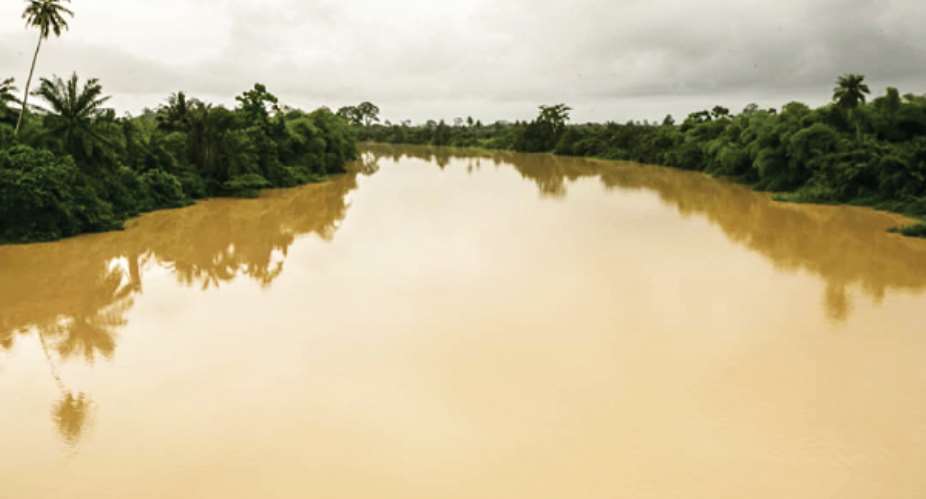
More than 60 per cent of Ghana’s waterbodies have been polluted by illegal mining activities, posing serious environmental, health and livelihood risks to communities, a research scientist at the Groundwater Division of the Council for Scientific and Industrial Research-Water Research Institute (CSIR-WRI), Dr Franklin Obiri-Nyarko, has disclosed.
Dr Obiri-Nyarko said the extent and variety of contaminants in the affected waterbodies meant that restoring them would remain difficult even if illegal mining activities were stopped immediately.
He called for urgent and sustained measures to rehabilitate polluted rivers and other water sources to safeguard lives and livelihoods.
“If you look at the state of our water resource now, it is clear that we are not doing enough to protect this valuable resource and going forward, there is the need for urgent steps to be taken to sustainably restore the polluted rivers to save lives,” he said.
According to him, effective restoration would require an integrated approach that tackles the sources of pollution, removes contaminants and treats affected rivers and other water sources.
He also stressed the need for dedicated and sustainable financing for the restoration of polluted waterbodies.
“This will require dedicated investment into the restoration of water bodies through sustainable funding. If not, we will not go anywhere,” he added.
Dr Obiri-Nyarko made the remarks during a presentation at the CSIR-WRI’s mid-year review programme, where he spoke on the topic, “Can Ghana Heal Her Water? Towards Sustainable Remediation of Polluted Water Bodies.”
The three-day workshop, which coincides with the institute’s 30th anniversary, is being held on the theme, “Water-Environment-Food-Health Nexus: Building Resilience for the Future.”
Call for coordinated action
Acting Director of CSIR-WRI, Dr Kwadwo Ansong Asante, called for a shift from the traditional silo approach to a more collaborative strategy in tackling challenges affecting Ghana’s environment, water and health sectors.
He said the three sectors were closely interconnected and therefore required an integrated approach supported by strong partnerships.
Dr Asante particularly cited the impact of illegal mining, popularly known as galamsey, which he said cuts across the environment, water and health sectors.
“We need to work together to fight this common enemy,” he said.
Galamsey threatens livelihoods
Another CSIR-WRI researcher, Dr Prosper Bazaanah, said studies conducted on the impact of illegal mining on the Volta River had established significant socio-economic consequences for affected communities.
He explained that residents depended on polluted waterbodies for farming and other livelihood activities, exposing them to long-term economic and health challenges.
“In terms of health, one of the key issues we saw is that miners complained of skin rashes, diarrhoea, cough and other health complications,” he said.
Dr Bazaanah also said some communities in the northern parts of the country had reported that cooked food spoiled unusually quickly after being left for some time.
The social consequences, he added, included children abandoning school to engage in illegal mining, while uncovered mining pits posed dangers to people and animals.
He called on the government to strengthen transboundary water management as part of efforts to protect waterbodies, particularly in northern Ghana.
Volta River faces future threat
Research Scientist Zita Abuntori, presenting findings from a study titled “Socio-economic Impact Assessment of Illegal Mining on the Volta River System in Ghana,” said the Volta River remained relatively safe but could face serious degradation if illegal mining activities were not brought under control.
She warned that continued mining activities along tributaries of the Volta River could eventually compromise the quality of the river, as has happened to several other waterbodies across the country.
“That is why I see the proposal made for the government to strengthen transboundary water management of water as a crucial one. If we do not stop galamsey in the tributaries of the Volta River, we will eventually lose it the way we have almost lost our rivers across the country,” she said.
Ms Abuntori further urged state institutions responsible for water and environmental management to work together to restore polluted waterbodies.
She also appealed to the government to provide CSIR-WRI with the necessary resources to undertake further research into Ghana’s water systems and develop effective strategies for protecting the country’s water resources.

 Apostle who made offensive comments about Prophet Mohammed arrested
 Imam who declared violence against anyone who speaks ill of Prophet Mohammed arr...
 Over 60% of Ghana’s waterbodies polluted by galamsey – CSIR-WRI Researcher
 NPP must learn from NDC's ability to unite despite personal differences — Afenyo...
 Sedina Tamakloe free as Court of Appeal strikes out AG’s application to stay acq...
 NSA suspends national service deployment for graduates from 13 tertiary institut...
 Atta Akyea insists he will not appear in Adu-Boahen case during legal vacation
 Court of Appeal to rule on State’s bid to suspend Sedina Tamakloe-Attionu acquit...
 Ignore NPP’s cheap propaganda and assent to COCOBOD Bill – Majority tells Mahama
 'Grey-headed KT Hammond should recuse himself as lawyer for Kwabena Donkor in AK...

