




To: Smallholder Farmers, Rural Cooperatives, Private Investors, Local Fabricators, and the Leadership of the Tree Crops Development Authority (TCDA).
THE SILENT REVOLUTION IN GHANA’S SOIL
For decades, Ghana’s agricultural narrative has been heavily dominated by cocoa. Meanwhile, a massive 200,000-ton annual structural deficit in Crude Palm Oil (CPO) has left our local manufacturing sector dependent on expensive, imported edible oils. This trend drains our foreign exchange reserves and sidelines local processing talent.
Today, this landscape is shifting. With the passage of the Tree Crops Regulations, 2023 (L.I. 2471) and a historic $500 million integrated financing window supported by the World Bank and Development Bank Ghana (DBG), we are moving away from empty agricultural talkshops. We are entering an era of enforceable minimum pricing, strict import regulations, and structured supply chains.
However, this opportunity will slip through our fingers if it remains locked in high-level regulatory boardrooms. True sustainable wealth is not built by massive foreign conglomerates alone. It is driven by the strategic combination of 10-acre smallholder blocks, mini-processing hubs, and grassroots cooperatives. This open letter serves as a practical guide and a call-to-action to bridge the gap between policy and real-world practice, turning raw land into a high-margin manufacturing network.
THE STRUCTURAL OPPORTUNITY: FROM RAW FRUIT TO HIGH-MARGIN MANUFACTURING
Many Ghanaians view oil palm farming through an outdated lens: selling raw fruit to middlemen for minimal returns. Shifting this dynamic requires understanding how the value chain is organized under the new rules:
- The Danger of Raw Sales: Fresh Fruit Bunches (FFB) must be milled within 48 hours of harvest. If left unmonitored, the fruit spoils rapidly, reducing your bargaining power against aggressive middlemen.
- The Mini-Processing Advantage: Processing raw fruit into Crude Palm Oil (CPO) locally allows a cooperative to capture an immediate 25% to 35% boost in return on investment (ROI), keeping processing profits within the community.
- Guaranteed Floor Prices: The TCDA now enforces a structural Minimum Producer Price (MPP) (set at GHS 1,699.70 per metric ton for August 2026). This baseline protects local farms from sudden market drops.
- Import Protection: The rollout of the TCDA’s Tax Stamp Regime on imported edible oils makes locally produced, processed oil highly competitive for domestic soap and food manufacturers.
REGIONAL CALLS-TO-ACTION: GEOGRAPHIC ADVANTAGES TO ACTIVATE
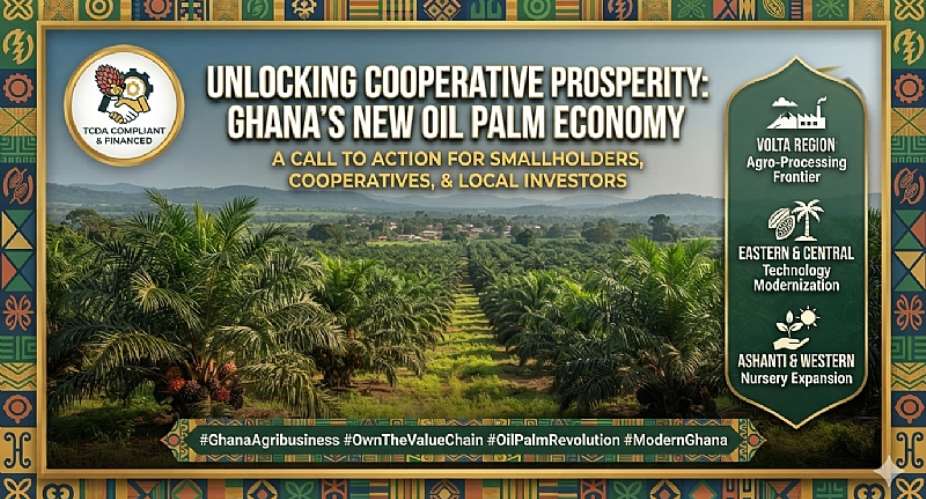
The Volta Region (The Emerging Agro-Processing Frontier)
- The Target Districts: Hohoe, Kpando, Jasikan, and the borders along the Eastern Corridor.
- The Strategy: With the rollout of the Volta Economic Corridor infrastructure initiative, the Volta Region is uniquely positioned for agroecological industrial parks. Cooperatives in these areas must aggregate 10-acre blocks to tap into the newly optimized transport routes directly to major urban markets.
The Eastern and Central Regions (The Traditional Powerhouses)
- The Target Districts: Kwaebibrem, Denkyembour, Twifo Hemang Lower Denkyira, and Abura Aseibu Kwamankese.
- The Strategy: These regions house the highest concentration of smallholder networks. However, nearly 80% of small mills here still rely on inefficient, manual hand-screw presses, leaking up to 38% of potential oil yields during peak seasons. The mandate here is technology modernization—moving from manual tools to automated mini-mills.
The Ashanti and Western Regions (The Forest Belt Expansion)
- The Target Districts: Adansi South, Mpohor, and Nzema East.
- The Strategy: These areas boast high rainfall patterns ideal for oil palm cultivation. Investors here should focus heavily on high-yield Tenera nursery operations to support massive farm expansion projects.
DOMESTIC INNOVATION: THE ROLE OF UNIVERSITY ENGINEERING AND LOCAL FABRICATORS
To make 10-acre mini-processing hubs economically viable, Ghana cannot rely on expensive imported machinery from Malaysia or China. We must look inward to our academic institutions and local engineering hubs.
What KNUST and Technical Universities are Doing:
- Optimized Mechanical Design: The Kwame Nkrumah University of Science and Technology (KNUST) and leading Technical Universities (like Sunyani and Takoradi Technical Universities) have shifted from abstract research to applied TVET engineering partnerships.
- Scientific Precision: KNUST research teams have engineered optimized mesh and sieve sizing for palm nut and kernel cracking units. This eliminates the old problem of crushing the interior kernel during automated shell cracking.
- Eco-Efficient Digestion: Engineering departments are designing automated, low-energy digesters that reduce the massive water and boiling fuel demands that historically plagued rural operations.
Harnessing Local Fabricators & TSC Networks:
- The Suame Magazine Connection: Grassroots mechanical engineers and fabricators (such as those in Kumasi's Suame Magazine or Accra's Kokompe) are converting these academic blueprints into rugged, cost-effective equipment. They specialize in fabricating modular FFB strippers, motorized masher-digesters, and centrifugal clarifiers.
- The Technology Solution Centre (TSC) Blueprint: Under the Rural Enterprises Programme, specialized TSCs operating in locations like Hohoe and Kumawu act as intermediate engineering hubs. They provide local cooperatives with custom-built spare parts, equipment maintenance, and technician retraining, ensuring mini-mills avoid extended downtime.
ACTIONABLE RECOMMENDATIONS FOR AGRIBUSINESS STAKEHOLDERS
1. For Smallholders: Form "Block-Farming" Cooperatives
- Consolidate Your Land: Do not farm in isolation. Cluster individual 10-acre plots into unified, continuous cooperative blocks to make your operations eligible for large-scale development support.
- Register Formally: Formalize your group with the Department of Co-operatives. A legally registered cooperative is a mandatory requirement to access international funding streams.
- Ban Uncertified Seedlings: Sourced parent stock must come exclusively from TCDA-approved sources like the CSIR-Oil Palm Research Institute (OPRI). Planting uncertified seeds wastes land and fertilizer on low-yield trees.
2. For Local Investors & Engineers: Partner with Academic Hubs
- Utilize Certified Blueprints: Do not rely on guesswork fabricators. Request processing machine designs modeled after KNUST, GRATIS, or TSC specifications to guarantee high extraction efficiencies.
- Anchor the Community: Build your mini-mill as a reliable processing partner for neighboring smallholders, guaranteeing them fair floor pricing to secure a steady supply of raw fruit.
- Apply for Licensing Early: Ensure your facility complies with L.I. 2471 by registering with regional TCDA offices to avoid transportation disruptions under the Conveyance Certificate System.
3. For the TCDA and Financial Institutions: Simplify Grant Access
- Demystify the Matching Grants: Actively promote the TCDA Matching Grant Support (MGS) tiers, making it straightforward for small-scale operators to access the $30,000 input grants and $80,000 mill upgrade windows.
- Deploy Field Officers: Expand the presence of technical teams in rural areas to help farmers transition smoothly into the new digital licensing and tracking systems.
A CALL TO OWN THE VALUE CHAIN
Ghana’s oil palm industry is evolving past the point of simple farming; it is becoming a structured commercial market. The combination of legislative backing and targeted financing means the tools for long-term growth are available. However, policies on paper cannot clear fields, and grant funds cannot operate machinery.
It is time for Ghanaian entrepreneurs, landowners, and youth to move up the value chain. Stop selling raw materials for low margins. Organize your communities, formalize your cooperatives, build local processing hubs, and secure your market share. Let us work together to build an agricultural sector that feeds our country, secures our rural economies, and keeps manufacturing wealth right here at home.
✍️ Submitted by:
Retired Senior Citizen
For and on behalf of all Senior Citizens of the Republic of Ghana 🇬🇭
Teshie-Nungua
[email protected]


 Sedina Tamakloe free as Court of Appeal strikes out AG’s application to stay acq...
 NSA suspends national service deployment for graduates from 13 tertiary institut...
 Atta Akyea insists he will not appear in Adu-Boahen case during legal vacation
 Private citizen challenges legal vacation of superior courts at Supreme Court
 Court of Appeal to rule on State’s bid to suspend Sedina Tamakloe-Attionu acquit...
 Ignore NPP’s cheap propaganda and assent to COCOBOD Bill – Majority tells Mahama
 'Grey-headed KT Hammond should recuse himself as lawyer for Kwabena Donkor in AK...
 Internal divisions, indiscipline hurt NPP in Upper East – NPP Chairman
 Enough of the inspections — Upper East residents demand action on Airport projec...
 Meta faces $1.4 trillion damages in lawsuit over child social media addiction

