




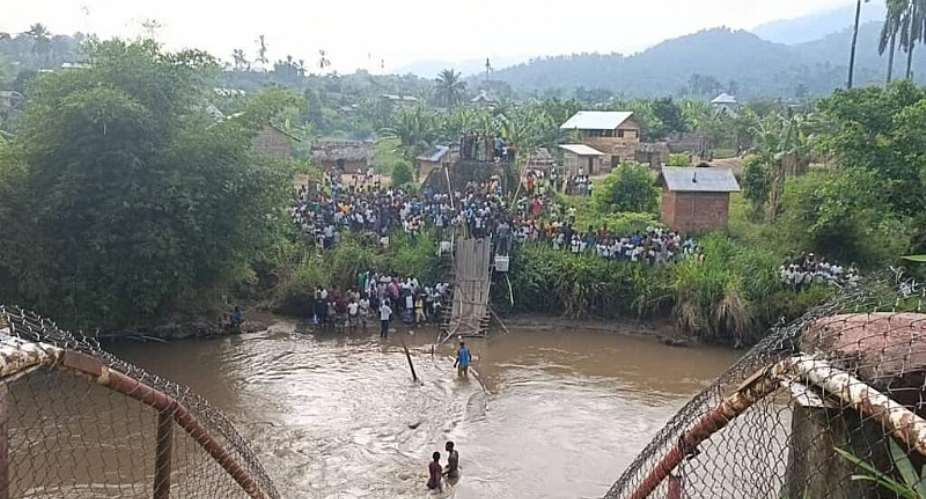
The footage shows at least seven people floundering in the muddy river, trying to keep from being swept away by the current. An eighth person seems to be swimming towards them to help. A few seconds later, the man who is filming the scene and describing what is happening turns the camera to show what caused the chaos below: a wooden bridge has broken in half and both sides have collapsed into the water. Large groups of people are gathered on both banks.
'The bridge is also important for commerce'
No one died in the bridge collapse that took place on June 3, 2026, in Hombo, according to two local sources. However, it has created a complicated situation, especially because the two parts of the village, located on either side of the Luhoho River, actually belong to two different administrative districts or “sectors". This makes the bridge an even more important link for the local population, says Augustin Mbula, a local journalist based in Walikale territory.
"The bridge means that people can cross the river, but it is also important for commerce. For example, Hombo North [Editor's note: the part of Hombo located on the western bank of the river] gets most of its food from fields located in Hombo East [Editor's note: located to the east of the river]. So if the bridge remains in this state, it is bound to cause problems. We already have sources there who say that there have already been food shortages. The bridge needs to be repaired urgently.” Hombo, the village where the bridge collapsed, is located in one of the most remote parts of the region. It is located in Walikale, a territory in the eastern part of North Kivu province.
The local community has been working together to create a makeshift solution, says someone who lives just a few metres from the bridge.
"I was one of the people within the local community who worked to build a new bridge so that people could cross the river. But the bridge we made is extremely dangerous – it could honestly collapse at any moment. People might drown in the river. But I don't know what more we can do; we don't have a lot of resources. That's why we've been calling on the Congolese government to help us.”
'A number of bridges in the territory are extremely dilapidated'
Local journalist Augustin Mbula says that many bridges in the region are in terrible shape.
"A number of bridges in Walikale are extremely dilapidated. Many of the roads are also in bad shape."
In fact, the bridge collapse in Hombo appears to be far from an isolated incident. In late April 2026, two bridges in Walikale territory collapsed 24 hours apart, according to the local press. Two people, one of them a child, were killed in one of these incidents.
The terrible state of the roads in the region has been widely documented by locals. On National Road 3 from Walikale to Bukavu, the capital of South Kivu province, there are a number of stretches where vehicles can't pass, and people have to go by foot.
This situation means that Walikale is “particularly isolated”, according to a number of people interviewed by the FRANCE 24 Observers team.
'In Walikale, there is no sign that riches are currently being extracted'
Prince Kihangi, a former deputy for Walikale territory at the North Kivu Provincial Assembly and a coordinator for the organisation DRC Ecologists ("Les Écologistes RDC"), has been documenting the failing infrastructure in his home region for several years.
Now based in Goma, Kihangi denounces the huge disconnect between Walikale's lucrative natural resources and the poor level of economic development.
"In Walikale, there is no sign that riches are currently being extracted. Once, when I was on the route, I saw a long line of more than 30 trucks carrying mineral ore. Walikale is being emptied out."
This territory is, in effect, home to the only large industrial mine in North Kivu province: Bisie. The site, which is run by Alphamin Resources, majority-owned by an Emirati company, represents 7% of the global tin production each year. Walikale territory is divided into two sectors: Bakano and Wanianga, where the Bisie tin mine is located. Hombo and its collapsed bridge are located in the south of this territory, right between the two sectors.
"But these riches will run out. One day, the Bisie mine will shut down and there will have been no impact on local development. Alphamin will leave Walikale and will leave behind gaping holes. I visited the mine in 2021: all of the investment has gone into installations right by the mine. But you just have to go a few kilometres to encounter a hellscape.”
Why money from the mining companies is having a limited impact on local infrastructure
Under Congolese law, mining companies must fulfil a number of obligations related to local development in order to operate, says Emmanuel Umpula, the executive director of African Resources Watch (Afrewatch), an NGO based in the DRC that advocates for a fair and equitable exploitation of African resources.
"The Congolese mining code calls on companies to sign a 'cahier des charges', a formal agreement between the company and local communities. You need to have specific development projects, including building infrastructure like schools, roads and bridges. They need to agree on a specific amount and sign in front of the provincial authorities."
But these agreements, some of which can be consulted online, show that the projects are only taking place in the area directly in and around Bisie. Hombo is more than 120 kilometres away from the mine as the crow flies.
Umpula continues:
"In addition to these agreements, the company must pay 0.3% of its annual revenue to a special endowment fund, meant to develop local infrastructure like schools, for example.
However, we carried out an evaluation and discovered that there are lots of problems within this model. The supervising committee takes nearly 4% of this money just to run. There is also an issue with actually implementing these projects. The people running these projects are often not local people – they come from Kinshasa, and so a lot of money is spent on their travel. At the local level, not enough is happening. The original idea was for these projects to be run by local people and thus to be beholden to the communities directly impacted.”
The Observers team spoke to Alphamin, who confirmed these numbers. They said that the establishment of projects financed by the 0.3% endowment "is a long process that is currently being contested by a number of people”.
"In order to get authorisations and to solicit bids, we have to go to Kinshasa. That costs a lot of money. Moreover, 4% has to be paid to the supervising committee, also located in Kinshasa. We are trying to manage this; there has been lots of embezzlement when it comes to this endowment, though not within Alphamin."
Alphamin also finances a non-profit called Alliance Lowa outside of its purely legal obligations. Alliance Lowa finances and manages development projects across Walikale. But Alphamin admitted to the FRANCE 24 Observers team that its budget is limited to "a million dollars [Editor's note: around 875,000 euros] a year", and that it "never had the goal” of responding to all of the infrastructure needs across the territory.
'Walikale territory represents a large part of the provincial budget'
Like all the mines in the DRC, Alphamin also directly pays the Congolese authorities an annual fee based on the total ore extracted. This is divided amongst the different levels of government: around 44% goes to central authorities, 23% to the province and 13% to the sector. The remaining money is divided between something called the Mining Fund for Future Generations, which is meant to provide for an eventual future post-mine period, and the National Victims Reparations Fund, which is meant to support victims of conflicts in the eastern DRC. The region has long been in the grips of a rebellion by the armed M23 movement, supported by Rwanda, which now occupies part of Kivu, including the large cities Goma and Bukavu.
The amounts paid by Alphamin, made public by the company, aren't insignificant: since 2020, the company has paid the equivalent of 13 million euros to North Kivu province and more than 7.8 million euros to the Wanianga sector, the part of Walikale territory where the Bisie mine is located.
Enough to make a huge impact on the budgets of the administrations involved, says Michel Moto Muhima, a deputy for Walikale territory. He worked with other parliamentarians to carry out an investigation in 2025 into the social impact of Alphamin's activities.
"Walikale territory contributes significantly to the budget of the province of North Kivu. But when you go there, you see an isolated, cut-off region. It would be good for the population there to have access to at least a minimum of viable infrastructure.
When you look at the sector level, Alphamin also plays a large role in the budget. When you look at the budget of Bakano sector [Editor's note: a Walikale sector where part of the village of Hombo is based and which does not receive money from Alphamin], it's practically peanuts. They can barely function, whereas the sector where the mine is located [Editor's note: Wanianga] has a much more significant budget. You can see the difference on the ground."
'The amounts linked to the annual fees paid by mining companies aren't enough to support big infrastructure projects'
A number of activist groups within Walikale contest the way that these significant budgets are being managed. The Observers team saw letters sent to both provincial and national authorities by a group called Young Leaders for Change ("Jeunes leaders pour le changement") who called for an investigation into the "opaque management of Wanianga sector", where the Bisie mine is located.
Our team also spoke to Descartes Akilimali, the leader of this sector, who shared with us a list of recent projects, which includes the purchase of vehicles and heavy construction machinery as well as the construction of offices, agricultural roads and a different pedestrian bridge over the Luhoho River (not the one in Hombo). He defends his record, saying that he has done more than his predecessor.
"All the local structures of the civil society, everyone supports us,” he claimed.
Emmanuel Umpula, the executive director of African Resources Watch, said that the sums paid by Alphamin as part of their yearly fees – which represent nearly 95% of the sector's budget, according to Descartes Akilimali – don't go far considering the cost of infrastructure and transport in the DRC. One single kilometre of road could cost “up to a million US dollars”.
Hombo's bridge should, eventually, be replaced. Walikale deputy Michel Moto Muhima has confirmed that "the sector is trying to begin work to see how it might be repaired” even though bringing heavy machinery on site “requires a miracle because of the isolated nature of the area and the presence of aggressive forces [Editor's note: the armed group M23] on the road between Bukavu-Hombo".
Alphamin says that they also "sent a technical team to the site” and are trying to figure out “how to resolve the problem.”
Our Observer remains worried. On July 17, he shared new videos with us, showing the makeshift bridge open to crossings on a market day. A huge crowd gathers on one side, trying to cross the unstable bridge one by one under the concerned gaze of their neighbours.
This article has been translated from the original in French by Brenna Daldorph.


 “We never knew life was going to be hard like this in Ghana; we can’t even get j...
 $1.17bn GoldBod gave BoG is repayment, not new money’ – Dr. Gideon Boako
 Baffour Awuah didn’t help his case if he ignored EOCO’s invitation – Appiah Danq...
 Arrest warrant against Manhyia South MP does not mean conviction – Kwasi Kwarten...
 October 1: Cedi sells at GHS12.25 on forex market, GHS11.72 on BoG interbank
 Institutions, public policy must remove barriers facing women – Vice President
 Ghana has lost the fight against galamsey — Barker-Vormawor
 Fire outbreak at Avenor disrupts power supply in parts of Accra
 Accra: Fire breaks out at Avenor Industrial Area; two feared dead
 Carlos Queiroz leaves Black Stars role after poor AFCON qualifying start


