




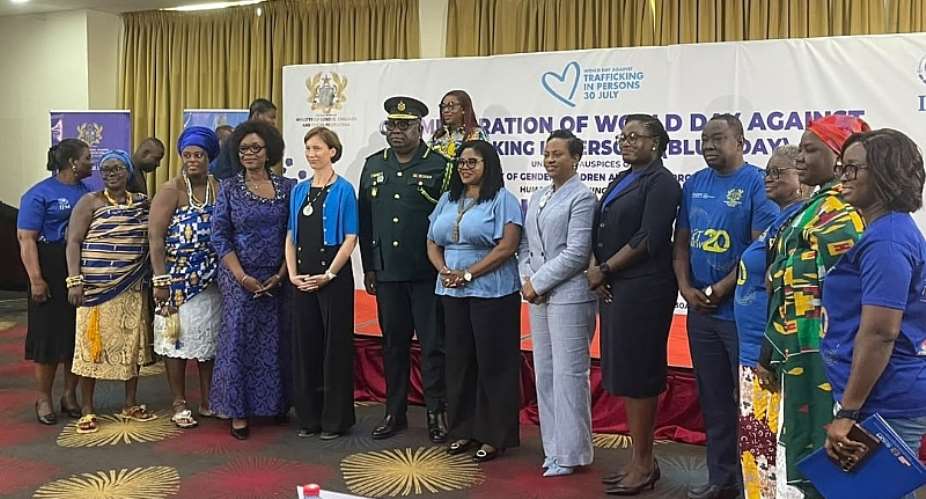
The Minister for Gender, Children and Social Protection, Dr. Agnes Naa Momo Lartey, has called on Ghanaians to remain vigilant and report suspected cases of human trafficking, warning that criminals are increasingly using digital technology, fake job offers, and online scams to lure unsuspecting victims into exploitation.
Addressing stakeholders at the national symposium marking the 2026 World Day Against Trafficking in Persons (Blue Day), Dr. Lartey said the country must strengthen prevention, victim protection, prosecution, and partnerships as Ghana commemorates 20 years of the Human Trafficking Act, 2005 (Act 694).
She painted a vivid picture of the trauma endured by trafficking victims, urging participants to reflect on the human cost behind the crime.
“Imagine a child leaving home with dreams of a brighter future, only to find themselves trapped in exploitation. Imagine a young person accepting what appears to be a promising job abroad, only to discover that every promise was a lie,” she said.
Describing human trafficking as one of the gravest violations of human dignity, the Minister said Ghana’s landmark anti-trafficking legislation remains as relevant today as when it was enacted two decades ago.
Dr. Lartey acknowledged the progress Ghana has made through collaboration between government agencies, law enforcement bodies, civil society organisations, and international partners.
She disclosed that the number of rescued trafficking victims has risen significantly over the past five years, reaching 2,331 rescued victims in 2025, the highest figure recorded during the period.
The Minister also highlighted gains made in prosecuting offenders, noting that dozens of traffickers and exploitation-related offenders were convicted and prosecuted last year, reinforcing Ghana’s commitment to bringing perpetrators to justice.
However, she warned that trafficking networks are rapidly adapting to the digital age.
“Today’s traffickers no longer rely only on physical recruitment. They increasingly hide behind mobile phones, social media platforms, and fraudulent online advertisements, luring young people with promises of employment, education, sports opportunities, and migration pathways that ultimately lead to exploitation,” she cautioned.
The Director-General of the Criminal Investigation Department (CID), COP Lydia Yaako Donkor cited that in 2025 alone, the Anti-Human Trafficking Unit at the CID Headquarters received 127 cases, rescued 1,202 victims, sent 19 cases to court, and secured eight convictions.
She added that Ghana has maintained its Tier 2 ranking in the U.S. Department of State’s Trafficking in Persons Report through sustained national efforts and strategic partnerships.
However, COP Donkor cautioned that traffickers are increasingly leveraging technology to deceive vulnerable people.
“Traffickers are no longer relying only on physical recruitment. They are using social media, smartphones, digital platforms, and encrypted messaging services to identify, recruit, and exploit victims across borders,” she said.
Highlighting emerging threats, Deputy Comptroller-General of Immigration in charge of Operations and Command Post, DCGI Faisal Disu, warned that trafficking syndicates are increasingly using digital platforms to recruit victims and revealed that Cambodia has emerged as a new hub for cyber scam compounds involving forced labour.
DCGI Disu disclosed that 79 male victims were rescued on July 26, followed by 93 female victims while 29 suspects were arrested in an initial operation and 17 additional suspects were apprehended on July 27.
“This year alone, we have received over 150 Ghanaian returnees who were deceived by fraudulent employment offers linked to cyber scam operations in Cambodia,” he disclosed.
He further revealed that, through collaboration with international partners, Ghana has facilitated the safe return of approximately 1,551 Ghanaian migrants from Libya between January and July this year.
Human trafficking is no longer confined to one country or one region. Criminal networks exploit poverty, unemployment, conflict, irregular migration, and advances in technology to recruit, transport, harbour and exploit vulnerable people,” he stated.
He urged parents, teachers, traditional authorities, faith-based organisations, and community leaders to educate young people about deceptive recruitment tactics and report suspicious activities to law enforcement agencies.

 We have cut cost of capital by more than half since Mahama took office – Ato For...
 Dr Bertha Ayi on how parents hurt children by raising them only on English
 Customs intercepts three firearms, 610 rounds of ammunition at Tema Port
 NDC to open nominations for 2026 regional executive elections on October 6
 Africa will be mostly self-sufficient in fuel by 2030: Dangote to AFP
 PRETAG threatens to intensify strike over unpaid teacher entitlements
 Lands Minister exits GoldBod Board as Minister's Chief Director takes over
 Court refuses bail for six accused in 3.9-tonne cocaine shipment case
 Philippines to open first-ever embassy in Ghana
 1992 Constitution review: Prof. Atsu Ayee and Dr Osae-Kwapong explain why Consti...


