




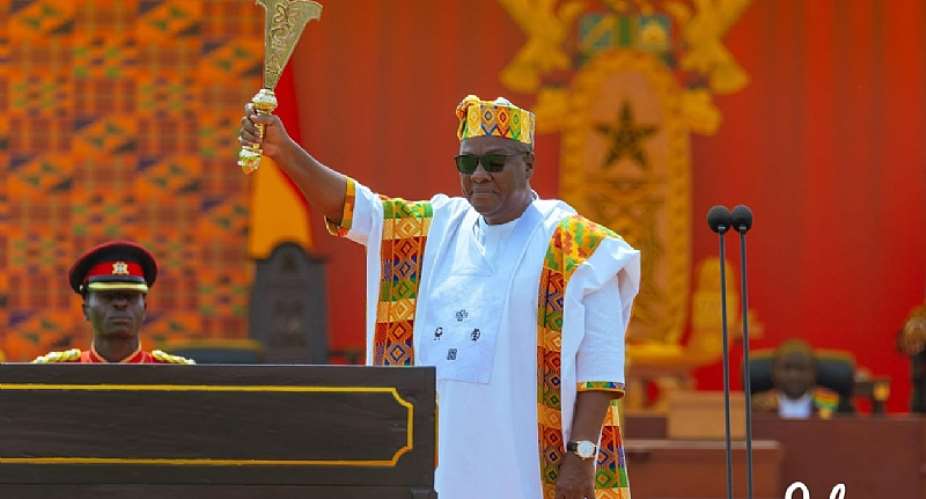
The conversation about extending the presidential term limit is not a sudden invention of contemporary Ghanaian politics. It has existed for years and has attracted voices from across Ghana’s political spectrum. Former President John Agyekum Kufuor, towards the end of his administration, expressed concerns about the limitations imposed by a four-year term and the difficulty of implementing relevant developmental programmes within such a short period.
President John Dramani Mahama has also argued that governance requires sufficient time for policies to mature and deliver results, while political actors such as Alan Kyerematen have advocated constitutional reforms including extending the presidential tenure from four to five years.
The issue, therefore, is not about one political party or one administration, it is about a broader recognition that Ghana’s democratic architecture must continuously evolve to meet the demands of national development.
Those who designed Ghana’s fourth republican constitution in 1992 were responding to a specific historical reality. After decades of political instability and military interventions, the priority was to establish strong safeguards against executive excesses and ensure regular accountability through elections.
The four-year presidential term, coupled with a two-term limit, served that purpose effectively. However, constitutional arrangements, like all human institutions, must be assessed not only by their original intentions but also by their practical consequences over time.
After more than three decades under the fourth republican constitution, Ghana must confront an uncomfortable reality.
The reality is that, the four-year presidential cycle has created a governance environment where administrations are constantly racing against time. A newly elected government spends its first year transitioning, assembling its team, understanding the state of the economy, reviewing policies and establishing administrative structures.
By the second year, serious implementation begins. But before the achievements of government can fully mature, the political atmosphere begins shifting towards the next election.
The result is a democracy where governments often have barely enough time to start before explaining why they should be allowed to continue.
A five-year presidential term however , provides an additional period for governments to move beyond policy announcements into measurable implementation.
Major national transformations are rarely achieved within short political windows. Industrialisation, economic restructuring, agricultural modernisation, educational transformation, healthcare expansion and digital innovation require continuity, patience and sustained execution. The additional year is not merely about giving politicians more time in office, it is about giving national policies a realistic opportunity to succeed.
In my view , a five-year term can even strengthen democratic accountability because it raises the standard by which governments are judged. A government given additional time will have fewer excuses. Citizens will therefore expect more than promises.
They will demand completed projects, measurable reforms, economic opportunities and tangible improvements in their daily lives.
Equally important is the endorsement by government to reduce the presidential age qualification from 40 to 35 years. That is a commendable move, but left to me alone, the age limit should be reduced further. Under Article 94 of the 1992 Constitution of Ghana, any citizen who is at least 21 years old and a registered voter is eligible to stand for election as a Member of Parliament, provided they meet residency or tribal connection criteria in qualifications.
If the 1992 Constitution permits a 21 year old to contest for elections and enter parliament to make laws for Ghana, then I believe there must not be a barrier in place to prevent a competent 21 year old from vying for the highest position of the land. In fact in advanced countries like Finland and France, the minimum age requirement for a candidate to run for president is 18. Since our country's political landscape is evolving, it will not be out of place to take inspiration from such countries.
The assumption that leadership automatically improves with age is a flawed argument. Experience matters, but age alone does not guarantee wisdom, competence or vision.
Around the world, societies have witnessed exceptional leaders who assumed national responsibility at relatively young ages. What distinguishes great leaders is not simply the number of years they have lived but the quality of their ideas, their ability to inspire confidence, their understanding of national challenges and their capacity to deliver results.
Ghana today is a youthful nation. Its entrepreneurs, technology innovators, academics, creative industry leaders and social reformers are overwhelmingly young.
This generation is driving conversations about artificial intelligence, digital transformation, entrepreneurship, climate change and global competitiveness. Yet, under the current constitutional arrangement, many of our youthful citizens are excluded from the possibility of seeking the nation’s highest office until they reach 40.
Lowering the age threshold is therefore not about handing power to young people simply because they are young. It is about removing an unnecessary constitutional limitation and allowing competence, rather than age to determine eligibility.
A 21 year-old candidate who lacks vision and leadership ability will be rejected by the Ghanaian voter but a 21year-old candidate with exceptional leadership qualities should not be prevented from competing merely because of an arbitrary age requirement.
A democracy cannot continuously demand responsibility from its young citizens while simultaneously denying them the opportunity to aspire to the highest levels of public service.
Ghana’s democratic success has never been built on refusing change. It has been built on adapting when circumstances demand it.
The Fourth Republic itself was born from the courage to abandon failing political arrangements and embrace a better system. Constitutional reform is therefore not a threat to democracy, it is evidence that democracy is alive.
In conclusion, the five-year presidential term and the reduction of the presidential age limit represent a necessary recalibration of Ghana’s democratic framework. One gives governments the breathing space required for meaningful transformation and the other expands the pool of citizens capable of offering leadership to the Republic.
Together, they reflect a simple but powerful principle, which is, democracy must not only protect the right of citizens to choose leaders, it must also ensure that the best potential leaders are not unnecessarily excluded from offering themselves for national service.
Believe me to be;
Opare Philip Israel

 Don't politicise Upper East's exclusion from World Bank roads project – Rev. Aka...
 July 31: Cedi sells at GHS12.30 on forex market, GHS11.67 on BoG interbank
 Court quashes ORC’s attempt to wound up, liquidate Zeepay
 Prove me wrong that Chairman Wontumi’s conviction is not a selective justice or ...
 Dennis Miracles Aboagye's Family Land Defence: Stewardship or Personal Enrichmen...
 FIFA vows to proceed with private investor plan consultation as opposition sprea...
 What we know about the Hamas disarmament deal announced by Trump
 AI safety scare: Anthropic says Claude models accessed outside systems during te...
 Pakistan says US-Iran talks still alive despite fresh wave of US strikes

