




For over three decades, the Republic of Ghana has been paraded as a beacon of democratic stability in West Africa, yet our economic sovereignty remains trapped in a humiliating, neo-colonial cycle of resource exploitation. Today, the Ghanaian street is a battleground of fierce political propaganda. On one side, the opposition sounds the alarm over blatant "state capture" regarding the lightning-fast handover of the mature Damang Gold Mine to Engineers & Planners (E&P)—a firm owned by Ibrahim Mahama, the biological brother of President John Dramani Mahama. On the other side, citizens watch with boiling anger as the Akufo-Addo administration hands over our strategic mineral baseline to Chinese state-backed monopolies, masked under a US$450 million manganese processing deal with the Ghana Manganese Company (GMC) in Nsuta [GMC processing partnership].
Let us strip away the partisan spin: this is not a harmless political debate. This is a structural emergency. Whether our national wealth is being systematically funneled into the pockets of politically connected domestic dynasties or surrendered wholesale to foreign geopolitical superpowers, the victim remains the same: the ordinary Ghanaian citizen. To tolerate this status quo is to be complicit in our own economic enslavement. We must critically dissect the mechanics of these deals, expose the catastrophic historical data of our past mining failures, name the political actors responsible, and demand an immediate halt to the structural looting of our sovereign wealth.
1. The Historical Landscape: A Legacy of Catastrophic Failures and Named Enablers
To understand why the Damang and Nsuta deals smell so foul, Ghanaians must remember the devastating history of how our leaders have repeatedly traded our birthright for a pittance:
- The 10% Free-Carried Shame: For decades, Ghana has operated under a mining framework where the state retains a measly 10% free-carried equity interest in multi-billion dollar mines. Over a 30-year period, this structurally flawed model allowed foreign multinationals to export over US$30 billion worth of gold, while Ghana received less than US$2 billion in direct corporate taxes and royalties.
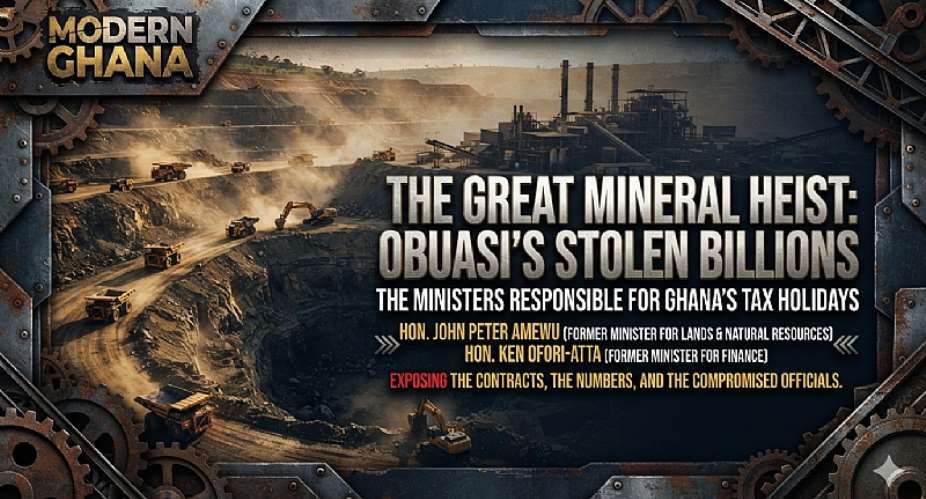
- The AngloGold Ashanti Tax Holiday Disaster: In 2018, the state formalized a notorious Development and Tax Concession Agreement for the Obuasi mine redevelopment. This disastrous deal granted the multinational a staggering US$259 million to US$300 million tax concession package, capped royalties, and extended fiscal stability protections. [1, 2]
- The Institutional Enablers: This massive revenue surrender was laid before and pushed through Parliament directly by John Peter Amewu, the then-Minister for Lands and Natural Resources, alongside Ken Ofori-Atta, the then-Minister for Finance. Assisted by their respective deputies, such as Kwaku Kwarteng (Finance) and Benito Owusu-Bio (Lands), these officials actively structured the fiscal waivers that cost the Ghanaian taxpayer millions in lost revenue while global gold prices skyrocketed. [3, 4]
- The US$5.2 Billion Illicit Financial Flows: Data from the United Nations Economic Commission for Africa (UNECA) and Global Financial Integrity reveals that between 2005 and 2015, Ghana lost an astronomical US$5.2 billion through trade misinvoicing and under-declaration of gold exports by foreign-controlled mining entities.
- The PDS and Agyapa Precedents: We must not forget the stinking ghosts of the Power Distribution Services (PDS) scandal, where national power assets were handed to a consortium with fraudulent guarantees, or the aborted Agyapa Royalties deal, an audacious attempt to alienate Ghana’s future gold royalties to an offshore tax haven (Jersey) for a measly upfront cash infusion. The actors change, but the playbook of elite-driven asset stripping remains identical.
2. The Damang Gold Mine Deal: Technical Merit vs. Unacceptable Ethical Rot
The lease transfer of the Damang Gold Mine to Engineers & Planners (E&P) cannot be swept under the rug as a routine local contract; it is a textbook case of compromised ethics:
- The Procurement Reality: Official Minerals Commission records show that E&P technically outmanoeuvred its rivals in a three-phase tender [Tender Committee reports]. Two bidders failed basic tax, VAT, and SSNIT clearances, while a third scored a pathetic 63.4% on technical competence. E&P scored 95.4%, leveraging its 25-year history as the on-site contractor under Gold Fields.
- The Private Jet Conflict: The technical data cannot wash away the putrid optics of political favoritism. President Mahama chaired the Cabinet that approved this multi-million dollar asset transfer to his biological brother. Compounding this brazen conflict of interest, the President regularly utilized Ibrahim Mahama’s private jet for official state travels during the exact window the bid was being evaluated [The Ghanaian Times]. This is a severe violation of Article 284 of the 1992 Constitution.
- The High-Risk Asset: Industry data reveals Damang is a depleting, mature mine that produced just 97,500 ounces of gold in the 2025 financial year. E&P has secured a US$505 million financing package from Absa and Stanbic Bank, committing US$250 million to a new heavy fleet to squeeze out the remaining ore.
3. The Nsuta Manganese Surrender: Value Addition or Chinese Monopoly Creep?
While the NDC-linked elite privatizes gold, the NPP-led administration is aggressively leasing Ghana's mineral sovereignty to Beijing under the guise of industrialization:
- The US$450 Million Monopoly: The state has sanctioned a US$450 million refinery investment by the Ghana Manganese Company (GMC)—which is 90% owned by China's Ningxia Tianyuan Manganese Industry Group (TMI) [GMC processing partnership].
- The Illusion of Retained Wealth: The Minerals Commission boasts that this refinery will increase Ghana’s retained export revenue from raw manganese from 27% to 40% and create 400,000 jobs. However, the raw truth is that 90% of the equity, dividends, and ultimate commercial control of our manganese reserves remain firmly in the hands of a Chinese conglomerate.
- The Strategic Capture: This is not an isolated deal. Chinese state-backed entities have quietly built an ironclad monopoly over Ghana's resource future. They control the US$1 billion Cardinal Namdini Gold Mine (West Africa's largest single-stream mine) and are aggressively swallowing critical green minerals like the Ewoyaa Lithium project.
- The Galamsey Hypocrisy: The state routinely deploys the military to shoot and arrest poor, desperate local miners and low-level Chinese nationals destroying our river bodies via galamsey, yet the same state rolls out the red carpet at the cabinet level to hand billion-dollar legal extraction monopolies to Chinese state corporations.
4. Hidden Economic Fault Lines: The Threat to Taxpayers
Both deals feature highly dangerous financial engineering frameworks that could detonate under the feet of Ghanaian taxpayers:
- The Cedi Deficit Trap: The Damang buyback agreement forces E&P to sell 100% of its initial gold output to the Ghana Gold Board (GoldBod) at a 0.55% discount below global spot prices, with payments made strictly in Ghana Cedis (GHS) based on the Bank of Ghana reference rate.
- The Sovereign Debt Risk: Because E&P must import heavy mining equipment, explosives, and fuel using US Dollars while receiving revenue in a rapidly depreciating Cedi, a massive financial mismatch is created. If the Cedi plummets, the state-backed GoldBod may ultimately be forced to guarantee or bail out E&P's US$505 million private banking debt to prevent systemic bank failures.
- The Commodity-Backed Bauxite Trap: Civil society watchdogs have repeatedly warned that the aggressive, unvetted acceleration of these Chinese refinery deals serves as a desperate, opaque mechanism to service legacy, multi-billion dollar bauxite-backed infrastructure loans extended to the state by Beijing.
[Resource Extraction Model] │ ├──► DOMESTIC PRIVATE PRIVATIZATION (Damang Gold Mine) │ └─► Elite Family Overlap + Cedi Mismatch + State Backstop Risk │ └──► FOREIGN GEOPOLITICAL MONOPOLY (Nsuta Manganese) └─► 90% Chinese Control + Resource-Backed Debt Servicing Loop
SUGGESTIONS AND RECOMMENDATIONS FOR GHANA
Ghanaians must stop behaving like passive spectators while our house is looted. We demand the immediate implementation of the following aggressive reforms:
- Pass an Anti-Nepotism Mineral Ownership Law: Parliament must urgently enact legislation that legally bars immediate family members of sitting Presidents, Vice Presidents, Ministers, and heads of mining regulatory bodies from bidding on, or owning, state-leased mineral concessions during their relative's tenure.
- Enforce a 51% Minimum Sovereign Carrying Interest: Ghana must permanently scrap the archaic 10% free-carried interest model. For all critical, green, and strategic minerals (manganese, lithium, bauxite, and gold), the state must legally mandate a minimum 51% equity stake owned directly by the people of Ghana.
- Declassify All Bidding and Tender Metrics: The Minerals Commission must be legally compelled to publish unredacted evaluation sheets, beneficial ownership declarations, and financial capability certificates for all national asset tenders within 48 hours of allocation to eliminate backroom deals.
- Launch an Independent CHRAJ and OSP Criminal Probe: The Commission on Human Rights and Administrative Justice (CHRAJ) and the Office of the Special Prosecutor (OSP) must be fully funded to independently investigate the exchange of corporate gifts—specifically private jet travel—between state officials and active government bidders.
- Create a Mandatory Forex Sinking Fund: To insulate the domestic banking sector, the Bank of Ghana must establish a strict forex ring-fence for local mining firms operating under Cedi buyback mandates, ensuring their international operational costs do not crowd out local commercial bank credit.
Ghana cannot afford to waste its future on the playground of NPP vs. NDC partisan warfare. The economic data and historical facts reveal a painful reality: while the political elites take turns shouting "witch-hunt" or "local content" to shield their family members, and "value addition" to justify foreign domination, the wealth of the Black Star is being systematically evaporated.
True resource nationalism requires an uncompromising, aggressive stance against corruption, nepotism, and neo-colonial contracts. It is time for civil society, independent media, and the youth of Ghana to wake up and demand a total overhaul of our mining framework. Our minerals must build local roads, fund state-of-the-art hospitals, and secure our currency—not line the pockets of a politician's brother or fund the geopolitical ambitions of a foreign superpower. The looting must stop, and it must stop now!
✍️ Retired Senior Citizen
For and on behalf of all Senior Citizens of the Republic of Ghana 🇬🇭
📍 Teshie-Nungua
📧 [email protected]

 Dennis Miracles Aboagye's Family Land Defence: Stewardship or Personal Enrichmen...
 FIFA vows to proceed with private investor plan consultation as opposition sprea...
 Almost 50,000 migrants crossed Morocco-Ceuta border over past 24 hours
 What we know about the Hamas disarmament deal announced by Trump
 AI safety scare: Anthropic says Claude models accessed outside systems during te...
 Pakistan says US-Iran talks still alive despite fresh wave of US strikes
 Bekwai residents give Chinese quarry company one week ultimatum to address envir...
 Sedina Tamakloe’s acquittal sets a dangerous precedent in Ghana — Former Deputy ...
 Blows in CLOGSAG over disqualification of Oti regional chairmanship aspirant
 Attorney-General seeks stay of Court of Appeal ruling acquitting Sedina Tamakloe

