




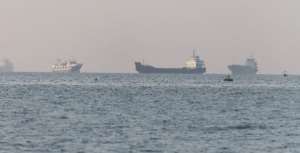
A Russian-flagged cargo vessel with a documented history in Moscow's African arms-logistics network has been sitting off the coast of Lagos for more than eight days without docking, a delay that is drawing scrutiny well beyond ordinary port congestion.
The ship and its record
The vessel, the roll-on/roll-off cargo ship Patria (IMO 9159921), has been anchored off Lagos since July 21. It sails under the Russian flag and is affiliated with the Sakhalin Shipping Company (SASCO). The Patria has been on the United States sanctions list since 2023 and was added to Canada's sanctions list in 2026. Ukrainian maritime-sanctions monitors describe it as a vessel used to transport weapons and military equipment on Russia's behalf.
The Patria belongs to what analysts call Russia's "Dark Fleet," a collection of vessels used to evade international sanctions through opaque ownership structures, frequent flag changes, minimal insurance and other practices designed to obscure their commercial or logistical activity. International research has increasingly flagged the security and environmental risks these fleets pose, particularly as their presence in African waters grows. In an emerging pattern, Moscow has begun re-flagging some of these vessels back to Russia rather than hiding them under African flags of convenience, calculating that Russian registration offers stronger legal cover in the event of an inspection and turns a potential interception into a diplomatic incident rather than a straightforward seizure.
A vessel with a documented arms-trafficking history
The Patria is not a first-time actor in this network. Investigations in 2025 documented its role ferrying Russian military equipment to West Africa, including armored vehicles, combat vehicles and artillery systems reported to have passed through Conakry, Guinea, before being transferred onward to Mali for use by Russia's Africa Corps. Its current position in the Gulf of Guinea follows a similar recent movement by the vessel Mikhail Britnev, which unloaded armored vehicles in Lomé, Togo, opening what analysts describe as a new Russian logistics corridor into the Sahel.
Why the delay?
Two explanations are circulating for why the Patria remains anchored rather than docked, despite Lagos being its listed destination after departing Douala, Cameroon. The first is straightforward port congestion, a persistent logistical bottleneck at Lagos that has slowed vessel turnaround generally. The second is more pointed: a quiet, unofficial reluctance to grant port access to a heavily sanctioned Dark Fleet vessel under close watch by U.S. intelligence agencies, given the diplomatic risk of appearing to host it.
That second explanation carries added weight in light of Washington's recent concrete support for Nigeria's counterterrorism operations. Accepting a sanctioned Russian vessel potentially carrying military cargo would send a mixed signal at a moment when U.S.-Nigeria security cooperation is deepening, and could complicate that relationship.
Why the Dark Fleet worries African coastal states
Beyond this single incident, the Dark Fleet carries risks that extend past sanctions evasion. Many of its vessels are ageing and poorly maintained, a genuine maritime hazard illustrated by the Mersin incident off the coast of Dakar, which narrowly avoided disaster. For African coastal states, the exposure runs across three fronts: environmentally, a shipwreck or major incident could trigger an oil spill, severe pollution or a prolonged blockage of Gulf of Guinea shipping lanes; diplomatically and economically, hosting these vessels exposes host countries to U.S. secondary sanctions and friction with Western partners; and from a security standpoint, opaque arms deliveries strengthen Russian influence in the region while potentially fuelling conflicts involving state and non-state actors alike.
The recurring presence of these vessels in West African waters raises a broader question about port sovereignty, maritime security and the region's shifting geopolitical balance. Until the nature of the Patria's cargo and the real reason for its prolonged wait off Lagos are clarified, Nigerian authorities and observers alike have legitimate grounds for concern.
Mustapha Bature Sallama.
Medical/ Science Communicator,
Private Investigator, Criminal investigation and Intelligence Analysis.
International Conflict Management and Peace Building.USIP
[email protected]
+233-555-275-880
Sources
SONARROW_OSINT, X (Twitter) post tracking the Patria's position off Lagos, July 2026
War & Sanctions (Ukraine), vessel profile: Patria (IMO 9159921)
Reuters, "Europe targets shadow fleet tankers falsely using Cameroon flag, sources say," July 2, 2026
Associated Press, investigation on Russian arms shipments to West Africa, 202
Liga.net, "AP: Russia expands military presence in Africa despite sanctions"
Africa.com, "From Conakry to Bamako: Tracking Russia's Covert Arms Trail into Mali"
MarineTraffic, vessel profile: Mikhail Britnev (IMO 9081370)
SONARROW_OSINT, X (Twitter) post on the Mikhail Britnev's arrival in Togo
The Guardian (Nigeria), "Congestion cost rises to $3.38 million as 39 ships await berth"
Afrik.com, "Nigeria–États-Unis : coopération militaire renforcée face à la menace djihadiste"


 Accra-Kumasi Expressway to cut travel time to 2hours, drive 120km per hour — Mah...
 'Our own money $2billion ready, we have not gone to borrow money from anywhere' ...
 Founder’s Day September 21 declared public holiday
 Council of State was not qualified to determine prima facie case against Torkorn...
 'Grounds for removal of Chief Justice and justice of superior court shallow, eph...
 Ghanaian banks write Off GH¢1.23bn in bad loans in first half of 2026
 Family of Gbewaa Training College lecturer killed by curfew soldiers vows legal ...
 Don't be a Bar that flips on principles but a Bar that is consistent — AG tells ...
 Prostate cancer may show no symptoms until advanced stage – Urologist warns
 Fully completed GH¢213,490 SOCO volleyball court abandoned after Bongo youth rej...


