




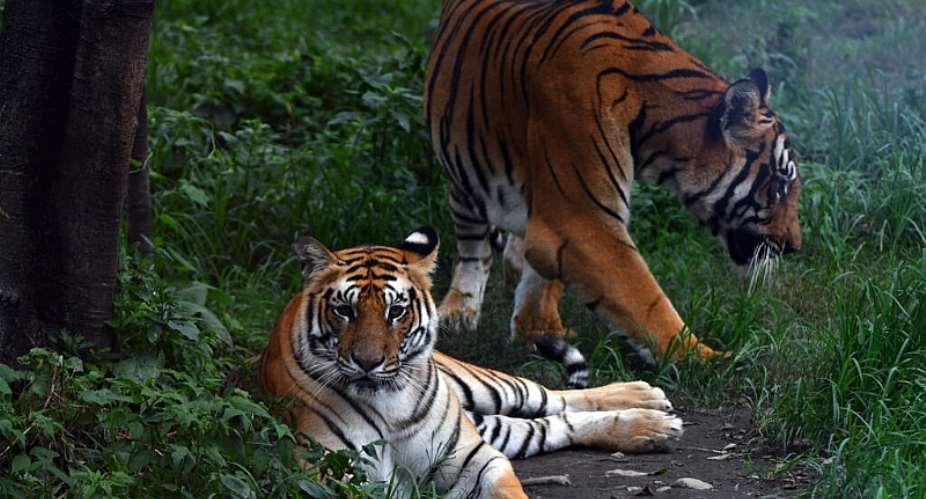
Nepal's tiger population has risen by roughly 20 percent in the past four years to an estimated 429, officials said on Wednesday, a conservation milestone despite challenges from human-wildlife conflict.
The latest nationwide survey found tiger numbers had increased from 355 in 2022, reinforcing the Himalayan nation's reputation as a success story in big-cat conservation.
"The data analysis shows that the tiger population has increased by five percent each year, and we are happy to see this increasing trend," Bed Kumar Dhakal, spokesman for Nepal's Department of National Parks and Wildlife Conservation, told AFP.
Read more Cambodia wants to bring tigers back, but should it?
The survey was conducted between December and July, and was announced to coincide with International Tiger Day. It covered more than 7,300 square kilometres of Nepal's southern plains that are home to the predators.
Wildlife officials deployed more than 3,600 motion-sensitive cameras across five protected areas, with experts analysing thousands of images to identify individual tigers by their distinctive stripe patterns.
"The reason behind the increasing number of tigers is because we could keep their habitat secure," said conservation department ecologist Hari Bhadra Acharya.
Deforestation, habitat loss and poaching have been major challenges for tiger populations across Asia, and Nepal has won international praise for reversing the decline.
In 2010, Nepal joined 12 other countries in pledging to double tiger numbers by 2022.
It became the first nation to meet that goal, boosting its tiger population to 355 in 2022 from about 121 in 2009.
Tiger attacks
However, the conservation success has also brought unintended risks for communities living near tiger habitats.
Government data shows at least 38 people were killed in tiger attacks between 2019 and 2023.
"The local communities played a crucial role in increasing the tiger numbers, but the government and organisations are not taking action when the tigers are attacking the same communities," said Nischal Neupane, an advocate for tiger victims in Bardiya district.
The district is home to 112 tigers, up from only 18 in 2009.
WWF Nepal country representative Ghana Shyam Gurung said conservation gains must be matched by efforts to ensure "people and wildlife can thrive together".
"By investing in effective co-existence programmes, Nepal can continue to offer a powerful model for other tiger range countries."
More than 100,000 tigers roamed the wild at the start of the 20th century, but global numbers plunged to an estimated 3,200 in 2010 before recovering in parts of Asia through intensified conservation efforts.
(FRANCE 24 with AFP)


 Gov't to hold state funeral for former Foreign Affairs Minister James Victor Gbe...
 Judiciary to roll out electronic court processes from October – Chief Justice ...
 Supreme Court explains why OSP can prosecute but A-G can discontinue any prosecu...
 Ghanaian jailed in US for role in $100 million romance scam
 'A very good day for accountability' — Prof Azar on Supreme Court ruling upholdi...
 Supreme Court upholds OSP’s prosecutorial powers, affirms AG’s authority to disc...
 Supreme Court abolishes delegate system for presidential and parliamentary prima...
 2026 budget is Ghana's worst performing since 2016 — Abu Jinapor
 July 29: Cedi sells at GHS12.30 on forex market, GHS11.67 on BoG interbank
 Government underfunding healthcare, putting lives at risk — Minority

