




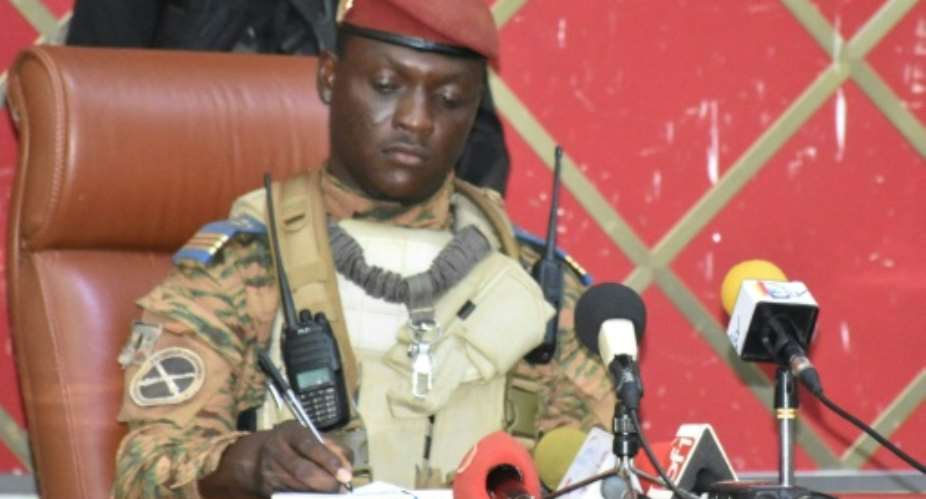
Burkinabes have fled to neighbouring Ivory Coast to escape the authoritarian military government led by Ibrahim Traore, who has suppressed dissent by cracking down on the media, opposition and civil society.
AFP spoke to four people from the media and judiciary, fields particularly in the authorities' crosshairs, although the military and even dissenting junta supporters have also been targeted.
Leaving Burkina Faso to go into exile was difficult and their return remains uncertain.
But in the meantime in Ivory Coast, they try to blend in with the four-million-strong Burkinabe diaspora, more than 72,000 of whom are refugees.
Escaping the front line
In late 2024, Boukary, a judicial officer, was summoned to be conscripted into the army and sent to fight jihadist groups that have waged attacks in Burkina Faso for a decade.
International NGOs accuse the military government of using a 2023 civilian mobilisation order to forcibly enlist and silence critical voices.
Boukary -- whose name AFP has changed for security reasons like the others interviewed for this story -- said his "punitive" conscription was linked to a legal case involving one of Traore's allies.
"I had received information indicating that I could be assigned to a very dangerous area or even physically eliminated," he told AFP.
The day after being called up he left Burkina Faso "secretly with the help of friends", he said.
Shortly after, members of the National Intelligence Agency intimidated his wife, who had just given birth.
The family joined him in Ivory Coast, which he considers the safest neighbour since Mali and Niger are also led by juntas and face jihadist violence.
"I have no professional activity now," Boukary said. "We survive due to support from friends and sometimes by selling the little we still own."
Can't 'give up' journalism
Adama, a journalist, received notice of his conscription at the end of 2023 but was not in the country at the time -- and he has not gone back since.
"To be a journalist in Burkina and live in this country, your only choice is to keep quiet and say that everything is fine; there is no press freedom anymore," he said.
"It is nothing but a relentless tyranny," he continued, adding he found the security situation "worrying".
In Ivory Coast, he has kept a low profile, coming off social media although he continues to work as a journalist and trains young investigative reporters.
"I can't completely give up this profession, even though it's getting harder and harder to do it under these conditions," he said.
Exile is 'resistance'
Ousmane crossed into Ivory Coast on a quiet Sunday in late 2023 when "there was less surveillance at the border".
"I was lucky enough to join an editorial team, so my day-to-day life hasn't changed much," the journalist said, although he now uses a pseudonym.
It has not shielded him from the junta's reach, however, and he said he received daily threats.
"I get them on my Facebook page, in my private messages. Some people write to me: 'If we run into you, we'll kill you'," he said.
Ousmane said supporters of the Burkinabe authorities were in Ivory Coast. "There are many of them and some know where we are... it has happened to me that after a post on social media, someone publicly revealed my location," he said.
Burkina Faso points to dissidents living in Ivory Coast to accuse the government of trying to destabilise it, a claim denied by the Ivorian authorities.
Ousmane sees exile as "a form of resistance. I will return to Burkina Faso if the political violence stops and there is a return to democracy," he vowed.
Difficult to report 'reality'
"I feel like the days have become much longer," sighed Salifou, who has not tried to work as a journalist in Ivory Coast since leaving Burkina more than two years ago.
But he said that to go home he needed "to be sure that I'm not at risk of being kidnapped", as has happened to dozens of critical voices.
In his home country, he said "the military created the conditions for the international press to become the only one able to report on reality".
Many of the international media outlets that cover Burkina have faced suspensions or bans by the junta, while correspondents have often been expelled.
But Salifou urged people not to "abandon" countries like his.
"It feels today as though there is a failure to assist peoples in danger," he lamented and called for "a return to constitutional order".

 Mysterious illness leaves children struggling to walk, hear in Mafi Kope
 ‘We’ve come back to make sure our father's ideas never die’ – Nkrumah family
 Ghana Jollof: Akosua Manu appeals to Naana Jane to use her influence to free Sal...
 Yellow fever confirmed in Sissala East after 21 mysterious deaths
 Kenyasi man allegedly attacked by prison officers and inmates over yam theft cla...
 Germany’s far-right AfD makes strong gains in two state elections
 Savannah Regional Minister, IGP Yohuno visit Gbindabuor following lynching of po...
 Jehovah's Witnesses make blood component decisions a matter of personal conscien...
 Road contractors fed on contracts for years without completing projects – Alhass...
 Ghana Jollof saga: ‘She has no right to do what she’s doing’ – Inusah Fuseini


