




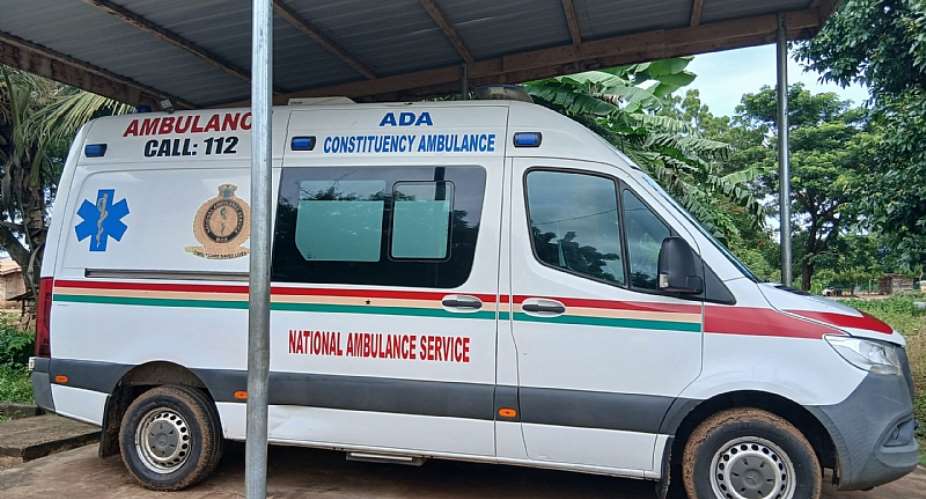
It takes less than four minutes for a blocked airway to turn a survivable accident into a fatality. It takes even less time for cardiac arrest to become permanent brain damage. Yet across Ghana, the people most likely to be standing beside a collapsed pedestrian, a choking child, or a crash victim in the critical first minutes are, overwhelmingly, ordinary citizens with no training in what to do.
Ghana's road crash statistics have gone from worrying to alarming. The National Road Safety Authority recorded 2,949 road crash deaths in 2025 alone the highest toll in 35 years, a rise of over 18% from the previous year, with nearly 15,000 crashes and tens of thousands of injuries reported nationwide. Many of these victims do not die on impact. They die in the gap between the crash and the arrival of professional help, a gap that, in many parts of Ghana, can stretch from many minutes to over an hour.
A Preventable Tragedy, Repeated Daily
This crisis is not confined to road accidents, and it does not discriminate by age or profession. On June 17, 2026, Ghanaians were celebrating the Black Stars' opening World Cup win over Panama when a young lawyer, recently called to the Ghana Bar, collapsed during the jubilation at a private hostel near KNUST in Kumasi. By the time she reached the hospital, doctors could only perform CPR for around 45 minutes before she was pronounced dead. She was 26. Her death has been widely reported as sudden cardiac arrest the kind of event where survival often hinges not on what happens at the hospital, but on what happens in the very first minutes, wherever the person collapses. Had someone among the friends and patrons around her that night known how to recognise cardiac arrest and start chest compressions immediately, rather than waiting for transport to a hospital, her chances of survival could have been meaningfully different. This is exactly the gap a national first aid curriculum is designed to close: putting basic, life-saving knowledge in the hands of ordinary people who are statistically far more likely to be present at the moment someone collapses than any paramedic or doctor.
Drowning, falls, burns, road injuries, and choking are leading causes of death and disability among Ghanaian children and adults and most of these emergencies are survivable if the first responder, often a bystander, a teacher, or a family member, knows basic first aid. International evidence consistently shows that immediate, correctly applied first aid and CPR by bystanders dramatically improves survival and reduces long-term disability. Countries that have embedded first aid training into basic and secondary education like Rwanda, the UK, much of Scandinavia, and increasingly several Anglophone African nations have seen measurable gains in bystander response and survival outcomes.
The Ghana Education Service and the National Council for Curriculum and Assessment have, in recent years, pushed reforms around inclusion, STEM, and competency-based learning. Physical Education already exists as a subject in primary schools. What is missing is a deliberate, standardised module on first aid and basic life support, one that does not depend on the goodwill of an individual school, a visiting NGO, or a parent who happens to be a health professional.
What I See in the Clinic
I do not say this from theory alone. As a Principal Physiotherapist in a government health facility, I have managed countless road traffic accident victims long after the crash itself and a pattern that troubles me deeply is how often the injury we are treating was made worse not by the accident, but by the rescue.
I have seen patients arrive with spinal injuries aggravated because they were dragged out of a vehicle by the arms instead of being supported along the length of the body. I have seen fractured limbs twisted further out of alignment because well-meaning bystanders lifted a victim by the injured leg or arm to "help them up." I have treated patients whose neck injuries went from manageable to life-altering because no one thought to stabilise the head and spine before moving them, or because they were bundled into the back of a taxi or pickup, folded at the waist, for transport to hospital. None of this happens out of malice. It happens because the people on the scene, often the only people on the scene genuinely want to help, and have never been taught how.
This is the part of the crisis that statistics alone do not capture. A crash that should have resulted in a fracture instead leaves someone with permanent paralysis. An injury that physiotherapy could have fully resolved instead becomes a lifelong disability, simply because of how the first twenty minutes were handled. As clinicians, we spend months rehabilitating damage that, with the right first aid knowledge at the scene, may never have happened in the first place.
This is precisely why first aid education cannot remain optional or informal. It is not enough for Ghanaians to simply want to help in an emergency, they need to know how, because right now, untrained "rescue" is quietly doing as much harm as the original incident.
Why the Curriculum Is the Right Lever
As a physiotherapist with postgraduate training in both health education and public health, I have seen first aid treated in Ghana as a specialist skill reserved for nurses, paramedics, and the armed forces rather than a basic life competency every literate adult should leave school with, the same way we expect every student to know how to read a thermometer or cross a road safely. This framing is the core of the problem.
Embedding first aid and basic resuscitation in the Ghanaian curriculum from junior high school through senior high school would mean that:
- Every graduating student understands how to manage choking, bleeding, burns, fractures, and unconsciousness before professional help arrives.
- A generation of teachers, prefects, and eventually parents and employers become a distributed, low-cost emergency response network, complementing Ghana's stretched ambulance and emergency services.
- The cost of training is absorbed into existing school structures (Physical Education, Integrated Science, or a dedicated Health and Life Skills module), rather than requiring new infrastructure.
- Ghana builds toward the World Health Organization's recommendation that bystander first aid and CPR training be normalised at population scale, not left to chance.
This does not require turning every student into a paramedic. A practical, age-appropriate syllabus covering scene safety, the recovery position, choking relief (the Heimlich manoeuvre), bleeding control, burns, and basic CPR can be taught in a few structured hours per academic year, using low-cost manikins, peer demonstration, and partnerships with the Ghana Health Service, National Ambulance Service, Ghana Red Cross Society, all of whom already run training programmes but lack a guaranteed, nationwide platform to reach every child.
A Call to Policymakers
The Ministry of Education and the National Council for Curriculum and Assessment have an opportunity to act before the next set of road safety or public health statistics is released. I urge the Ministry of Education, GES, NaCCA, the Ghana Health Service, and the National Ambulance Service to consider a pilot first aid and basic life support module integrated into Physical Education or Integrated Science at the basic and senior high school levels, developed in partnership with health professionals and existing humanitarian training bodies already active in Ghana.
We cannot keep treating emergency preparedness as an afterthought in a country where road deaths are rising year on year and where most health facilities themselves are not equipped to respond. The classroom is the most scalable, most cost-effective place to close that gap and it is long overdue that we use it.
By Jeffrey William Quainoo, Physiotherapist, MA (Health Education), MPH

 ‘We will invoke our unforgiving gods to deal with you’ – Atronie chiefs warn gal...
 272 Ghanaians lured into Russia-Ukraine war, 55 killed – Foreign Minister announ...
 Importers demand action against shipping lines for defying GH¢720 container fee ...
 'Wontumi went overboard, forgive and grant him clemency' — Spokesperson begs Mah...
 Transport unions, Transport Ministry to meet over proposed 30% fare hike
 Ghana probes reported recruitment of nationals into Russia-Ukraine war
 'IMF exit a result of collective efforts, not single event' — Egyapa Mercer
 Minerals Commission orders Earl Group, Small-Scale Miner to halt operations in G...
 GMet forecasts fog, cloudy weather, morning mist and afternoon thunderstorms acr...
 IMF approves final review of $3bn bailout as Ghana completes programme


Comments
nice piece. thats the way to go. it will go a long way to improve health litracy in thecountry