




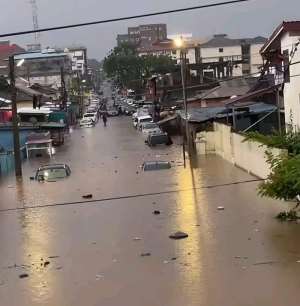
On 29 June 2026, Accra recorded 169.2 millimetres of rain in a single day, the fourth heaviest since 1995, closing out a month that at 593.2 millimetres became the wettest in Ghana’s meteorological history. By the time the water withdrew, 34 people were dead and 89,736 had been displaced across seven regions, 54,712 of them in Greater Accra alone. The Ministry of Finance moved quickly, crediting GH¢350 million from the Contingency Fund into a dedicated National Disaster Management Committee account: GH¢200 million for humanitarian relief, GH¢150 million for drainage, engineering, and demolition. It was a serious response to a serious emergency. It also contained no published allocation for the psychological consequences of putting ninety thousand people out of their homes.
That omission is not an oversight peculiar to this flood. It is the pattern.
The mental health cost of flooding in Ghana is not a speculative concern imported from European literature. It has been measured here, on Ghanaian households, by Ghanaian researchers. A study of 767 flood-prone household heads used the Kessler Psychological Distress Scale to establish that exposure to flood-related events raises the risk of psychological distress, and found the effect more pronounced among men and among younger adults. Photovoice work in Old Fadama has documented residents describing themselves as stressed, anxious, and sick from repeated inundation. What the June floods delivered was not an unforeseeable shock but a well-characterised exposure, at scale, to a population already understood to be vulnerable to it.
The professional response was immediate and almost entirely unfunded. The Ghana Psychological Association issued a statement on 1 July warning that survivors would face shock, grief, anxiety, and sleep disturbance, opened a helpline on 0553470086 staffed by volunteers offering psychological first aid to affected families and to emergency responders, and asked employers across Accra to relax lateness policies and permit remote work while roads remained impassable. The Mental Health Authority offered trauma therapy. Both organisations did precisely what they should have done. Both did it on goodwill, outside any budget line, and largely outside the government’s own emergency architecture.
We have run this exercise before. When the Akosombo and Kpong dam spillage flooded the Lower Volta in October 2023, the Mental Health Authority deployed clinical psychologists and psychiatrists into displacement camps to provide crisis and trauma therapy. It worked. It was also improvised, and nothing about it was converted into standing capacity, which is why in July 2026 a professional association is once again publishing a mobile number and hoping displaced people find it.
The reason improvisation keeps recurring is structural, and it sits in a law that has been on the books for fourteen years. The Mental Health Act, 2012 (Act 846) created a Mental Health Fund and left the levy that would capitalise it to be specified by a Legislative Instrument that has still not been passed. The Authority has been reduced to lobbying for a share of the COVID-19 levy instead. Without a standing fund, there is no pot from which a psychosocial component of disaster response can be drawn, and so each disaster restarts the argument from zero while the water is still in people’s living rooms.
Ghana has, meanwhile, made real progress on financing that the flood response has not yet caught up with. Since 1 November 2024, the National Health Insurance Scheme has covered depression, bipolar disorder, anxiety disorder, and schizophrenia, funding outpatient care and initial acute hospitalisation at accredited facilities, with treatment remaining free at Accra Psychiatric, Ankaful, and Pantang. That is a genuine shift. It is also a shift that assumes a person who knows they need help, knows the benefit exists, and can physically reach an accredited facility. A family living in a classroom in Ashaiman three weeks after losing everything satisfies none of those conditions, and all three of the specialist hospitals are in the south of a country whose psychiatrist count sits somewhere near thirty-nine.
The obvious objection is one of sequencing: people need food, shelter, and medicine before they need counselling, and a state with finite money should buy the mattresses first. That objection is right about the order and wrong about the trade-off. Psychological first aid is not psychotherapy. It is a structured, evidence-backed set of practices that a relief worker can be trained to deliver in a day, at the point of distribution, alongside the mattress. It costs a fraction of what untreated distress costs when it consolidates into chronic depression, substance use, and lost livelihood, and it is precisely the intervention that gets skipped when nobody has been given a budget or a mandate to deliver it.
So the asks are narrow and cheap. NADMO and the Mental Health Authority should ring-fence a named percentage of the GH¢200 million humanitarian tranche for psychosocial support and publish the figure, so that it can be audited rather than assumed. Every relief distribution team should be trained in WHO psychological first aid before deployment, which is a one-day investment against a response that will run for months. The GPA helpline number should be printed on relief materials and carried in NADMO’s public messaging rather than left to circulate on social media. NADMO should sign a standing memorandum with the Mental Health Authority and the Ghana Psychological Association so that clinical deployment is triggered automatically by a declared emergency instead of negotiated during one. Employers in Greater Accra should adopt the GPA’s flexible-work recommendations outright. And Parliament should finally pass the Legislative Instrument specifying the Act 846 levy, because a fund that exists only in statute cannot be drawn on when the rain comes.
Ghana can now dredge a drain within weeks of a flood and move hundreds of millions of cedis within days. That is a state that has learned something about emergencies. The next thing it needs to learn is that a house can be rebuilt on a budget line and a person cannot be rebuilt on a volunteer’s phone.
By Noah Boakye-Yiadom | [email protected]
The writer is a Ghanaian-Canadian mental health promotion researcher with the University of Calgary.


 How IGP Yohuno led Police team to rescue victim, arrest four kidnappers in Assin...
 Akufo-Addo would have used Accra-Kumasi expressway for galamsey – Mahdi Gibrill
 Nigeria's Dangote refinery launches continent's biggest IPO
 Accra-Kumasi Expressway to cut travel time to 2hours, drive 120km per hour — Mah...
 'Our own money $2billion ready, we have not gone to borrow money from anywhere' ...
 Founder’s Day September 21 declared public holiday
 Council of State was not qualified to determine prima facie case against Torkorn...
 'Grounds for removal of Chief Justice and justice of superior court shallow, eph...
 Don't be a Bar that flips on principles but a Bar that is consistent — AG tells ...
 Prostate cancer may show no symptoms until advanced stage – Urologist warns



Comments
Good one. Another good article. Congratulations. Although the Ghana government through NADMO, and other agencies are doing well by providing the physical needs of the flood victims, I agree with you that very little has been done about their mental well-being. They need psychologists and other professionals to speak to. This is where Pastors, churches and faith organizations as Psalm 46:1 tells us "God is our refuge and strength, a very present help in trouble" comes in to help. The...