




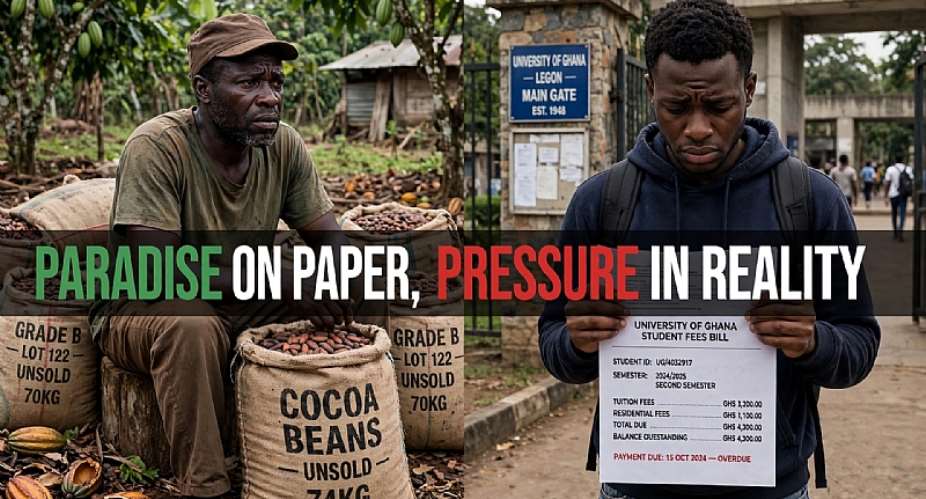
There are two Ghanas being described right now.
In one Ghana, according to some bloggers, journalists and civil society voices, we are in paradise. The economy is “turning around.” Policies are “working.” The future is “bright.”
In the other Ghana, the one where most people wake up every morning, the picture is different. Utility bills have gone up. Cocoa prices have come down. School fees have shot up. Farm produce is rotting because there are no buyers. Salaries have stayed flat while rent and transport keep climbing.
The question is simple: Which Ghana are we living in?
*THE BILLS THAT WON’T WAIT*
Start with the basics. Electricity and water tariffs were hiked this year. For a civil servant earning the same salary as last year, that hike didn’t come with extra income. It came with tough choices.
Do you pay ECG first, or buy food? Do you top up water, or pay for your child’s transport to school?
Across Accra, Kumasi, Tamale and the smaller towns, the conversation in homes is the same: _“Things are hard.” Not because people don’t want to work. But because the cost of staying alive has outpaced the money coming in.
COCOA: THE PRICE CUT THAT HIT THE FARM
Then there’s cocoa. Ghana’s golden crop. This season, the producer price was drastically reduced. For the farmer in Sefwi, Dunkwa, or Goaso, that reduction was not a statistic. It was school fees that won’t be paid. It was roofing sheets that won’t be bought. It was medicine that will be postponed.
And to make it worse, many farmers say there are no buyers even at the reduced price. So produce sits. Children are sent home for fees. Utility bills pile up.
Cocoa is not just an export commodity. It is how thousands of Ghanaian families survive from one term to the next. When that chain breaks, the pain moves straight into the classroom and the kitchen.
SCHOOL FEES AND THE DREAM ON CREDIT
At the same time, academic user fees in tertiary institutions have shot higher. For parents already struggling with rent and transport, this is another blow.
A university admission letter should be a moment of pride. Now for many families, it’s a moment of panic. “How do we find this money?”
Some students are deferring. Others are dropping out. The promise that education is the way out is being tested by the reality that education itself has become unaffordable.
STAGNANT PAY, RISING COSTS
Civil servants have not seen significant salary adjustments, yet rent in most urban areas has gone up. Transport fares have gone up, again. A trotro ride that was 5 cedis last year is 7 cedis today. To make things worse for the poor civil servant, the trotro driver and his conductor charge unapproved fees as the state sits aloof. Food at the market is not the same price it was 6 months ago.
Economists will talk about inflation and global factors. But in the market, nobody is buying economics. They are buying tomatoes, kenkey, and fuel. And those prices are telling a story that is hard to ignore.
WHY THE “PARADISE” NARRATIVE HURTS
This is where the frustration sets in.
While citizens are juggling bills, some journalists, bloggers and CSOs are on TV and social media calling Ghana “paradise.” They point to macro numbers, to projects, to promises.
There is nothing wrong with celebrating progress. But when praise becomes a blanket that covers real pain, it stops being journalism. It becomes PR.
People are not angry that someone is optimistic. They are angry that their reality is being denied. A farmer who cannot sell cocoa does not feel like he’s in paradise. A mother who cannot pay both light bill and school fees does not feel like she’s in paradise. A graduate with a degree and no job does not feel like he’s in paradise. A civil servant whose wages cannot take him through the month does not feel like he is in paradise.
THE VOTE WILL SETTLE IT
Ghanaians are not naive. They can tell the difference between data and experience. They can tell the difference between a press release and a market price.
Come election time, people will not vote based on what a paid blogger wrote, or what a TV panel said. They will vote based on what their wallet felt. Based on whether their child stayed in school. Based on whether their farm made money. Based on whether they could pay rent and still have something left.
That is how democracy works. The ballot is where lived experience speaks louder than any headline.
THE ROAD AHEAD
Ghana is not a failed state. We have resilience, we have resources, and we have people who still believe in this country. But belief must be met with relief.
Government, opposition, civil society and the media all have a role. The role is not to paint paradise or hell. The role is to tell the truth, and then fix what is broken.
Lower the pressure on households. Find buyers for farmers. Make tertiary education affordable. Adjust salaries to match the cost of living. And let the media reflect the country as it is, not just as some wish it to be.
Because at the end of the day, Ghanaians will not vote on slogans.
We will vote on school fees.
We will vote on light bills.
We will vote on cocoa prices.
We will vote on what is real.
And that reality, right now, feels a long way from paradise.
NOTE: This article does not seek o criticise the government; It is intended to communicate the exact reality of the voiceless poor Ghanaian tax payer whose hellish life is being painted as paradise.


 ‘We will invoke our unforgiving gods to deal with you’ – Atronie chiefs warn gal...
 272 Ghanaians lured into Russia-Ukraine war, 55 killed – Foreign Minister announ...
 Importers demand action against shipping lines for defying GH¢720 container fee ...
 'Wontumi went overboard, forgive and grant him clemency' — Spokesperson begs Mah...
 Transport unions, Transport Ministry to meet over proposed 30% fare hike
 Ghana probes reported recruitment of nationals into Russia-Ukraine war
 'IMF exit a result of collective efforts, not single event' — Egyapa Mercer
 Minerals Commission orders Earl Group, Small-Scale Miner to halt operations in G...
 GMet forecasts fog, cloudy weather, morning mist and afternoon thunderstorms acr...
 IMF approves final review of $3bn bailout as Ghana completes programme

