




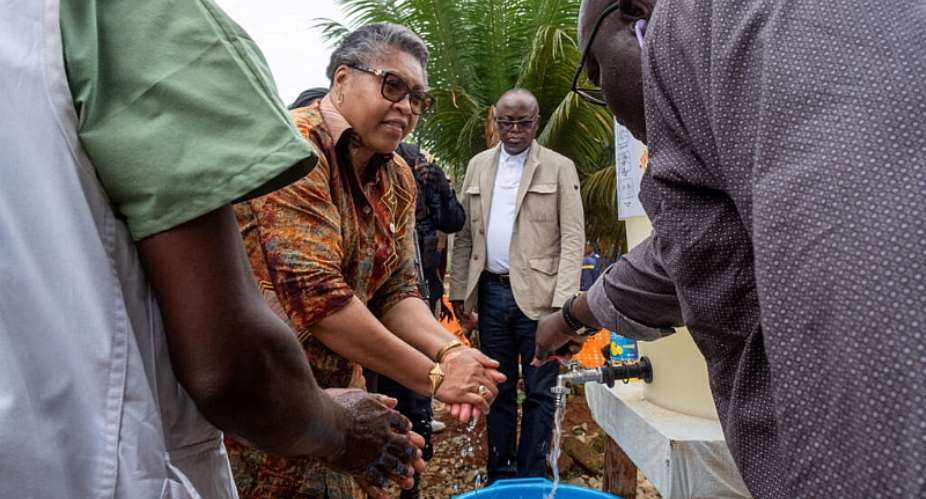
Medics have recorded more than 3,200 Ebola cases, including over 1,400 deaths, in the Democratic Republic of Congo's 17th outbreak, officials said on Sunday, after infections surged by around 1,000 in just 10 days.
The central African nation is battling its latest Ebola epidemic in the conflict-ridden east, a region scarred by decades of violence.
Cases have now been confirmed across five provinces, official figures showed, after the outbreak passed the 2,000-case mark on 15 July.
Authorities said improved detection and testing had helped identify more infections.
DRC's Ebola outbreak kills more than 1,000, with children hit hardest
The outbreak, declared on 15 May, is caused by the Bundibugyo strain of the Ebola virus, for which there is no approved vaccine or treatment.
Nearly 90 per cent of cases have been reported in the north-eastern province of Ituri, which borders South Sudan and Uganda, according to the World Health Organization (WHO).
The outbreak could last several more months, while strikes by healthcare workers demanding unpaid wages have disrupted response efforts in some hospitals.
More health workers strike as Ebola cases in Congo near 3,000, including over 1,300 deaths
Ebola spreads through contact with bodily fluids and causes haemorrhagic fever. It has killed more than 15,000 people across Africa over the past 50 years.
Scientists are racing to develop vaccines and treatments against the Bundibugyo strain. Oxford University said on Friday that the first volunteer group had received an experimental vaccine specifically targeting the virus.
Dr David Pulido-Gomez, Global Chemistry, Manufacturing and Controls (CMC) lead, Pandemic Sciences Institute, Nuffield Department of Medicine, said that "reaching this milestone in such a short timeframe reflects an extraordinary collaborative effort. Working alongside colleagues at the CBF and SII, we've taken this vaccine candidate from concept to clinic in just eight weeks."
Several other candidate vaccines are being fast-tracked for clinical trials, while two potential treatments are also under development.
The WHO's emergencies chief said on 15 July that the true number of cases could be up to four times the official tally in the DRC.
A report published by Oxford, Flowminder, the Africa CDC and other research centres highlighted last week that, among the ten health zones at greatest risk for the following two weeks, eight are located in Ituri, which thus remains the epicentre of the epidemic, namely Rethy, Mahagi, Jiba, Biringi, Linga, Nyarambe and Angumu.
Also included in the list are Lubero, in North Kivu, as well as Watsa and Gombari in Haut-Uélé.
(with newswires)


 Two sustain gun wounds in Mankrong Nkwanta robbery
 Military personnel deployed to Bawku vehicle crashed STC bus at Nkenkesu
 Bohyen chief appeals for fire station to improve emergency response
 Father jailed 20 years for incest with 17-year-old daughter
 Court jails man 10 years for defiling seven-year-old boy
 'Africa remains rich in promise; our task is to ensure that promise matures into...
 Justin Kodua Launches Bid to Retain NPP General Secretary Post Ahead of Crucial ...
 Zanetor Demands Continental Action: ‘Africa Cannot Progress While Women Live in ...
 Mahama assures transfer of UGMC to University of Ghana
 Wontumi told me he would get 20year jail term before judgment was read – Lawyer ...

