




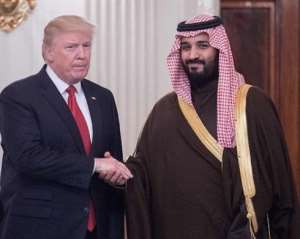
Less than 24 hours after his own Energy Department signed a landmark civilian nuclear cooperation agreement with Saudi Arabia, US President Donald Trump upended it. In a Truth Social post on Thursday, Trump wrote that the deal already signed by Energy Secretary Chris Wright and Saudi Energy Minister Prince Abdulaziz bin Salman "will be approved," but only on condition that Riyadh joins "the very respected and successful Abraham Accords."
The reversal blindsided not just the Saudis, for whom the nuclear pact had been a genuine diplomatic win, but reportedly the White House's own nuclear negotiating team, who were caught off guard by the new demand.
A Deal Unraveling in Real Time
The optics could hardly have been more awkward. On Wednesday, officials gathered at the Energy Department's Washington headquarters American and Saudi flags on stage, Prince Abdulaziz beamed in live from Riyadh to formalize an arrangement more than two decades in the making.
The agreement reportedly gives US firms priority access to build Saudi Arabia's nuclear reactors and supply fuel, and unusually for a US nuclear cooperation pact could eventually permit the kingdom to enrich its own uranium domestically, subject to a joint US-Saudi review of whether enrichment is warranted and commercially viable.
Saudi Arabia is also notably not required to sign the International Atomic Energy Agency's Additional Protocol, the stricter inspection regime the UAE accepted under its own 2009 "gold standard" nuclear deal with Washington.
By Thursday morning, Trump had attached a precondition that hadn't featured in the Wednesday signing at all: normalization with Israel. White House Press Secretary Karoline Leavitt confirmed Trump likely hadn't spoken directly with Crown Prince Mohammed bin Salman since the post went up, but maintained that without Abraham Accords membership, "the deal is off."
Israeli Prime Minister Benjamin Netanyahu, for his part, welcomed the condition, calling Saudi accession to the Accords "an historic leap forward for peace in the Middle East," though notably without commenting on the nuclear deal itself.
Riyadh has not responded publicly.
So What Are the Abraham Accords?
For readers unfamiliar with the term, the Abraham Accords are a set of US-brokered agreements, first signed in September 2020 during Trump's first term that normalized diplomatic relations between Israel and a handful of Arab and Muslim-majority states.
The name deliberately invokes Abraham as a shared patriarchal figure across Judaism, Christianity, and Islam, framing the accords as an expression of common heritage rather than a narrow political bargain.
The original signatories were the United Arab Emirates and Bahrain, both formalizing ties with Israel on September 15, 2020, followed by Morocco that December. Sudan agreed in principle around the same time but has never completed a formal bilateral agreement, owing to the country's ongoing internal turmoil. Kazakhstan acceded in November 2025, though it had maintained normal diplomatic relations with Israel since the 1990s, making its accession more symbolic than substantive.
Structurally, the Accords are not a single multilateral treaty but a general declaration paired with separate bilateral agreements between Israel and each participating state, covering diplomatic recognition alongside expanded cooperation in trade, technology, energy, and security.
Crucially, and this is the point critics return to again and again, the Accords were built on an "outside-in" logic: normalizing ties between Israel and states not directly party to the Israeli-Palestinian conflict, while sidestepping the Palestinian statehood question that earlier peace efforts had treated as a prerequisite.
That is precisely why Saudi Arabia has held out. Riyadh has long insisted it will not normalize relations with Israel absent a credible pathway to Palestinian statehood a position that has not changed despite years of periodic reports that a Saudi-Israeli normalization deal was imminent.
Why This Matters Beyond Washington and Riyadh
The whiplash here is notable because, as recently as earlier this year, US officials reportedly told Reuters that Washington had delinked the civil nuclear talks from any Israel-normalization requirement altogether, dropping what had been a Biden-era condition tying nuclear cooperation to a broader normalization-and-defence-treaty package.
That the condition has now resurfaced, attached retroactively to an already-signed deal, suggests either a genuine shift in strategy or, as some reporting suggests, an improvised move that outran the administration's own negotiating apparatus.
For Saudi Arabia, the stakes are considerable: a civilian nuclear programme with eventual domestic enrichment capability would be a major strategic and prestige asset, particularly against the backdrop of Iran's own nuclear ambitions.
For the wider Abraham Accords project, a Saudi accession would be its most consequential expansion yet the kingdom is the Arab world's largest economy and home to Islam's two holiest sites, giving any normalization with Israel a symbolic weight the UAE, Bahrain, and Morocco agreements never carried.
Whether Trump's gambit forces Riyadh's hand or simply kills a two-decades-in-the-making nuclear agreement is, for now, an open question one that will likely be answered less by Truth Social posts than by what Congress, which must still approve the underlying nuclear pact, ultimately does with it.
Mustapha Bature Sallama.
Medical/ Science Communicator,
Private Investigator, Criminal investigation and Intelligence Analysis.
International Conflict Management and Peace Building.USIP
[email protected]
+233-555-275-880
Sources
"Trump places new condition on signed Saudi nuclear deal, says country must join Abraham Accords," CNN Politics: https://www.cnn.com/2026/07/23/politics/saudi-arabia-nuclear-deal-trump
"How Trump upended the Saudi nuclear deal less than 24 hours after its signing," CNN Politics: https://www.cnn.com/2026/07/23/politics/saudi-nuclear-deal-trump-conservatives
"Trump says Saudi Arabia's nuclear deal hinges on the kingdom normalizing Israel ties," NPR: https://www.npr.org/2026/07/23/nx-s1-5904327/us-saudi-arabia-iran
"Trump says Saudi nuclear pact hinges on kingdom joining Abraham Accords," Al Jazeera: https://www.aljazeera.com/news/2026/7/23/trump-says-saudi-nuclear-pact-hinges-on-kingdom-joining-abraham-accords
"Trump adds condition to Saudi nuclear deal: Normalizing relations with Israel," The Washington Post: https://www.washingtonpost.com/politics/2026/07/23/trump-adds-condition-nuclear-deal-with-saudi-arabia-throwing-pact-into-doubt/
"Exclusive-Under Trump, Saudi civil nuclear talks delinked from Israel recognition, sources say," Reuters via AOL: https://www.aol.com/news/exclusive-under-trump-saudi-civil-153354113.html
"The Abraham Accords," Middle East Institute backgrounder: https://mei.edu/backgrounder/abraham-accords/
"Abraham Accords," Encyclopaedia Britannica: https://www.britannica.com/topic/Abraham-Accords
"Kazakhstan joining Abraham Accords, US official confirms," Fox News: https://www.foxnews.com/world/kazakhstan-joining-abraham-accords-us-official-confirms


 'Some NPP members did not vote in 2024 election because I left NPP' – Alan Kyere...
 How €225 million cocaine from Ghana traced to fugitive Dutch drug kingpin based ...
 'Galamsey remains an existential threat' – Gyampo demands more action
 'I’m like Akpeteshie, I don’t need adverts to win' – Hawa Koomson storms home tu...
 'Excessive bail conditions must be reviewed' – GBA President
 Ketu South: Four-year water crisis deepens hardship in Agbozume
 Show evidence of higher operating costs to justify fare hike – NPA CEO to transp...
 Four Ghanaians arraigned over alleged €225 million cocaine shipment to France
 Agbogbloshie: Police kill suspected robber, recover AK-47, 186 rounds of ammunit...
 DVLA opens 29 new offices in 18 months; 62 offices nationwide - CEO


