




Warrant Officer Class One (Rtd.) Nana Akwah
"Freedom without discipline descends into chaos; discipline without freedom descends into tyranny. Between them stands the rule of law."
Every manuscript bears the imprint of the life that produced it. This reflection is no exception.
What follows is not a legal textbook, nor is it a judicial opinion. It is my personal observation and perspective, shaped by a lifetime of military service, leadership, citizenship, and quiet contemplation. It draws upon the Constitution of the Republic of Ghana, statutory law, judicial decisions, historical experience, and contemporary public debate. Yet the conclusions I reach are my own, formed not only through study but through experience.
For more than three decades, I served in an institution where discipline was not merely taught—it was lived. I learned that genuine authority is inseparable from responsibility, that restraint is often the highest expression of strength, and that order imposed without justice ultimately destroys itself. Those lessons did not end when I laid aside my uniform. They followed me into civilian life, shaping the way I understand leadership, citizenship, and constitutional government.
It is from that perspective that I write.
I do not claim to possess the final interpretation of the law. That responsibility belongs to the courts established under the Constitution. Neither do I suggest that my reflections are beyond challenge. In a healthy democracy, thoughtful disagreement is not a weakness but a virtue. It is through respectful debate that truth is refined and constitutional principles are strengthened.
Yet one question has remained with me throughout the years, a question that every democratic society must answer for itself.
Where is the bar set?
Who determines when speech remains the rightful exercise of constitutional liberty, and when it becomes conduct that threatens the peace of society?
Among all the liberties enjoyed by free people, few are as precious as the freedom of speech and expression. Through words, citizens challenge injustice, question authority, defend the vulnerable, and contribute to the life of the Republic. Through words, societies remember their past, debate their present, and shape their future. A nation whose people are afraid to speak is a nation whose democracy has already begun to lose its soul.
The Constitution of the Republic of Ghana recognizes this truth by guaranteeing freedom of expression under Article 21(1)(a). This liberty is not a favour bestowed by the government but a constitutional right belonging to every citizen. It reminds those who govern that sovereignty ultimately resides in the people and that public office carries with it the duty to answer criticism rather than suppress it.
Yet speech is also capable of wounding, dividing, provoking, and destroying. The same tongue that proclaims justice can incite violence. The same freedom that protects dissent can, if exercised without restraint, endanger the peace upon which every liberty ultimately depends.
Every enduring civilization has therefore understood that liberty and responsibility are inseparable companions. Freedom without responsibility descends into disorder. Authority without restraint descends into tyranny. Between these two dangers stands the rule of law.
It is my observation that the constitutional boundary should never be determined by the emotions of those who are offended, by the discretion of those who enforce the law, or by the convenience of those who temporarily hold political power. Governments change. Public passions rise and fall. Constitutional principles must endure.
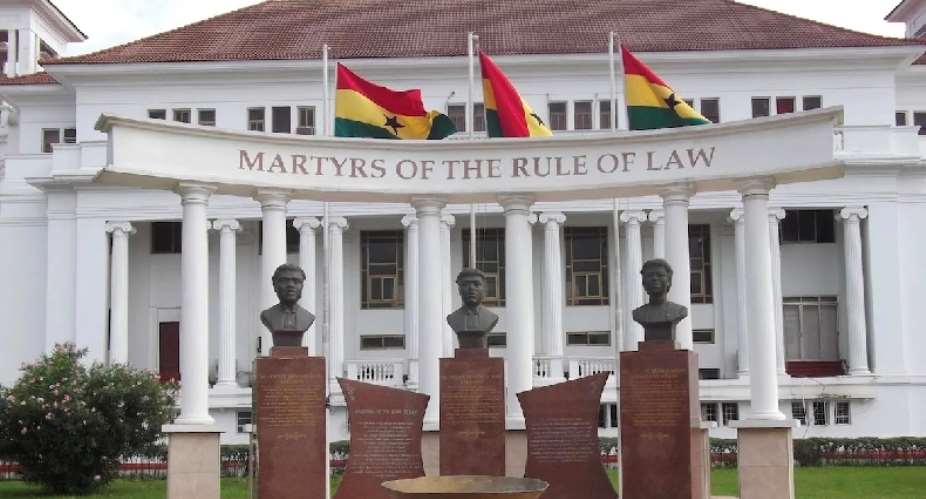
In my view, that boundary must ultimately be guarded by an independent judiciary, faithfully interpreting and applying the Constitution and the laws of the Republic. The courts alone are entrusted with weighing liberty against public order, individual rights against the peace of the community, and constitutional freedom against legal responsibility.
History reminds us why this responsibility is so important. Ghana inherited legal traditions shaped during the colonial era, when sedition and criminal libel laws were frequently employed to silence criticism of authority. Although the repeal of the Criminal and Seditious Libel Laws in 2001 marked a significant democratic milestone, debates surrounding Sections 207 and 208 of the Criminal Offences Act continue to remind us that every generation must remain vigilant. Laws intended to preserve public order must never become instruments for suppressing legitimate dissent, just as freedom must never become a licence for conduct that genuinely threatens the peace of society.
My understanding of this delicate balance has been shaped not only by constitutional study but also by military service. The parade square became my first classroom in the relationship between liberty and order. Within the armed forces, discipline was never the enemy of freedom. It was its guardian. A disciplined soldier learns that strength is measured not by the absence of restraint but by the wisdom to exercise it. Courage without discipline endangers comrades. Authority without accountability weakens command. Obedience without judgment diminishes leadership.
The Regimental Sergeant Major embodies this principle. His responsibility is not simply to enforce discipline but to preserve standards with fairness, consistency, and integrity. His authority is respected because it is exercised impartially and in accordance with established rules rather than personal preference. The purpose of discipline is never humiliation; it is the preservation of the unit.
I have come to see the judiciary in much the same light. Just as the Regimental Sergeant Major safeguards discipline within the regiment, the judiciary safeguards constitutional order within the Republic. Neither exists to dominate. Both exist to hold the line. One preserves the discipline of the armed forces; the other preserves the discipline of constitutional government.
The greatest lesson my years in uniform taught me is that enduring freedom is never preserved by the absence of discipline. It is preserved by discipline governed by justice. A disciplined army protects the territorial integrity of the nation. An independent judiciary protects its constitutional integrity. One secures the nation's borders; the other secures the boundaries of liberty itself.
This is why I remain persuaded that the constitutional bar should never be set by public passion, political convenience, or executive discretion. It should be held by the rule of law, faithfully administered by an independent judiciary acting without fear or favour.
This article is offered not as the final word, but as one citizen's reflection upon an enduring constitutional question. It is my observation, my perspective, and the product of a lifetime spent learning that true authority is inseparable from restraint, that genuine freedom flourishes only where responsibility is embraced, and that justice remains the surest guardian of both liberty and peace.
For freedom is among democracy's greatest treasures.
Peace is among society's greatest responsibilities.
And justice must forever hold the line between them.

 Ghana Armed Forces to hold land combat firepower demonstration at Bundase on Oct...
 Gambia to pay victims of Yahya Jammeh’s rule from proceeds of his seized US mans...
 Kolgo Paramount Chief questions 24-hour economy market without security
 'ABFA utilisation data excluded from PIAC's report not withholding of informatio...
 Obuasi SHTS sex scandal: Manasseh never said headmaster is a rapist - Brako-Powe...
 Government targets GH¢15.38bn domestic financing in Q4 to support 2027 bond buyb...
 Obuasi SHTS sex scandal: GES to ban teachers from inviting students to bungalows...
 Adwoa Safo to contest Dome-Kwabenya parliamentary seat again
 UG directs students with CGPA below 1.00 to go home
 Uganda Revenue Authority delegation visits TOR to understudy Ghana’s oil refinin...


