




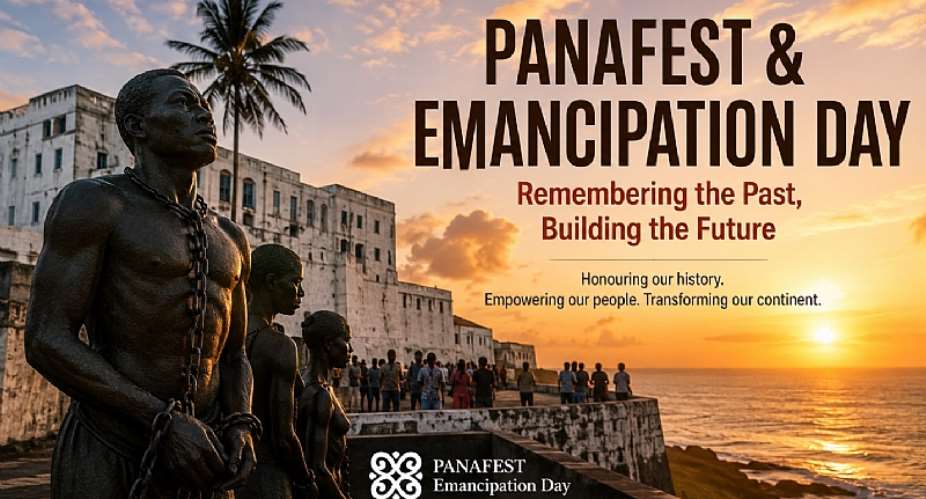
Nearly three decades after the launch of the Pan-African Historical Theatre Festival (PANAFEST) and many years of commemorating Emancipation Day, Ghana stands at a crossroad as We celebrate yet another PANAFEST and Emancipation days from the 23rd July to 1st August 2026. These celebrations have undoubtedly contributed to preserving the memory of the transatlantic slave trade, reconnecting Africans in the diaspora with the continent, and positioning Ghana as a spiritual home for people of African descent. They have also reinforced Ghana's image as the Gateway to Africa and inspired important initiatives such as the "Year of Return" and "Beyond the Return." Yet, as the world changes rapidly, an important question deserves honest reflection:
Are PANAFEST and Emancipation Day still achieving their intended objectives, or have they become largely ceremonial events that require a new vision?
I believe the time has come - not to abandon these historic celebrations, but to fundamentally rethink and reposition them for the twenty-first century.
The Original Vision Was Noble
PANAFEST was conceived as more than a cultural festival. It was intended to promote Pan-Africanism, healing, reconciliation, historical education, cultural exchange, and investment between Africa and its diaspora.
Emancipation Day similarly serves as a solemn reminder of the abolition of slavery and honours millions of Africans who suffered one of humanity's greatest tragedies.
These objectives remain relevant. However, the context in which these festivals were created has changed dramatically. Today's Africa faces different challenges, youth unemployment, climate change, digital transformation, migration and Artificial Intelligence as well as investment deficits and skills development. These issues now define Africa's future just as much as remembering its painful past.
Have We Become Too Focused on the Past?
Every year, thousands gather at Cape Coast and Elmina Castles and now Tamale to remember slavery. Emotional ceremonies, candlelight vigils and symbolic processions continue to dominate the programme. These ceremonies remain necessary but remembrance alone cannot build Africa's future. Many young GhanaiansAfricans attending these events leave inspired emotionally but without opportunities to contribute meaningfully to Ghana/Africa's development. The descendants of enslaved Africans increasingly seek more than historical reconnection. They are asking practical questions like: How can we invest in Africa, establish businesses, get our children study here, transfer technology and create jobs? Unfortunately, PANAFEST has not evolved sufficiently to answer these questions.
The World Has Changed
When PANAFEST began in 1992, globalisation was still emerging. Today, the global African community is interconnected through digital technology. Diaspora engagement has become more sophisticated. Countries now compete for investment, talent, innovation and influence. Many African nations have equally developed creative industries, innovation hubs and international cultural diplomacy programmes that connect heritage with economic development. Meanwhile, PANAFEST largely remains organised around conferences, durbars, cultural performances and memorial activities. These are valuable, but they are no longer enough.
Heritage Must Create Prosperity
One of the biggest weaknesses of PANAFEST is that its economic impact remains limited. Imagine if the festival also became: Africa's largest diaspora investment forum, a Pan-African innovation summit, a youth entrepreneurship convention a creative industries marketplace a tourism investment expo, a heritage technology exhibition, a diaspora property and investment fair an African university collaboration platform.
Such additions would transform remembrance into economic empowerment. Instead of visitors simply attending ceremonies, they would leave having signed business agreements, research partnerships, investment commitments and educational exchanges. That is how heritage can generate prosperity.
Young People Are Missing
One of the greatest concerns is the limited participation of Ghanaian/Africa's youth. Many young Ghanaians/Africans view PANAFEST as an event designed mainly for older generations or diaspora visitors. Yet over sixty percent of Africa's population is under thirty years old. If young people do not see themselves reflected in PANAFEST, its future becomes uncertain. The festival should become Africa's largest gathering of young innovators, entrepreneurs, creatives, tourism professionals, researchers and future leaders. The youth should not merely perform cultural dances. They should shape conversations about Africa's future.
Tourism Needs More Than Commemoration
From a tourism perspective, PANAFEST has enormous untapped potential. Many international visitors spend only a few days in Ghana during the celebrations. Few travel extensively across the country. Few engage with local communities beyond selected heritage sites. Few participate in structured educational or investment programmes. A redesigned PANAFEST should encourage visitors to experience Ghana's national parks, ecotourism destinations, cultural villages, festivals, gastronomy, creative arts, museums, universities and business ecosystems. This would significantly increase visitor spending, length of stay and regional tourism development.
Ghana Must Lead a New Pan-African Movement
The success of the Year of Return demonstrated that Ghana possesses extraordinary convening power. Millions around the world now see Ghana as the spiritual home of the African diaspora. The challenge is maintaining that momentum. Rather than organising separate initiatives every few years, Ghana should establish PANAFEST as Africa's permanent platform for diaspora engagement. Every edition should produce measurable outcomes: Investment commitments, research collaborations, student exchanges, tourism partnerships business deals, technology transfers, skills programmes, youth employment initiatives and policy recommendations. Without measurable outcomes, festivals risk becoming symbolic rather than transformational.
Recommendations for a New PANAFEST
A reimagined PANAFEST should include several strategic pillars.
First, establish an annual Global African Investment Forum alongside the festival to connect governments, entrepreneurs, investors and diaspora business leaders.
Second, create a Pan-African Youth Leadership and Innovation Summit focused on entrepreneurship, technology, tourism, creative industries and sustainable development.
Third, organise an African Heritage Tourism Expo where destinations, museums, tour operators, airlines and hospitality businesses can showcase investment opportunities.
Fourth, introduce a Diaspora Skills Exchange Programme that enables African professionals abroad to contribute expertise in medicine, engineering, education, technology and governance.
Fifth, establish a PANAFEST Research and Policy Forum bringing together universities, think tanks and policymakers to develop practical solutions for Africa's development challenges.
Sixth, integrate digital technologies including virtual reality, artificial intelligence, digital storytelling and interactive museums to engage younger audiences worldwide.
Seventh, decentralise activities so every region of Ghana benefits economically rather than concentrating programmes in only a few locations.
Eighth, introduce annual impact reports measuring tourism receipts, investments secured, jobs created, partnerships formed and community benefits.
Emancipation Must Mean More Than Freedom from Chains
True emancipation today extends beyond remembering the abolition of slavery. It means liberation from poverty, unemployment, poor education, corrupt practices, underdevelopment, dependency and technological exclusion. If PANAFEST and Emancipation Day inspire Ghana/Africa to confront these modern forms of bondage, then they will become even more meaningful than ever before.
Conclusion
History must never be forgotten. The memory of slavery remains essential to understanding our collective identity. But remembrance should inspire action.
PANAFEST and Emancipation Day should no longer be viewed simply as commemorative festivals. They should become engines of tourism development, investment promotion, youth empowerment, innovation, research, cultural diplomacy and continental cooperation.
Ghana has already shown the world what visionary leadership can achieve through the Year of Return. The next bold step is to transform PANAFEST from a festival of remembrance into a global movement for African renewal. Only then will we truly honour the past while building the future our ancestors dreamed of.
By Emmanuel Frimpong
Tourism Analyst and Consultant


 Attorney-General appeals ruling halting trial of former Buffer Stock CEO, wife
 NAIMOS destroys 1,970 changfans, 863 Illegal mining structures in three months —...
 Let's see how Asiedu Nketia becomes NDC flagbearer with same people he conspired...
 Asiedu Nketiah opts out of NDC chairmanship race amid flagbearership speculation
 NDC insists Nkwanta North elections will proceed despite court injunction
 'My side of the story will shock you; I'm waiting for court days' – Obuasi SHTS ...
 Obuasi SHTS sexual abuse: 'GES must distant itself, allow the law to work' — For...
 Upper East: Fear grips nine Kusaug communities over mysterious fish deaths in da...
 NDC suspends Amasaman Communications Officer over 'irresponsible' remarks on Obu...
 Parliament secures religious leaders’ support to end witchcraft accusations


