




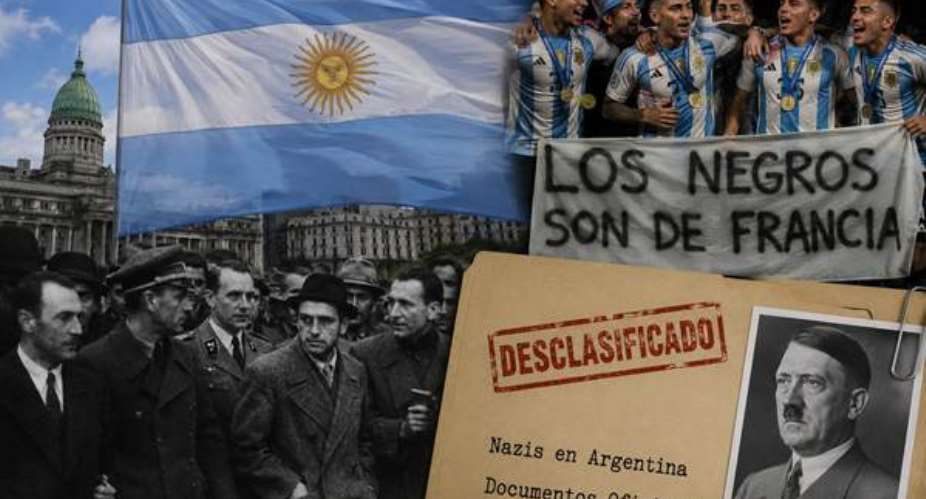
Why does it seem like everyone is suddenly talking about Argentina?
The World Cup did more than crown a champion. It placed history, geopolitics, immigration, and race before billions of viewers. For many people of African descent, the Spain-Argentina final created an almost unimaginable dilemma: cheering for the nation associated with Christoper Columbus against a country increasingly scrutinized over racial erasure, racist football chants, and its history of sheltering Nazi fugitives. Argentina had an evil underground railroad for Nazi war criminals. If you're from the U.S., America used and was patriotic toward Nazi war criminals for the Cold War.
Unlike African American women working at NASA during those times, these Nazis could use NASA restrooms.
Actress and activist Sonja Sohn, best known for The Wire, expressed that discomfort on social media by describing the matchup as a difficult historical choice involving Columbus on one side and Argentina’s Nazi associations on the other. Her language was provocative, but it captured a real sentiment: this game had become larger than soccer.
This is an attack on the ‘mess’ in Argentina, not necessarily Lionel Messi, every Argentine athlete, or an entire population. Argentina includes scholars, activists, and citizens who oppose racism. However, no championship, national hero or flag should place a country beyond accountability.
The question is not whether every Argentine is racist. The question is: Has Argentina earned its place among the world’s most scrutinized nations on race?
In my earlier EURweb story titled 'Argentina's Whitened Mirror: What Its World Cup Team Reveals About Race", I examined how a South American country with African and Indigenous foundations came to present an overwhelmingly European national image. A football roster alone cannot prove intentional racial exclusion, but it becomes symbolically powerful when compared with teams visibly shaped by Africa, the Caribbean, and modern migration.
Argentina’s defenders frequently respond, “We did not have Jim Crow. We mixed everyone."That is not the historical victory some believe it is.
Using American segregation as the only definition of systemic racism creates a strawman. The United States frequently maintained white supremacy by separating and excluding Black people. Argentina developed a different pattern involving European immigration, racial reclassification, cultural absorption, and the statistical invisibility of African descendants.
Different methods. Similar racial objectives.
Kahlil Greene, widely known as “The Gen Z Historian,” has built a national platform by uncovering histories frequently erased from popular memory. His educational work emphasizes why historical disappearance is often political rather than accidental. He has also challenged the claim that Afro-Argentines simply vanished, directing audiences toward the effects of warfare, population policies, social classification, and Argentina’s whitening ideology.
Three defenses continually fail. Whataboutism says America had Jim Crow, so Americans cannot criticize Argentina. The strawman pretends critics are claiming Argentina was identical to 1960s Alabama. Gateskeeping argues that Black Americans lack authority to study the greater African Diaspora.
None addresses Argentina’s actual history.
Consider ten reasons the scrutiny continues.
First, Afro-Argentines were pushed outside the national story. Wars, disease, poverty, intermarriage, migration, census practices, and government-supported European immigration all contributed to their declining official visibility.
Second, Argentina cultivated a Eurocentric identity. African and Indigenous contributions were frequently minimized while European appearance and ancestry became central to the country’s preferred self-image. Black Argentinians were positioned to fight and die first during conflicts.
Third, members of Argentina’s national team were recorded singing a racist traveling chant. Following the 2024 Copa América victory, Enzo Fernández livestreamed players on the team bus singing about French players of African descent. The French Football Federation condemned the chant, FIFA investigated, and Fernández later apologized.
This was not an anonymous fan hiding in a stadium. These were internationally celebrated Argentina soccer players traveling together after winning a championship, and it was captured and apparently normalized. Has Lionel Messi ever spoken out against this team culture of racism publicly? Now more than ever this the time for that video to surface.
Former French captain Hugo Lloris rejected celebration as an excuse, explaining that success creates greater responsibility. He was correct. A trophy does not suspend moral judgment.
Fourth, some Argentine supporters have shown appallingly poor judgment. The same offensive chant was later sung by River Plate supporters while Fernández appeared at the stadium. Repetition transforms an isolated controversy into evidence of a broader cultural problem. This was displayed to other Black or African players as well.
Fifth, political leaders redirected the controversy toward nationalism. Argentina’s sports undersecretary lost his position after suggesting that Messi and the football association should apologize. Vice President Victoria Villarruel defended the team while attacking France’s criticism.
According to the Buenos Aires Herald, Argentina’s President Javier Milei’s administration also dissolved INADI, Argentina’s anti-discrimination agency. That does not by itself prove Milei is personally racist, but eliminating an institution created to combat discrimination deserves direct examination.
Sixth, Argentina became a refuge for Nazi fugitives after World War II. Adolf Eichmann and Josef Mengele were among those who found sanctuary there. In 2025, Milei’s government expanded public access to hundreds of declassified records concerning Nazi activity and escape networks. NPR reports that they also found over 80 Nazi boxes and documentation in 2025 in a courtroom basement.
Seventh, Indigenous people and immigrants from neighboring Latin American countries have long reported xenophobia and discriminatory treatment.
Eighth, racial slurs and colorism are too frequently defended as humor or cultural misunderstanding.
Ninth, an Argentine burger business publicly used the full English-language N-word as part of its branding. Mainstream independent reporting remains limited, but no racial slur should become a restaurant concept or marketing gimmick.
Tenth, denial repeatedly replaces national reckoning. The claim that Argentina cannot have a serious racial problem because it has few visible Black citizens exposes the very historical erasure being questioned.
Sports history helps us understand why the final carried such symbolism.
When Jesse Owens entered Hitler’s Berlin in 1936 and won four Olympic gold medals, he shattered Nazi claims of Aryan superiority before the world. When African American heavyweight Joe Louis fought Germany’s Max Schmeling for the second time in 1938, their contest became more than boxing. Louis represented democratic America—imperfect and segregated—while Schmeling was presented internationally as a symbol of Nazi Germany.
Spain versus Argentina was not Nazi Germany versus the United States, and historical suffering should never be reduced to a sports metaphor. Yet the comparison shows how athletic contests become symbolic struggles over race, identity, and national morality. For some viewers, Spain occupied the symbolic position of Owens and Louis, while Argentina’s documented Nazi connections and contemporary racial controversies cast a troubling shadow over its team.
Christian teaching provides no shelter for racial superiority. Matthew 7:12 commands us to treat others as we desire to be treated. John 13:34 commands believers to love one another. Philippians 2:3 instructs us to value others above ourselves.
Argentina should not be collectively punished. FIFA should instead impose transparent fines, suspensions, educational requirements, and stadium restrictions when players, officials, or supporters violate anti-discrimination standards.
No responsible historian can crown the “most racist nation” as though hatred were a World Cup table. But based on Argentina’s whitening history, Afro-Argentine invisibility, Nazi-fugitive legacy, football chants, political responses, and repeated denial, its growing scrutiny is neither imaginary nor undeserved.
The purpose must not be revenge.
It must be truth, accountability, and reform.
Selected Sources
- Edmond W. Davis, EURweb commentary on Argentina, race and World Cup representation.
- United Nations Office of the High Commissioner for Human Rights, findings concerning people of African descent in Argentina.
- Reuters reporting on the Argentina team-bus chant, Hugo Lloris’ response and the Argentine government’s reaction.
- Reuters reporting on Argentina’s declassified Nazi records and Nazi escape networks.
- The Guardian reporting on Wesley Fofana, the French Football Federation and the dismissal of Argentina’s sports undersecretary.
- Kahlil Greene, “The Gen Z Historian,” educational commentary on hidden and erased history.
- George Reid Andrews, The Afro-Argentines of Buenos Aires, 1800–1900.
- Erika Denise Edwards, Hiding in Plain Sight: Black Women, the Law, and the Making of a White Argentine Republic.
- Uki Goñi, The Real Odessa: Smuggling the Nazis to Perón’s Argentina.
- Sonja Sohn’s public social-media commentary regarding the Spain-Argentina matchup.
ABOUT THE AUTHOR
Edmond W. Davis is a social historian, media strategist, professor, and documentary host. Davis is the founder of the National HBCU Black Wall Street Career Fest. This native of Philadelphia, PA, his wife, and his son currently live in the Little Rock, Arkansas, area. Davis is committed to cultural empowerment and educational equity through storytelling and civic engagement. In 2026, Davis was a grand marshal at the 38th Annual African American History Month Celebration Parade, the largest in the U.S. during Black History Month.

 'If we were wrong, we must first apologise to NPP' – Mustapha Gbande on National...
 Han SHS to get boarding status as Mahama inspects GETFund projects in Upper West
 Late herbal doctor’s wife granted GH¢100,000 bail amid poisoning, arson claims
 NDC has failed to deliver on Agenda 1-3-3 for 24-hour economy – Sam Pyne
 Wa-Bolgatanga trunk road to be asphalted – Mahama
 Gbewaa College of Education lecturer dies after alleged military assault in Pusi...
 Ghana won’t back down on mining value addition – Ambassador Kojo Bonsu
 How Dr Jesse Amuah, wife was murdered over GH¢1,500 payment dispute
 Mahama announces 20% salary incentive for health workers in deprived areas
 Ghana must move from plastic policies to implementation – EPA CEO


