




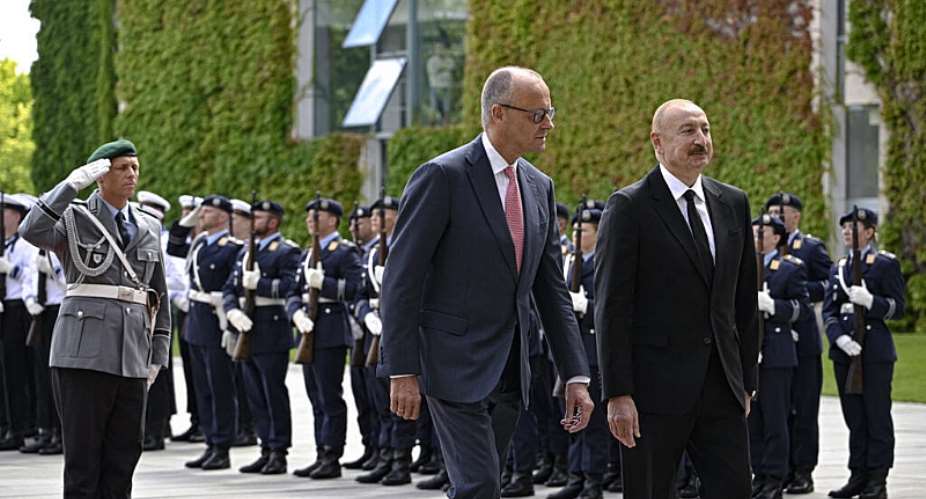
Aliyev's visit to Berlin produced a Joint Declaration on the Strategic Agenda for Bilateral Partners and established an Azerbaijan-Germany Business Council.
"I am confident that the documents signed today will elevate our relations to a new level," Aliyev told a joint press conference on Tuesday, saying a strategic dialogue had been launched and that Germany, "as the leading country of the European Union", was increasing its influence in the South Caucasus.
Berlin's interest is largely economic. Aliyev noted that Azerbaijan began supplying gas to Germany this year, as the EU is moving away from Russian energy imports, while Merz described the South Caucasus as "a key connectivity hub linking Europe and Asia" – a nod to the Middle Corridor, the trade route connecting the Caspian and Black seas that bypasses Russia.
Reconciliation
Relations with Armenia, with which Azerbaijan is in a slow process of reconciliation after decades of brutal hostilities and war, also featured in the talks.
Merz congratulated Aliyev on the initialling of the peace agreement with Armenia, calling it a "historic agreement" offering "a new opportunity to permanently overcome the long-standing conflict".
But the text, initialled at a White House ceremony last August, still awaits changes to Armenia's constitution demanded by Baku before a final signature.
"Azerbaijan offered peace to Armenia and received a positive response," Aliyev said, crediting the German government's role as intermediary and noting that more than 40,000 tonnes of transit cargo had crossed Azerbaijan to Armenia, with Azerbaijani petrol and diesel "benefitting Armenian energy security".
Berlin appears keen to avoid taking sides. Last March, Steinmeier's trip to Baku followed a two-day visit to Armenia, where he urged both sides to summon "the courage to compromise".
France, meanwhile, has tilted openly towards Yerevan, selling the country 36 Caesar howitzers for the Armenian army, alongside radars and armoured vehicles.
Could the war in Iran lay a path for peace between Armenia and Azerbaijan? Armored vehicules of the Armenian army equipped with CAESAR artillery system take part in a military parade on Armenias Republic Day, in Yerevan on May 28, 2026.
Armenia, meanwhile, has kept its membership of the Russian-led CSTO alliance – Russia's "NATO" – frozen, with Prime Minister Nikol Pashinyan ruling out any return to active participation. Its parliament voted in February 2025 to launch the country's EU accession process.
Azerbaijan Airlines jet
Baku is moving the other way. Relations with Moscow collapsed after Russian air defences struck an Azerbaijan Airlines jet on 25 December 2024, killing 38 people when it crashed in Kazakhstan.
But on 17 July, foreign ministers Jeyhun Bayramov and Sergey Lavrov declared relations "fully normalised" after talks in Moscow, with direct flights set to resume and bilateral trade reaching $4.9 billion in 2025 – leaving the region's map more fluid, and more contested, than at any point since the war.
(With newswires)


 'The height of absurdity' — Ayew Afriye slams BNI over invitation of Efya Royal ...
 US envoys arrive in Moscow to thrash out plan to end war in Ukraine
 'Chief Justice was talking as a citizen; you have to look at the context in whic...
 Mandatory towing to remove broken-down, stationary vehicles from roads to begin ...
 Domelevo backs OSP probe into alleged GH¢70,000 payment to Appiagyei despite den...
 WAEC releases 2026 WASSCE results, cancels entire results of 861 candidates for ...
 Baffour Agyeman-Duah explains why profitability may not be only reason behind SO...
 Kofi Bentil defends Mahama’s dissolution of nine State Boards
 5-year-old girl dies after falling into water-filled manhole at Winneba
 Sierra Leone ex-president to return after treason case dropped

