




A man who correctly predicts one storm may be lucky. A man who correctly predicts three in a row deserves, at the very least, your attention.
That is the uncomfortable position now occupied by Professor Jiang, a geopolitical analyst and host of the YouTube channel Predictive History, who uses history, geography, economics, and game theory to map where global power is heading before the headlines catch up. According to his own account and that of his growing audience, he forecast Donald Trump's return to power, a US-Iran military confrontation, and — most strikingly — American difficulty prevailing in that very confrontation. Whether one treats this as rigorous forecasting or simply a well-reasoned bet that happened to land, three consecutive hits demand a hearing rather than a dismissal.
His latest argument is his boldest yet: that the current Iran conflict is not an isolated flashpoint, but possibly the opening chapter of a far larger global reordering. Let us examine the argument on its merits, as any serious commentator should, while being honest about where prediction ends and certainty begins.
THE STRAIT THAT COULD BREAK THE WORLD
Start with what is not in dispute. The Strait of Hormuz, a narrow waterway between Iran and Oman, is one of the most consequential chokepoints in the global economy, with a significant share of the world's seaborne oil exports passing through it daily. Any serious disruption there — military, political, or otherwise — carries real potential to spike global energy prices, and energy prices have a well-documented habit of dragging food prices, shipping costs, and inflation along with them. This is not speculation; it is basic supply-chain arithmetic that any economist, hawk or dove, would concede. Professor Jiang's contribution is connecting this known chokepoint to a broader thesis: that whoever controls the flow of oil, and the trade routes surrounding it, holds a lever over the entire global economy far more powerful than any single battlefield.
FOUR EMPIRES, ONE CHESSBOARD
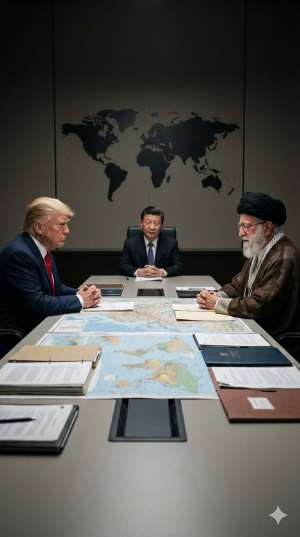
The professor's central framework treats the current moment as a contest between competing worldviews — the United States, China, Russia, and Iran, with Israel playing a pivotal regional role — each pursuing security and influence through a different logic. Whether one calls it a "chessboard," a "great game," or simply old-fashioned power politics, the underlying observation is not new: great powers rarely fight each other directly if they can arrange for smaller, resource-rich, strategically located nations to bear the cost of the contest on their behalf. The Middle East, tragically, has long served this function.
Jiang's more provocative claim — that Israel's ambitions in this conflict may extend beyond simply neutralising Iran's nuclear or military capacity, toward a broader reshaping of regional power — is a serious geopolitical argument made by serious regional analysts, though it remains, by its nature, a matter of interpretation rather than settled fact, and one Israeli officials would likely dispute. Readers should treat it as one lens among several competing analyses of a fast-moving, deeply contested conflict.
THE WORLD WAR THREE QUESTION
Here I must be careful, and I urge you to be careful with me, because this is where analysis brushes up against alarm.
The suggestion that Russia could enter the conflict on Iran's side, that a wider war could draw in multiple nuclear-armed powers, and that we may already be witnessing the opening moves of a third world war, is a dramatic claim — and dramatic claims, however compelling the reasoning behind them, deserve scrutiny rather than automatic belief. It is true that Russia and Iran have deepened military and economic cooperation in recent years, and it is true that a genuinely globalised, energy-driven crisis is not impossible given how tightly interconnected shipping lanes, currencies, and food supply chains have become. But probability is not certainty, and a persuasive narrative arc is not the same thing as a confirmed outcome. History is littered with confident predictions of imminent world war that did not, in the end, arrive on schedule. I share this analysis with you not as prophecy fulfilled, but as one serious framework for understanding a genuinely dangerous moment — and I would encourage every reader to weigh it against equally serious voices who see a narrower, more containable conflict.
THE DOLLAR, THE DRAFT, AND OTHER CLAIMS THAT NEED YOUR SCEPTICISM
Some of the claims circulating in this broader conversation — including suggestions of an already-active national conscription effort in the United States, or a third presidential term already being quietly arranged — deserve particular caution. The Twenty-Second Amendment to the United States Constitution limits a president to two elected terms, and no credible constitutional pathway currently exists to override that without a formal amendment process requiring supermajorities in Congress and the states — an extraordinarily high bar. Claims of this nature circulate widely in online geopolitical commentary, but a responsible reader, and a responsible columnist, should distinguish between a commentator's speculative forecast and a documented, confirmed fact. I raise this not to dismiss Professor Jiang's broader analytical framework, much of which is genuinely thoughtful, but to model the discipline every reader should bring to any single source, however impressive their track record.
WHY AFRICA SHOULD BE WATCHING CLOSELY
For those of us in Ghana and across the wider continent, a genuine disruption to Middle Eastern oil flows is not an abstract geopolitical curiosity. Ghana imports refined petroleum products, and any global oil shock reliably finds its way to the fuel pump in Accra and the market stalls of Kumasi within weeks, not months. A wider energy and food crisis, should one materialise, would strike import-dependent economies like ours long before it meaningfully touches Washington or Beijing. We are not spectators in this story. We are, as ever, among its most exposed characters.
THE HONEST CONCLUSION
I will not tell you Professor Jiang is certainly right, and I will not tell you he is certainly wrong. What I will tell you is that his framework — reading conflict through the lens of trade routes, energy dependence, and competing national worldviews rather than through the simpler language of "good side" and "bad side" — is a genuinely useful analytical tool, regardless of how any individual prediction ultimately unfolds. The measure of a good geopolitical thinker is not whether every forecast lands, but whether the questions they force us to ask make us wiser observers of the world as it actually moves.
Whether this is the opening chapter of a wider global war, or simply the latest chapter in a long, grinding Middle Eastern story, one thing remains true regardless of the outcome: the world is more interconnected, more fragile, and more flammable than most of us comfortably admit. Perhaps that, more than any single prediction, is the lesson worth carrying forward.
Author's note: I write this as a Ghanaian observer with no stake in Washington, Tehran, Moscow, or Tel Aviv beyond the shared humanity we owe every ordinary family caught beneath these decisions. My duty as a columnist is not to hand you certainty where none exists, but to sharpen the questions you ask of those who claim to have it.
About the author: Chief Tutu Baffour Asare Brownsy Williams is a highly acclaimed independent Ghanaian author, columnist, filmmaker, and digital content creator, and the founder of Brownsy Silva Company, a multi-disciplinary creative enterprise spanning literature, film, and digital storytelling. A student of engineering at Accra Technical University, he brings a distinctive blend of analytical rigour and narrative craft to his commentary on global affairs, technology, and power. His columns for Modern Ghana are read across Ghana, the United Kingdom, the United States, Canada, and Germany, and his body of work spans multi-generational novels, feature screenplays, and short films exploring identity, ambition, and the modern African condition.


 GES directs Ashanti regional, Obuasi East educational directors to step aside ov...
 Ghana's economy doing well; Bawumia's 'pocket economy’ theory will not fly – Apa...
 Obuasi SHTS headmaster resigns as Juaben NDC secretary, withdraws chairmanship b...
 NDC reverses decision, directs Obuasi SHTS headmaster to step aside from Juaben ...
 Africa must turn mineral wealth into jobs and shared prosperity – Mahama
 'Despicable!’ – Prof. Prempeh blasts GES, NDC over handling of Obuasi SHTS alleg...
 Police search for missing fishing canoe and seven crew members off Axim
 October 20: Cedi sells at GHS12.25 on forex market, GHS11.67 on BoG interbank
 'Very distasteful’ – Selorm Branttie blasts NDC for clearing Obuasi SHTS headmas...
 Power fluctuation destroys MTN mast power plant worth GH¢200,000 in Begoro


