




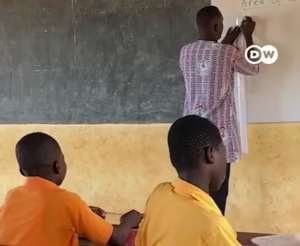
When armed jihadist groups began seizing territory in Burkina Faso's north and east from 2015, the human cost was measured in bodies and displacement. Over a decade later, part of that cost is being carried by the schools of northern Ghana, where thousands of children who fled the violence are now sitting often without chairs in classrooms not built for them.
A DW Africa report titled "As more refugee children arrive in northern Ghana, schools are feeling the pressure" has drawn attention to a slow-building crisis playing out quietly along Ghana's northern border, one that carries the hallmarks of a regional refugee emergency that international agencies say remains dangerously underfunded and underreported.
The DW Africa report documents how the armed conflict in Burkina Faso, which has forced millions from their homes, has pushed a significant number of children across the border into Ghana, where they are now enrolling in local schools and straining already limited infrastructure and resources.
The numbers behind the crisis are sobering. As of December 2024, Ghana was hosting approximately 17,300 registered refugees and asylum seekers, mainly from Burkina Faso, Togo, Liberia, and Sudan. Refugee populations are primarily located in four areas: the north (Burkinabe), the west (camp-based), urban centers including Accra, and the Volta Region.
By mid-2026, that figure had climbed further. According to the Strategy and Integrated Programmes Director of World Vision Ghana, Joshua Roland Baidoo, the crisis unfolding in Burkina Faso and the Sahel region was not a distant tragedy but a lived reality, in which conflict, extremist violence, and climate shocks had forced thousands of families to seek refuge across Ghana's northern border.
Ghana has taken formal steps to recognize this population's status. The Government of Ghana, in a gazette published on 30 January 2025, granted prima facie refugee status to Burkinabe asylum seekers who had sought safety within its borders, with the Ghana Refugee Board stating that the recognition applied to Burkinabes who arrived in Ghana before, on, or after 1 January 2020, with no cutoff date, as arrivals from Burkina Faso continued.
The education challenge for these children is severe and layered. At Tarikom KG/Primary School in the Upper East Region, the scale of the influx was impossible to ignore.
The school, built for just 250 pupils, was suddenly expected to welcome an additional 600 children in September 2023, including 320 girls brought in by UNHCR. With no extra space, no new teachers, and barely enough learning materials, the situation felt impossible. (UNICEF) A UNICEF emergency response eventually provided relief, but the episode illustrated precisely the kind of pressure the DW Africa report describes as an ongoing feature of life in the north.
Language presents one of the biggest structural barriers to integrating refugee children. Burkina Faso is a francophone country, and many children arrive speaking French or local languages, while Ghana's education system is conducted in English. A total of 3,731 children living at camps in the Sissala East Municipality, Sissala West and Lambussie Districts were not attending school because they came from a francophone country and therefore spoke French, making it difficult to integrate them into the Ghanaian educational system.
Children remain the most vulnerable among displaced populations. Globally, children account for nearly 40 per cent of all refugees, with many of those affected facing interrupted education, heightened risks of abuse and exploitation, as well as psychosocial trauma. The physical needs of refugee children in Ghana's north have been partly met through humanitarian partnerships. World Vision Ghana, in collaboration with the Ghana Refugee Board and UNHCR, was providing mechanized water systems in the Tarikom and Zini refugee camps, delivering more than 500 cubic meters of safe water daily to over 5,000 people.
Over 500 children had been supported with clothing and school supplies, and more than 5,000 refugee households received cash transfers through collaboration with the World Food Programme.
The wider humanitarian picture in Burkina Faso offers no relief. As of early 2026, 4.5 million people in Burkina Faso, including 2.9 million children, required urgent humanitarian assistance. The country continued to experience a complex crisis driven by displacement, food insecurity and recurrent climate shocks, with chronic needs persisting despite a slight reduction in new internal displacements compared to 2025.
The conflict's spillover into Ghana is part of a wider pattern. Conflict in the central Sahel continues to spill into Mauritania, Benin, Cote d'Ivoire, Ghana and Togo, placing growing pressure on fragile communities. An estimated 206,000 people have fled to Gulf of Guinea countries, though actual displacement figures are likely higher due to incomplete registration.
For the host communities of northern Ghana themselves among the poorest in the country the pressure is felt acutely. Schools built for hundreds are receiving thousands. Teachers trained for one classroom reality are managing another. And the children at the centre of it all, many of whom witnessed violence they should never have seen, are simply trying to learn.
Mustapha Bature Sallama.
Medical/ Science Communicator,
Private Investigator, Criminal investigation and Intelligence Analysis.
International Conflict Management and Peace Building.USIP
[email protected]
+233-555-275-880
References:
DW Africa, "As more refugee children arrive in northern Ghana, schools are feeling the pressure" DW Africa Facebook post. https://www.facebook.com/dw.africa/posts/as-more-refugee-children-arrive-in-northern-ghana-schools-are-feeling-the-pressu/1420123966818158/
UNHCR, "Ghana Country Page," December 2024. https://www.unhcr.org/where-we-work/countries/ghana
UNHCR Africa, "UNHCR Welcomes Ghana's Granting of Prima Facie Refugee Status to Displaced Burkinabes," January/February 2025. https://www.unhcr.org/africa/news/press-releases/unhcr-welcomes-ghana-s-granting-prima-facie-refugee-status-displaced-burkinabes
Ghana Business News, "Over 10,000 Burkinabes seek asylum in Ghana," June 21, 2026. https://www.ghanabusinessnews.com/2026/06/21/over-10000-burkinabes-seek-asylum-in-ghana/
UNICEF Ghana, "From Despair to Dreams: How a School Struggling to Stay Open Became a Beacon of Hope in Ghana." https://www.unicef.org/ghana/stories/despair-dreams-how-school-struggling-stay-open-became-beacon-hope-ghana
Ghana News Agency, "A bleak future awaits refugee children regarding education," January 19, 2024. https://gna.org.gh/2024/01/a-bleak-future-awaits-refugee-children-regarding-education/
UNICEF, "Burkina Faso Humanitarian Action for Children Appeal 2026." https://www.unicef.org/appeals/burkina-faso
UNICEF, "West and Central Africa Region Appeal 2026." https://www.unicef.org/appeals/wca
UN SDG, "Nourishing Hope: How Ghana is Tackling Food Insecurity for Refugees and Asylum Seekers," December 2024. https://unsdg.un.org/latest/stories/nourishing-hope-how-ghana-tackling-food-insecurity-refugees-and-asylum-seekers


 Contractor hands over Weija Children’s Specialist Hospital to govt
 Car dealer shot dead outside residence at Beach Drive Estate near Tuba
 Former TOR boss Asante Berko convicted in US over Ghana power plant bribery sche...
 NDC slams Afenyo-Markin's 'nobody' remark against Nana Yaa Jantuah
 Heavy security deployed to Laboma Beach ahead of demolition exercise
 James Agalga named majority leader following Mahama Ayariga's ministerial appoin...
 Omane was a true friend, a younger brother and a loyalist — Mahama eulogises lat...
 'My focus is on delivering the mandate' — Prof. Opoku-Agyemang responds to rumou...
 US appeals court halts construction of Trump’s $400 million White House ballroom...

