




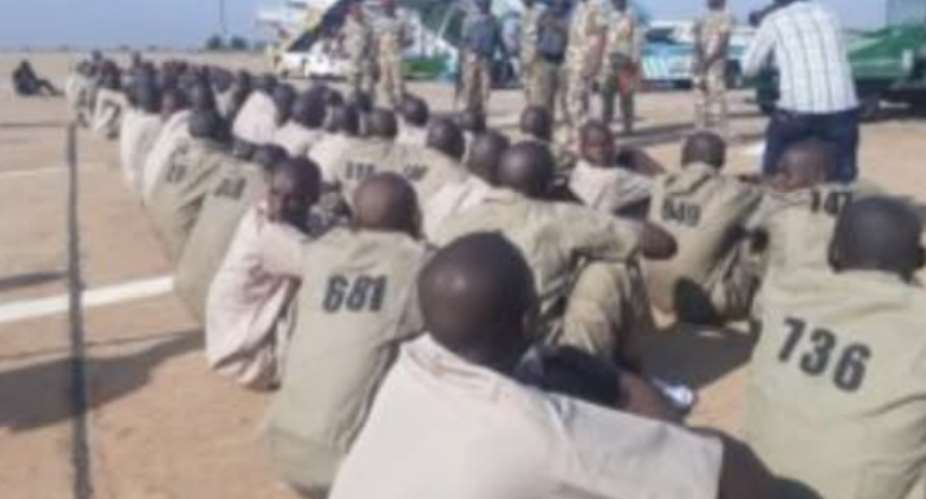
A decade into Nigeria's experiment with rehabilitating and reintegrating surrendered terrorists, the gap between official confidence and public faith has only widened. Each new batch of "repentant" Boko Haram and ISWAP members released into communities is met not with relief but with renewed suspicion a suspicion rooted not in prejudice, but in a documented record of broken promises and repeated betrayal.
The Scale of the Programme
Nigeria's flagship deradicalisation effort, Operation Safe Corridor, and its state-level counterpart in Borno, has processed thousands of former combatants. Borno's Special Adviser on Security, Ishaq Abdullahi, recently confirmed that a fresh cohort of 720 repentant terrorists had completed the state's rehabilitation programme, bringing the cumulative total reintegrated under the scheme to 9,680. The programme is built around psychological therapy, vocational training, and religious re-education before former fighters are handed back to their communities.
Why Trust Has Collapsed
Public reaction to these releases has consistently run counter to government messaging. When the 720-member cohort was announced, the response across Nigerian social media was overwhelmingly critical, with one widely circulated comment summarizing the public mood: "The government will rehabilitate repentant terrorists, but cannot save those who are being killed and abducted by them. If they explain Nigeria to you and you understand, they didn't explain well."
That distrust is not speculative. It is anchored in real recidivism cases. Investigative reporting has documented how Auwalun Daudawa, the man who led a group of terrorists in kidnapping 300 schoolboys in Zamfara State in 2020, was caught and pardoned in 2021, only to return to the forest and take up arms again within days of release. Cases like this are precisely what Nigerians point to when they argue the state cannot reliably tell genuine reform from temporary, tactical surrender.
Victim advocates have framed the issue as a question of justice denied. Ambassador Mary Abyomi-Fatile, Convener of Prayer and Support for Nigerian Armed Forces, put it starkly: "We have not finished dealing with those behind the insecurity bedeviling our nation, yet we are trying to reintegrate culprits who claim they are truly repentant, or who may simply be pretending for self-interest. There must be a price for such crimes. If the cost is not high enough, others will see it as a loophole rather than a warning."
Even senior military leadership has implicitly acknowledged the problem of victim exclusion. Chief of Naval Staff Idi Abbas told the Senate during his confirmation that families of victims killed in terrorist attacks must give their consent before any repentant terrorists are granted amnesty and reintegrated into society a tacit admission that the current process proceeds largely without victims' input.
Academic Research Confirms the Pattern
This is not merely anecdotal sentiment. A peer-reviewed study examining community perceptions in Lagos and Plateau states found that respondents overwhelmingly had little faith in the ability of former Boko Haram combatants to genuinely reform or repent from terrorist acts. The researchers' own recommendation that public fear should be shifted toward a more positive outlook implicitly concedes how deep that fear runs.
A Debate That Has Reached the Political Class
The controversy escalated in late 2025 when Major General Abdulmalik Bulama Biu, General Officer Commanding 7 Division, claimed in Maiduguri that a repentant ex-Boko Haram member could go on to "be the president of this country or hold any position in this country." The remark provoked widespread condemnation from commentators who argued it trivialized the suffering of victims of abduction, sexual violence, and mass killing. Inspector General of Police Kayode Egbetokun's parallel comment that surrendering bandits "won't" find the door shut on them drew similar criticism, particularly given documented cases of armed bandits attending state-brokered peace talks, collecting incentives, and resuming attacks soon after.
Even lawmakers who support reintegration in principle have insisted it cannot mean blanket amnesty. Senator Ali Ndume has argued that repentant fighters with "blood hands" must still be made to face consequences as prescribed by international law, even while some may have been coerced into the group as forced laborers or human shields.
The Bottom Line
What Nigerians are expressing is not a rejection of peace, but a rejection of unverified peace. Until the federal and state governments pair reintegration with transparent screening, victim consultation, and visible consequences for those proven to have killed, the public's verdict will remain unchanged: repentance, as currently administered, is a claim the state accepts too easily and verifies too rarely.
Aisha Lawal Malumfashi
A Criminologist from Department of Sociology, University of Abuja, Nigeria.
+2348036443457
[email protected]
with
Mustapha Bature Sallama
Medical/ Science Communicator
Private Investigator, Criminal Investigation and Intelligence Analysis.
International Conflict Management and Peace Building.
+233555275880
mustysallama@gmail .com
References
Vanguard News "Reintegration of Repentant Terrorists: Nigerians furious - 'Help victims before helping killers'," April 18, 2026
FIJ "Nigerians Heard About Borno's Reintegration of 'Repentant' Terrorists. They Aren't Having It"
AllAfrica "Nigeria: 'Repentant' Terrorist Can't Be President," December 4, 2025
AllAfrica "Nigeria: How Military Will Handle Repentant Terrorists," October 30, 2025
PressReader/The Guardian Nigeria "Repentant Terrorists With Bloody Hands Must Face Consequences Ndume"
Kolaking/Tarela Juliet Ike, Teeside University "Boko Haram reintegration process: weaknesses and how they can be fixed"
Punch Nigeria "Can terrorists really repent?"
Punch Nigeria "Rehabilitation of terrorists counterproductive"

 Trump unveils new Air Force One converted from luxury jet gifted by Qatar
 Mexican archaeologists unearth 'unprecedented' ancient ruins with Mayan features
 Trans-Saharan Gas Pipeline: an African dream that could reshape world energy mar...
 Israel, Hezbollah agree to ceasefire in Lebanon as attacks strain US-Iran interi...
 DR Congo's deadly Ebola outbreak is 'evolving fast', WHO warns
 NACOC raids Central University, arrests 5 students in possession of wee-infused ...
 Ireland deports 42 South Africans
 Chief Justice Baffoe-Bonnie's Canada trip self-funded — Judicial Service
 Boakye Agyarko is best suited to lead NPP as National Chairman – Kpandai MP
 African Union condemns deadly Niamey airport attack, pledges support to Niger


