




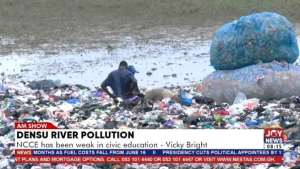
The environmental crisis facing Ghana is no longer an abstract policy discussion. It is flowing through one of the country’s most important water systems—the Densu River.
Stretching approximately 116 kilometres from the Atewa Forest Range through the Eastern Region to the Weija Dam in Greater Accra, the Densu serves as a critical source of drinking water for millions of people. Yet today, the river is under unprecedented pressure from illegal mining, poor waste disposal, deforestation, sand winning, and uncontrolled human settlement.
Environmental experts warn that unless urgent action is taken, the river that sustains much of Ghana’s capital could face irreversible damage.
A River in Decline
The Densu River Basin is among Ghana’s most economically important watersheds. Beyond providing water for domestic use, it supports farming, fishing, industry, and hydro-ecological systems across several districts.
However, decades of environmental abuse have transformed sections of the river into heavily polluted channels carrying excessive sediment, chemicals, and waste.
The Ghana Water Company Limited (GWCL) has repeatedly expressed concern about deteriorating water quality in the Densu Basin, particularly upstream of the Weija Dam.
Studies conducted within the basin have revealed alarming trends:
Turbidity levels in some sections of the river have exceeded 230 Nephelometric Turbidity Units (NTU), far above the World Health Organization’s recommended drinking water standard of 5 NTU.
Heavy metals including lead, cadmium, arsenic and mercury have been detected in several water samples at concentrations above permissible limits.
Surface water quality assessments indicate that many sections of the basin are unsuitable for direct human consumption without extensive treatment.
Hand-dug wells and streams within mining communities have shown elevated health risks associated with long-term exposure to contaminated water.
The result is increasing pressure on water treatment facilities and rising concerns about public health.
Galamsey and the Destruction of River Ecosystems
Illegal mining, commonly known as galamsey, remains one of the greatest threats to the Densu River.
In several communities within the basin, including areas around Potrase, Apedwa and Odumase, miners have excavated riverbanks, destroyed vegetation and diverted natural water channels in search of gold.
The environmental consequences are severe.
Mining activities introduce large volumes of sediment into the river, increasing turbidity and reducing aquatic biodiversity. The use of mercury and other hazardous substances further contaminates water resources and threatens both human and ecosystem health.
Environmental Protection Agency (EPA) officials have repeatedly stressed that mining activities near major water bodies pose unacceptable environmental risks and should not be permitted.
In some affected communities, residents describe stretches of the river as resembling thick brown sludge rather than flowing water.
Pollution Beyond Mining
Although galamsey receives much of the public attention, experts caution that it is only one part of a larger problem.
Agricultural runoff, indiscriminate waste disposal, sand winning and deforestation are also degrading the Densu Basin.
Fertilizers and pesticides from farms wash into streams and tributaries during rainfall, increasing nutrient loads and encouraging excessive growth of aquatic weeds.
Illegal sand winning destabilizes riverbanks and accelerates erosion, while uncontrolled logging removes vegetation that naturally protects waterways from sedimentation.
Around the Weija catchment area, rapid urbanization has introduced another threat: solid waste.
In recent years, portions of the river and its surrounding wetlands have increasingly become dumping grounds for household refuse. Flood events have occasionally washed waste directly into the Weija Reservoir, raising concerns about long-term contamination from plastics, organic waste and toxic materials.
The Growing Cost of Clean Water
The deterioration of raw water quality has significantly increased the cost of water treatment.
The Weija Water Treatment Plant must now use larger quantities of treatment chemicals such as alum and chlorine to remove suspended particles and harmful contaminants before water can be supplied to consumers.
According to water sector officials, pollution-related treatment costs have risen substantially over the years.
Excessive nutrients entering the reservoir also encourage the growth of aquatic weeds, which clog intake systems, damage infrastructure and increase maintenance expenses.
The burden is ultimately borne by both utility providers and consumers.
As water quality worsens, the cost of producing safe drinking water continues to rise.
Why Weija Dam Matters
The Weija Dam is one of Ghana’s most strategic water assets.
Located on the lower reaches of the Densu River, the dam supplies a significant proportion of potable water to Greater Accra, Kasoa and several surrounding communities.
With Accra’s population continuing to expand rapidly, demand for water is increasing every year.
Yet the reservoir faces growing threats from siltation, encroachment and pollution.
Environmental experts warn that if current trends continue, the effective storage capacity of the reservoir could gradually decline, reducing its ability to meet future demand.
The challenge is compounded by distribution inefficiencies. Large volumes of treated water are lost through leakages, illegal connections and aging infrastructure before reaching consumers.
Protecting the source therefore remains just as important as improving distribution systems.
A National Environmental Challenge
The crisis confronting the Densu reflects broader environmental challenges across Ghana.
Major rivers including the Pra, Ankobra, Offin, Birim and Tano have all experienced varying degrees of pollution linked to mining, deforestation and poor land management practices.
According to environmental assessments, Ghana continues to lose significant forest cover annually, reducing the natural protection afforded to watersheds and increasing vulnerability to climate-related disasters.
Environmental degradation carries enormous economic costs through reduced agricultural productivity, damaged infrastructure, water treatment expenses and adverse health outcomes.
Experts estimate that environmental losses cost Ghana billions of dollars annually.
Flooding and Encroachment
The consequences of neglecting the Densu Basin extend beyond water quality.
Communities downstream of the Weija Dam frequently experience flooding during periods of heavy rainfall and controlled spillage from the reservoir.
Residents of areas such as Tetegu, Oblogo and surrounding settlements have repeatedly called for regular dredging and improved management of drainage channels.
Encroachment on wetlands and natural floodplains has further increased vulnerability, leaving thousands of residents exposed whenever water levels rise.
Climate change is expected to intensify these risks through more frequent extreme weather events.
The Path Forward
Saving the Densu River will require coordinated action from government, traditional authorities, communities, civil society organizations and the private sector.
Three priorities stand out.
1. Eliminate Sources of Pollution
Illegal mining, indiscriminate waste disposal, uncontrolled sand winning and farming within buffer zones must be addressed through strict enforcement of environmental regulations.
Without stopping pollution at its source, restoration efforts will achieve only temporary results.
2. Restore the River Ecosystem
Reforestation of degraded catchment areas, rehabilitation of wetlands and protection of riparian vegetation are essential for reducing erosion and improving water quality.
Community participation in conservation efforts will be critical to long-term success.
3. Strengthen Water Infrastructure
Regular dredging, improved flood-control systems and continued investment in water treatment infrastructure can help safeguard water supplies while reducing disaster risks.
However, experts emphasize that treatment plants alone cannot compensate indefinitely for a deteriorating watershed.
The Stakes Could Not Be Higher
The Densu River is more than a watercourse. It is a lifeline for millions of Ghanaians.
Its waters support households, farms, industries and entire communities. Its reservoir sustains the economic heartbeat of the nation’s capital.
If pollution, encroachment and environmental degradation continue unchecked, the consequences will extend far beyond the riverbanks. They will affect public health, economic productivity, water security and climate resilience.
The future of the Densu River is therefore inseparable from the future of Accra itself.
Water is life. Protecting the Densu is not simply an environmental obligation—it is a national imperative.

 Trump unveils new Air Force One converted from luxury jet gifted by Qatar
 Mexican archaeologists unearth 'unprecedented' ancient ruins with Mayan features
 Trans-Saharan Gas Pipeline: an African dream that could reshape world energy mar...
 Israel, Hezbollah agree to ceasefire in Lebanon as attacks strain US-Iran interi...
 DR Congo's deadly Ebola outbreak is 'evolving fast', WHO warns
 NACOC raids Central University, arrests 5 students in possession of wee-infused ...
 Ireland deports 42 South Africans
 Chief Justice Baffoe-Bonnie's Canada trip self-funded — Judicial Service
 Boakye Agyarko is best suited to lead NPP as National Chairman – Kpandai MP
 African Union condemns deadly Niamey airport attack, pledges support to Niger


