




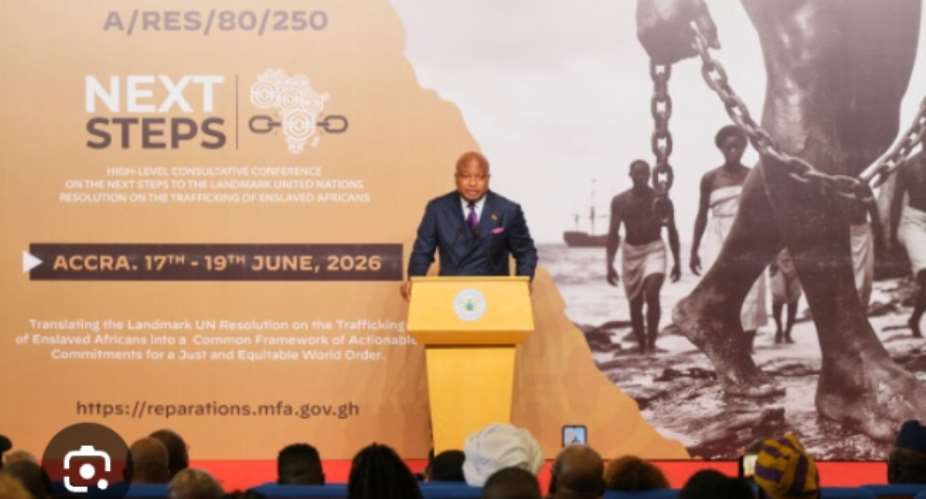
Ghana's hosting of the High-Level Consultative Conference on Next Steps for UN Resolution A/RES/80/250, held in Accra on June 18, 2026, marked another milestone in President John Dramani Mahama's campaign to position Ghana as the diplomatic centre of Africa's reparations movement. The conference, bringing together African Union member states, CARICOM and CELAC governments, the African diaspora, UN agencies and international partners, sought to translate three months of political momentum into a coordinated implementation agenda.
But the gathering's significance is best understood not only by who attended, but by who, structurally, has so far declined to fully engage and the pattern of Western response reveals as much about the limits of the reparations campaign as the resolution itself did about its strength.
A Resolution Passed Without Western Backing
The Accra conference builds directly on the UN General Assembly's March 25, 2026 resolution the first in the UN's eighty-year history dedicated exclusively to the transatlantic slave trade. The Ghana-proposed resolution, recognizing transatlantic slavery as the "gravest crime against humanity" and calling for reparations, was adopted despite pushback from Europe and the United States.
Of 123 countries supporting the resolution, three opposed it, including the United States and Israel, while 52 abstained, including the United Kingdom and European Union countries.
That voting pattern is the clearest available data point on how Western governments actually regard Ghana's reparations push, as distinct from how they speak about it diplomatically. Most European countries, including Britain and France, dissociated themselves from the resolution, while the United States, Israel and Argentina voted against it.
Notably, the US delegation justified its opposition partly by arguing the resolution narrowly focused on Western states' responsibility and characterized compensation claims as an attempt to reallocate modern resources to people only distantly related to historical victims.
Abstention as Strategy, Not Neutrality
Britain's position is instructive. The UK's acting UN ambassador, James Kariuki, speaking on behalf of mainly Western nations, said the history of slavery and its devastating consequences must never be forgotten, and that Western nations were committed to tackling root causes such as racial discrimination and xenophobia persisting today.
Yet this rhetorical acknowledgment stopped well short of a vote in favor. Commentary following the vote was split even within Britain's own foreign policy establishment: one academic view held the abstention defensible on the technical grounds that the resolution did not condemn all historical slavery and human trafficking, only that undertaken specifically by Western nations , while a sharply opposing view characterized the same abstention as a political choice rather than a principled position in essence, an evasion of the ongoing legacies of colonialism, dispossession and structural inequality that continue to shape Africa and the African diaspora today.
This tension between symbolic sympathy and substantive non-commitment is the defining feature of how Western capitals have approached Ghana's campaign. The Netherlands remains the only European country to have issued a formal apology for its role in slavery, underscoring how rare even rhetorical accountability has been among the states most implicated in the historical trade.
The Wider Diplomatic Undercurrent
The reparations debate has not unfolded in isolation from broader frictions between Washington and European capitals over questions of historical responsibility. US Secretary of State Marco Rubio's call for Europe to take pride in its heritage was widely criticized for appearing to valorize colonialism as a foundation of Western civilization, with the remarks arriving amid US criticism of European migration policy and Britain's ceding of sovereignty over the Chagos Islands to Mauritius. The juxtaposition is telling: even as Western governments resist binding reparations frameworks for Africa, intra-Western disputes over colonial legacy elsewhere the Chagos case being the most prominent recent precedent show that restitution is not categorically off the table when courts and treaties compel it.
Human Rights Watch framed the vote in starker terms, describing it as exposing a continuing divide between Global South countries living with the enduring consequences of colonial atrocities and slavery, and many Global North countries unwilling to take responsibility or to act.
What the Accra Conference Signals
Against this backdrop, the Accra conference functioned less as a negotiation with the West than as an African and diaspora-led effort to build momentum independent of Western buy-in. Ghana's Foreign Minister Samuel Ablakwa described the campaign as having gathered "unprecedented momentum" since the resolution's passage, while Liberian President Joseph Boakai used the Accra platform to urge that reparations become a comprehensive framework encompassing economic justice, institutional reform, historical accountability and cultural restoration explicitly broadening the agenda beyond what a Western-skeptical reading might dismiss as purely financial demands.
The structural reality, however, is that the resolution remains non-binding, carries no enforcement mechanism, and was adopted without the political weight of the very governments whose historical conduct it addresses. Analysts have warned that Western opposition signals requests for reparations are likely to meet pushback or tokenism rather than genuine engagement, placing the burden on affected countries and populations to remain proactive.
For Ghana, that proactive posture is precisely the point. By convening Africa, the Caribbean and the diaspora in Accra rather than waiting on Western capitals to come to the table, Mahama's government has effectively reframed reparations as an agenda Africa will pursue with or without Western consensus leaving Western governments to decide, conference by conference and resolution by resolution, how long symbolic acknowledgment can substitute for substantive engagement.
Mustapha Bature Sallama
Medical/ Science Communicator
Private Investigator, Criminal Investigation and Intelligence Analysis.
International Conflict Management and Peace Building.
+233555275880
mustysallama@gmail .com
References
AFP/France24 "Ghana pushes for concrete slavery reparations," June 18, 2026
Reparations 2026 High-Level Event Ghana Ministry of Foreign Affairs, reparations.mfa.gov.gh
GhanaWeb “Reparatory Justice: Why Ghana must lead a more courageous conversation"
Liberian Observer “Boakai Urges Africa to Broaden Reparations Agenda," June 2026
PassBlue "A UN Resolution Urging Reparatory Justice Wins Backing Without Western Support," March 26, 2026
Daily Maverick/ISS Africa "Can the UN's landmark transatlantic slavery resolution deliver meaningful reparations?" April 9, 2026
Britain's World (UACES) "Was Britain right to abstain from the UN vote on slavery reparations?" April 10, 2026
Human Rights Watch "Landmark UN Resolution on the Slave Trade," March 30, 2026
The Independent/AOL "Britain abstains from key UN vote to recognise slavery as 'gravest crime against humanity'"
Al Jazeera "UN passes resolution naming slave trade 'gravest crime against humanity'," March 25, 2026
AFP/France24 "Ghana pushes for concrete slavery reparations," June 18, 2026
Reparations 2026 High-Level Event Ghana Ministry of Foreign Affairs, reparations.mfa.gov.gh
GhanaWeb "Reparatory Justice: Why Ghana must lead a more courageous conversation"
Liberian Observer "Boakai Urges Africa to Broaden Reparations Agenda," June 2026
PassBlue "A UN Resolution Urging Reparatory Justice Wins Backing Without Western Support," March 26, 2026
Daily Maverick/ISS Africa "Can the UN's landmark transatlantic slavery resolution deliver meaningful reparations?" April 9, 2026
Britain's World (UACES) "Was Britain right to abstain from the UN vote on slavery reparations?" April 10, 2026
Human Rights Watch "Landmark UN Resolution on the Slave Trade," March 30, 2026
The Independent/AOL "Britain abstains from key UN vote to recognize slavery as 'gravest crime against humanity'"
Al Jazeera "UN passes resolution naming slave trade 'gravest crime against humanity'," March 25, 2026


 GoldBod’s gains must be weighed against full cost to Ghana – Prof. Bokpin
 ‘Afenyo-Markin’s smear campaign against me is about extortion’ – Sammy Gyamfi
 August 22: Cedi sells at GHS12.30 on forex market, GHS11.13 on BoG interbank
 There is a deliberate smear campaign against GoldBod from Minority – Sammy Gyamf...
 ‘If GoldBod wants credit, it must accept blame for losses’ – Dr Owusu Sarkodie
 Akosombo control system to be restored next month – Energy Minister
 ‘Temporary Akosombo system not very robust’ – Energy Minister on recent power ou...
 Mike Ocquaye Jr reacts to Adwoa Safo’s reported return to NPP Dome-Kwabenya race
 Foreign Affairs Ministry urges Tijjaniya pilgrims to Senegal to travel by air ov...
 Bono Police Arrest 36‑Year‑Old in GH¢1.1M Fake Gold Deal; Hunt for Three Others ...

