




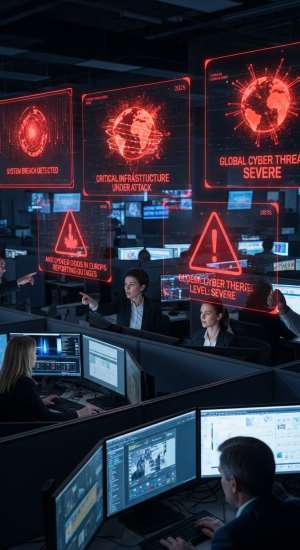
THE INVISIBLE BATTLEFIELD
For generations, the phrase "World War" conjured images of tanks rolling across borders, fighter jets dominating skies, and armies confronting each other on vast battlefields. Yet many security experts now argue that the next global conflict may look very different.
Instead of a single declaration of war, modern geopolitical confrontation is increasingly unfolding through cyberattacks, proxy conflicts, economic coercion, disinformation campaigns, artificial intelligence, and strategic competition between major powers. While the world is not officially at war, a growing number of analysts believe the foundations of international security are under greater strain than at any time since the Cold War.
The question is no longer whether warfare is changing. The question is whether societies are prepared for the new battlefield.
The Growing Nuclear Shadow
Despite decades of arms control agreements, nuclear weapons remain humanity's greatest existential threat.
Today, the world's major nuclear powers maintain thousands of nuclear warheads. Although safeguards, command structures, and verification systems have significantly reduced the likelihood of accidental launches, experts continue to warn that miscalculations, technological failures, cyber interference, or misinformation could trigger dangerous escalation during moments of crisis.
The emergence of artificial intelligence and increasingly sophisticated deepfake technologies has introduced a new concern. Security analysts worry that manipulated images, fabricated communications, or false military intelligence could complicate decision-making during already tense geopolitical confrontations.
The risk remains low, but the consequences would be catastrophic.
Cyber Warfare: The New Front Line
One of the defining characteristics of modern conflict is that battles increasingly occur behind computer screens rather than on traditional front lines.
Governments, military organizations, and critical infrastructure networks are now frequent targets of cyber operations. Electrical grids, financial institutions, transportation systems, telecommunications networks, hospitals, and government databases have all become potential targets.
Unlike conventional warfare, cyberattacks can be launched from thousands of miles away with relatively limited resources. A small team of highly skilled operators can potentially disrupt systems that entire societies depend upon.
The digital battlefield has become a central component of national defense strategies across the world.
The Rise of Proxy Wars
Modern powers increasingly avoid direct military confrontation with one another.
Instead, geopolitical competition often unfolds through proxy conflicts in which regional actors, allied governments, militias, or partner forces become the primary combatants while larger powers provide funding, intelligence, weapons, logistics, or diplomatic support.
From Eastern Europe to the Middle East and parts of Africa, proxy dynamics have become a defining feature of international security.
This approach allows major powers to pursue strategic objectives while minimizing domestic political costs and avoiding direct clashes that could trigger broader escalation.
However, proxy conflicts often prolong violence and increase civilian suffering, leaving local populations to bear the greatest burdens.
A World Experiencing More Conflict
According to multiple international conflict-monitoring organizations, the number of active armed conflicts worldwide has risen significantly in recent years.
Wars, insurgencies, territorial disputes, and political violence are occurring across several regions simultaneously. Although not all conflicts threaten global stability, their cumulative impact places increasing pressure on international institutions and humanitarian systems.
Millions of people have been displaced by violence, creating one of the largest refugee crises in modern history.
For many communities, geopolitical tensions are not abstract policy debates. They are daily realities affecting food security, education, healthcare, and personal safety.
The Information War
Perhaps the most significant transformation in modern conflict is the weaponization of information.
Foreign influence campaigns increasingly target public opinion through social media platforms, online communities, and digital advertising systems.
Rather than persuading populations to support a particular ideology, many influence operations seek to create confusion, deepen polarization, undermine trust in institutions, and weaken social cohesion.
Disinformation campaigns can exploit existing divisions within societies, amplifying political tensions and making democratic governance more difficult.
The objective is often not to convince citizens of a single narrative but to ensure they can no longer agree on what is true.
Lessons from Historical Upheaval
History demonstrates how quickly seemingly stable societies can change.
The Iranian Revolution of 1979 remains one of the most frequently cited examples. Within a relatively short period, a powerful government supported by extensive state institutions experienced dramatic transformation amid political unrest and public dissatisfaction.
The lesson for modern societies is not that history inevitably repeats itself, but that political stability should never be taken for granted.
Strong institutions, transparent governance, and public trust remain critical pillars of national resilience.
The Middle East and Global Tensions
The Middle East continues to occupy a central position in global security calculations.
Long-standing rivalries, territorial disputes, ideological differences, and competing regional interests create an environment where localized incidents can carry broader international implications.
Recent years have demonstrated how quickly regional confrontations can generate worldwide economic and political consequences, particularly through disruptions to energy markets, shipping routes, and international trade networks.
While diplomacy continues to play an essential role, analysts acknowledge that the region remains one of the world's most sensitive geopolitical flashpoints.
Why Nuclear Weapons Remain Different
Conventional wars, regardless of their destruction, generally allow nations to rebuild after hostilities end.
Nuclear conflict represents an entirely different category of risk.
Beyond the immediate humanitarian catastrophe, large-scale nuclear use could produce long-term environmental damage, economic collapse, mass displacement, and global food insecurity.
For this reason, deterrence remains a central principle of international security policy.
The objective of nuclear strategy is not victory but prevention.
Public Awareness and Preparedness
One of the greatest challenges facing modern societies is maintaining public awareness without encouraging panic.
Citizens cannot directly control international conflicts, but they can improve their resilience against manipulation and misinformation.
Experts recommend:
Verifying information through multiple credible sources.Being cautious of emotionally charged online content.
Developing digital literacy skills.
Understanding how algorithms influence information consumption.
Maintaining healthy engagement with news rather than constant exposure.
An informed population is more difficult to manipulate and better equipped to respond to crises.
Protecting Families in the Digital Age
The information environment has become one of the most important security considerations for modern households.
Parents, educators, and community leaders increasingly face challenges related to misinformation, online radicalization, conspiracy theories, and excessive doom-scrolling.
Media literacy has become as important as traditional literacy.
Teaching young people how to evaluate sources, identify manipulation techniques, and critically assess online claims is now a key component of civic preparedness.
Building Community Resilience
While global events often appear overwhelming, resilience begins at the local level.
Strong families, trusted institutions, community organizations, religious bodies, schools, and local leadership structures all contribute to societal stability.
Research consistently shows that communities with strong social bonds recover more effectively from crises than those characterized by deep mistrust and fragmentation.
National security is not solely determined by military strength. It is also shaped by social cohesion.
The Importance of Civil Disagreement
Democratic societies depend on the ability of citizens to disagree without becoming enemies.
Foreign influence campaigns frequently exploit political divisions, racial tensions, economic grievances, and cultural disputes.
The most effective defense against such interference is not censorship but a commitment to respectful dialogue, critical thinking, and shared democratic values.
Mutual respect reduces the opportunities for external actors to manipulate internal divisions.
Conclusion: The New Geopolitical Reality
The twenty-first century battlefield extends far beyond military bases and national borders.
Cyber operations, information warfare, proxy conflicts, economic competition, artificial intelligence, and nuclear deterrence now form the core architecture of modern geopolitical competition.
The world may not be witnessing a traditional World War III. However, it is undeniably experiencing a period of heightened strategic rivalry and growing global uncertainty.
The challenge for governments, institutions, and citizens alike is to recognize these evolving threats without surrendering to fear.
Preparedness, resilience, informed citizenship, and international diplomacy remain the strongest safeguards against the dangers of an increasingly complex world.
The future of global security may be uncertain, but understanding the nature of the modern battlefield is the first step toward navigating it wisely.
About the Author
Chief Tutu Baffour Asare Brownsy Williams is a Ghanaian author, filmmaker, digital strategist, and founder of Brownsy Silva Company. With a background in Mechanical Engineering and Software Engineering, his work explores technology, society, African identity, culture, innovation, and contemporary global issues through storytelling, film, and social commentary.


 Lawyer withdraws from Sky Train trial over dispute on Asamoah's testimony
 "I don't wait to be chased out, I've made my choice" — Asiedu Nketia on leaving ...
 Afia Schwarzenegger sentenced to 63 days in prison for contempt of court in Samm...
 Otumfuo cautions against undermining businesses linked to past administrations, ...
 Otumfuo urges banks to increase lending to private businesses instead of relying...
 Mahama urges private investors to guarantee markets for local farmers
 'If you are a consumer and not a producer; you will never create jobs and prospe...
 I want to see Ghanaian firms supplying regional markets, establishing production...
 'I encourage you to invest in Ghana, one of Africa’s most stable and dependable ...
 Ghana Air Force receives new Falcon 6X presidential jet to replace 16-year-old a...


