




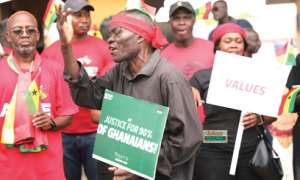
When Ghana’s Parliament passed the Human Sexual Rights and Family Values Bill, the loudest public reaction was not only about what the bill says. It was also about what many people think it says.
That difference matters.
A law can be dangerous because of its text. It can be even more dangerous when citizens, landlords, employers, families, teachers, neighbours and police officers act on rumours about its text. In a society where many people may never read the bill, the law risks becoming less a legal document than a social weapon. Suspicion may become evidence. Gossip may become accusation. Silence may become survival.
This is the neglected danger in Ghana’s current debate. The country is not only confronting a proposed legal regime against LGBTQ people. It is also confronting the consequences of public ignorance, moral panic and civic misunderstanding. When a law is widely discussed but poorly understood, the most vulnerable people often suffer first.
Ghana has every right to debate morality, family, culture and public values. But no democratic society should be comfortable with a law whose meaning may be enforced by people who do not know its limits. If a bill criminalises “promotion”, “support” or “advocacy”, many citizens will not wait for lawyers to define those terms. They will define them in homes, workplaces, markets, classrooms and churches. A person’s clothing, voice, friendships, profession, social media activity or mere association may become grounds for suspicion.
That is how ignorance becomes power.
The LGBTQ person in Ghana today is not only thinking about Parliament or the presidency. They are thinking about the landlord who may ask questions. The relative who may search their phone. The employer who may dismiss them quietly. The neighbour who may report them out of fear, prejudice or personal revenge. The police officer who may act first and ask questions later. The health worker who may become uncertain about confidentiality. The journalist, lawyer, counsellor, teacher or researcher who may hesitate to do their work because someone might call it “promotion”.
This is not abstract. Laws do not operate only in courtrooms. They operate in imagination. Once the public begins to believe that certain people are lawful targets, even before any prosecution, everyday life changes.
Fear is itself a form of punishment.
An LGBTQ person who fears exposure may withdraw from family, school, work, worship, and community. They may stop visiting clinics. They may avoid mental health support. They may leave WhatsApp groups, delete contacts, refuse invitations, move houses, or hide from people who once formed their support network. These are not small adjustments. They are the architecture of social death.
Seclusion also has economic consequences. In Ghana, as in many societies, survival depends heavily on family systems, friendships, apprenticeships, professional networks, and community trust. To be cut off from these networks is to be cut off from opportunity. A young person rejected at home may lose shelter. A worker suspected in the office may lose income. A student isolated on campus may lose confidence and academic stability. An activist or health educator labelled as a promoter may lose funding, employment or safety.
Poverty does not always begin with a lack of talent. Sometimes it begins when society blocks access to the relationships through which people survive.
Trauma follows the same path. A person who must constantly calculate what to say, how to dress, where to go, whom to trust and what not to reveal is living under permanent social pressure. Such fear can deepen anxiety, depression and loneliness. It can also make people less likely to seek help, because seeking help may require disclosure. In this way, the bill may create the very silence that makes suffering invisible.
Health care is one of the gravest areas of concern. Public health depends on trust. People must believe they can speak honestly to doctors, nurses, counsellors and outreach workers without being shamed, exposed or punished. If LGBTQ people believe that a clinic is no longer a safe space, they may delay or avoid care. This affects HIV prevention and treatment, sexual health services, mental health support, emergency care and general wellbeing.
The harm will not stop with LGBTQ people. Public health systems are interconnected. When any group is driven away from care, the wider society loses the benefit of early testing, treatment, counselling and prevention. A law that makes people afraid of clinics does not protect public morality. It weakens public health.
There is also a development communication problem here. Ghana’s debate has been dominated by slogans: family values, foreign agenda, human rights, culture, and morality. But development communication requires more than slogans. It requires accurate information, dialogue, listening, and public education. A society cannot make wise decisions when citizens are encouraged to react before they understand.
If the bill becomes law, the state must confront urgent questions. How will ordinary citizens know what the law actually permits and prohibits? How will false accusations be prevented? How will the police be trained to avoid abuse? How will medical confidentiality be protected? How will journalists, researchers, lawyers, teachers, counsellors and civil society organisations know whether their work is lawful? How will the government prevent vigilante behaviour carried out in the name of family values?
These questions are not technical details. They are the difference between law and mob permission.
Supporters of the bill may argue that it reflects Ghanaian values. But values should not require fear to survive. A society confident in its moral foundations should not need citizens to spy on one another. Nor should it create conditions in which vulnerable people disappear from public life, health care, education, and employment.
This is not an argument for Western approval. It is a Ghanaian argument about justice, knowledge, and social responsibility. Ghana’s democracy has long carried a reputation for constitutionalism, public debate, and relative stability. *That reputation is weakened when law becomes a tool for suspicion rather than fairness*.
The true test of a society is not how it treats those who already belong comfortably. It is how it treats those who are unpopular, misunderstood, or outnumbered. If the public does not know the content of the bill, and if the bill’s language invites broad interpretation, then LGBTQ people will not merely face the law. They will face every person who thinks the law has authorised them to punish.
That is the danger Ghana must not ignore.
A law passed in the name of values may end up rewarding ignorance. And when ignorance is rewarded, no minority is safe, no public institution is trusted, and no society remains as free as it believes itself to be.
Isaac Ofori
Tutor, Winneba Senior High School.
Social Activist and Human Rights Advocate
[email protected]


 Thousands attend Kenya opposition rally amid anger over political violence
 Trump slams AI sceptics as Altman pauses OpenAI IPO plans over safety concerns
 WASSCE: School officials helped students cheat for years, but we now see the tru...
 Probe alleged military killing of lecturer in Bawku – Kusaug Youth demands
 ‘If we all pay GH¢1,000 each, we should be able to construct National Cathedral’...
 Mahama inspects proposed site for Upper West Regional Airport
 Mahama reiterates government's commitment to end double-track SHS system
 Police interdict officer over death of 23-year-old Ivan Baidoo on Tema Motorway
 Improved invigilation is exposing true performance of Ghanaian students — Mahama...
 There's no policy to introduce Arabic, Chinese in all public schools — Mahama


