




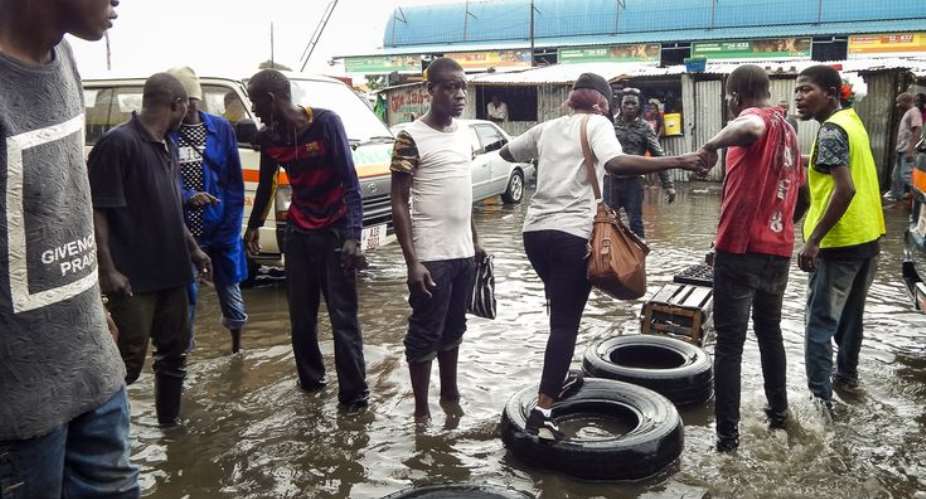
There is a particular kind of grief that comes not from shock, but from recognition. When the rains descend on Accra and the streets turn to rivers and the homes turn to graves, Ghanaians do not gasp in disbelief. They recognise it. They have been here before — many times, in many years, in many neighbourhoods — and the terrible truth of the June 3 anniversary and the flooding crises that have continued bleeding into 2026 is not that they were unexpected. It is that they were entirely, devastatingly predictable.
This is the story of a city that has been warned, repeatedly, by its own dead — and has yet to fully listen.
THE WOUND THAT NEVER HEALED: JUNE 3, 2015
To understand Accra's flooding crisis in its full, brutal context, you must first return to June 3, 2015 — a date that carved itself permanently into Ghana's national memory.
That evening, heavy rains overwhelmed the capital. Floodwaters surged through Kwame Nkrumah Circle, swallowing vehicles, sweeping people off their feet, and driving thousands from their homes. But what transformed a flood into a massacre was what happened near the Goil filling station at Circle. Floodwaters ignited spilled fuel. The resulting explosion and fire killed over 150 people in a single night — many of them young Ghanaians who had sought shelter from the rain under the station's canopy, believing they were simply waiting out a storm.
One hundred and fifty lives. Gone in a night of rain and fire and institutional failure.
The National Disaster Management Organisation declared a national disaster. There were vigils. There were inquiries. There were solemn promises from government that Accra's drainage infrastructure would be fundamentally overhauled, that encroachments on waterways would be cleared, that early warning systems would be established, that June 3 would never happen again.
It kept happening.
A CITY BUILT AGAINST ITSELF
To understand why Accra floods with such reliable devastation, you have to understand what Accra actually is — and what it was never designed to handle.
Accra is a coastal city of over five million people, built across a landscape of natural drainage channels, wetlands, and low-lying coastal plains. The Odaw River, the Onyasia, and a network of smaller tributaries once moved rainwater efficiently from the city's higher ground to the sea. They were the city's natural immune system against flooding.
Decades of unplanned, poorly regulated urban growth have systematically destroyed that system. Waterways have been encroached upon and built over. Wetlands — which once absorbed enormous volumes of rainwater — have been drained and developed into residential and commercial land. Storm drain networks, where they exist at all, are chronically clogged with solid waste, because Accra also has a waste management crisis running simultaneously with its flooding crisis, and the two feed each other in a vicious, entirely preventable loop.
Informal settlements have spread into floodplains — not because residents are ignorant of the risk, but because land elsewhere in the city is unaffordable, and because successive governments have allowed informal development to proceed without enforcement of the spatial planning laws that exist clearly on paper. Low-income communities cluster along the banks of the Odaw, in Alajo, Nima, Avenor, and Agbogbloshie — neighbourhoods where flooding is not an occasional disaster but an annual expectation, where families pack their most important belongings upstairs when the rains begin, where children have grown up knowing that June and July are months to fear.
The Ghana Meteorological Agency issues forecasts. The warnings are real. They are often accurate. And they are structurally ignored in terms of pre-emptive action.
2024 AND 2025: THE DISASTERS THAT KEPT ARRIVING
June 3 is now commemorated annually in Ghana as National Flood Disaster Day — a moment of reflection and, theoretically, recommitment. But the commemoration has, in too many years, served more as ritual than as genuine reckoning.
In 2024, Accra experienced severe flooding events that once again inundated major roads, displaced thousands of residents, and destroyed property on a scale that NADMO struggled to adequately capture or respond to. The Accra-Tema motorway was submerged. Airport residential areas flooded. Lapaz, Adenta, Achimota, McCarthy Hill — the water made no distinctions between wealthy and poor neighbourhoods, though as always, the poor suffered with far less capacity to recover.
Deaths were recorded. Homes were destroyed. Government officials visited affected communities. Drains were promised. Budgets were announced.
By 2025, as Ghana marked a full decade since the June 3 disaster, investigative journalists, civil society organisations, and urban planning experts published a grim collective verdict: the fundamental conditions that caused the 2015 catastrophe remained largely unreformed. The Odaw River basin remained heavily encroached. Portions of the storm drain upgrade projects announced after 2015 were incomplete, stalled, or had been constructed to inadequate specifications. Waste continued to choke drainage channels across the city. And the communities most at risk had received no meaningful relocation support — only occasional, tokenistic warnings to move to higher ground, as though higher ground were simply a matter of personal choice.
The tenth anniversary was marked with ceremonies. Bereaved families spoke. Dignitaries attended memorials. And then the rains came again.
THE INFRASTRUCTURE THAT FAILED AND THE POLITICS THAT LET IT
Ghana has not lacked for flood management plans. What it has lacked is consistent, accountable implementation.
The Greater Accra Resilient and Integrated Development project — GARID — funded partly by the World Bank, was designed to address flooding in the Odaw basin and improve solid waste management in flood-prone areas. It represented genuine international investment and genuine local political will at the point of signing. But infrastructure projects in Ghana, as in many developing nations, face a complex gauntlet: procurement delays, contractor performance issues, political transitions that reshuffle priorities, and the chronic mismatch between announcement timelines and delivery timelines.
Urban planners have long identified the key interventions: dredging and widening the Odaw and its tributaries, relocating settlements from high-risk floodplains with genuine compensation and adequate resettlement housing, constructing retention ponds and green infrastructure to absorb stormwater, enforcing building codes and setback requirements near waterways, and fundamentally fixing the solid waste collection system so that drainage channels stop being used as dumping grounds.
Each of these interventions is technically achievable. None of them is cheap. Several are politically difficult, because they require displacing communities, disciplining powerful developers, and maintaining enforcement systems across election cycles. And Ghana's political culture, which tends toward short-term visible wins over long-term infrastructure investment, has not historically rewarded politicians for doing the hard, invisible work of drainage.
What it has rewarded is crisis response — the dramatic arrival of boats and relief supplies, the emotional community visit, the promise of rebuilding. Disaster as spectacle generates political capital in ways that upstream prevention never does. This is not unique to Ghana. It is a failure mode of democratic systems worldwide. But in Accra, it kills people.
THE CLIMATE DIMENSION ACCRA CANNOT IGNORE
Here is the layer of the crisis that makes every existing challenge harder and every delay more costly.
West Africa is warming. Rainfall patterns across the Gulf of Guinea region are shifting in ways that climate scientists have been documenting with increasing precision. What were once considered extreme rainfall events — the kind that overwhelmed Accra's drainage on June 3, 2015 — are becoming more frequent. The intensity of rainfall during peak season is increasing. The Accra that was built, even inadequately, for a particular climate envelope is now being asked to cope with conditions that regularly exceed that envelope.
The Intergovernmental Panel on Climate Change has identified West African coastal cities — Accra among them — as among the most vulnerable urban areas in the world to the combined effects of increased rainfall intensity, coastal flooding from rising sea levels, and extreme heat events. Ghana has made climate commitments. The National Climate Change Policy exists. But the translation of national climate policy into municipal drainage infrastructure, spatial planning enforcement, and genuine community resilience remains a gap that is dangerously, unconscionably wide.
Accra cannot engineer its way entirely out of the climate dimension. But it can choose to build systems robust enough to handle more water more often. Right now, it demonstrably cannot.
WHO PAYS THE REAL PRICE
The geography of flood risk in Accra is not random. It is a precise map of poverty.
The communities that flood most severely and most consistently — Nima, Alajo, Agbogbloshie, Avenor, Gbegbeyise — are communities of low-income Ghanaians who did not choose their exposure to risk any more than they chose their income level. They live where they can afford to live. They build where they are permitted, or merely tolerated, to build. And when the waters rise, they lose what little they have — furniture, appliances, documents, livestock, and sometimes their children.
Recovery in these communities is not funded by insurance payouts or government compensation schemes. It is funded by the community itself — by neighbours pooling what they have, by relatives sending money from elsewhere, by the extraordinary and exhausting resilience of people who have been failed systematically and who have learned, generation by generation, to survive on that failure.
The psychological cost of annual displacement has not been meaningfully studied or addressed within Ghana's disaster management framework. The economic cost — in destroyed assets, lost income, and damaged health — runs into hundreds of millions of cedis annually, dwarfing the cost of the preventive infrastructure investments that would reduce the flooding in the first place.
This is the defining absurdity of Accra's flood crisis: it is far more expensive to keep failing to address it than it would be to fix it. Ghana is paying, repeatedly, for a disaster it could have prevented once.
2026 AND THE QUESTION OF POLITICAL WILL
As Ghana moves through 2026, the flooding question is once again present — in parliamentary debates, in civil society advocacy, in the lived anxiety of millions of Accra residents who have learned to watch the sky when June arrives.
The current administration has inherited a city in which the infrastructure deficit is enormous, the fiscal space is constrained, and the political pressure to demonstrate tangible progress is real. NADMO's operational capacity has improved incrementally, and early warning communication — through radio, television, social media, and community networks — has become more functional than it once was. These are real, if insufficient, gains.
But early warning systems that tell people a flood is coming are not a substitute for drainage infrastructure that prevents the flood from being catastrophic. Telling a family in Nima that heavy rain is forecast does not give them a safe place to go. It does not protect their home. It does not save their belongings or their lives if the waters rise faster than any forecast predicted.
What 2026 demands — what every year since 2015 has demanded — is the political decision to treat Accra's flooding not as a weather event but as a governance failure. A failure of planning, of enforcement, of investment priority, and of the most basic obligation of the state: to protect the people living within it.
That decision has been deferred for a decade. The city's dead are still waiting for it.
A CITY THAT DESERVES BETTER
Accra is one of West Africa's great cities. It is a city of remarkable energy — of hustle and creativity and cultural richness, of a people who have built thriving lives amid conditions that would exhaust lesser spirit. It is a city that has produced scientists, artists, athletes, entrepreneurs, statesmen, and thinkers of genuine global standing. It is a city that deserves infrastructure worthy of its people.
A city of five million should not dread its own rainy season. Mothers should not have to calculate, in June, whether their children can safely walk to school. Families should not have to sleep with one ear open when the clouds gather. The dead of June 3, 2015, should not have died to teach a lesson that has still not been fully learned.
The water will come again. It always does. The only question — the only question that has ever mattered — is what Accra will have built before it arrives.
Tutu Baffour Brownsy Williams is a Ghanaian columnist, author, and creative director. He writes on African society, development, culture, and the human stories that data alone cannot carry. His work is published on Modern Ghana and across multiple literary and digital platforms under the banner of Brownsy Silva Company, his creative enterprise.


 GES directs Ashanti regional, Obuasi East educational directors to step aside ov...
 Ghana's economy doing well; Bawumia's 'pocket economy’ theory will not fly – Apa...
 Obuasi SHTS headmaster resigns as Juaben NDC secretary, withdraws chairmanship b...
 NDC reverses decision, directs Obuasi SHTS headmaster to step aside from Juaben ...
 Africa must turn mineral wealth into jobs and shared prosperity – Mahama
 'Despicable!’ – Prof. Prempeh blasts GES, NDC over handling of Obuasi SHTS alleg...
 Police search for missing fishing canoe and seven crew members off Axim
 October 20: Cedi sells at GHS12.25 on forex market, GHS11.67 on BoG interbank
 'Very distasteful’ – Selorm Branttie blasts NDC for clearing Obuasi SHTS headmas...
 Power fluctuation destroys MTN mast power plant worth GH¢200,000 in Begoro



Comments
Often in life, one has to focus on what is within once's control. The behavioral and attitudinal aspects of the root causes -- improper waste disposal, building on waterways, building code violations, etc. -- are quite important but hard to control. So let the focus be on solutions that can easily be implemented and managed: (1) Create a FLOOD PREVENTION POLICE (FPP) that would monitor waste disposal EVERYDAY OF THE YEAR and make arrests when necessary. (Particularly near drains and gutter...