




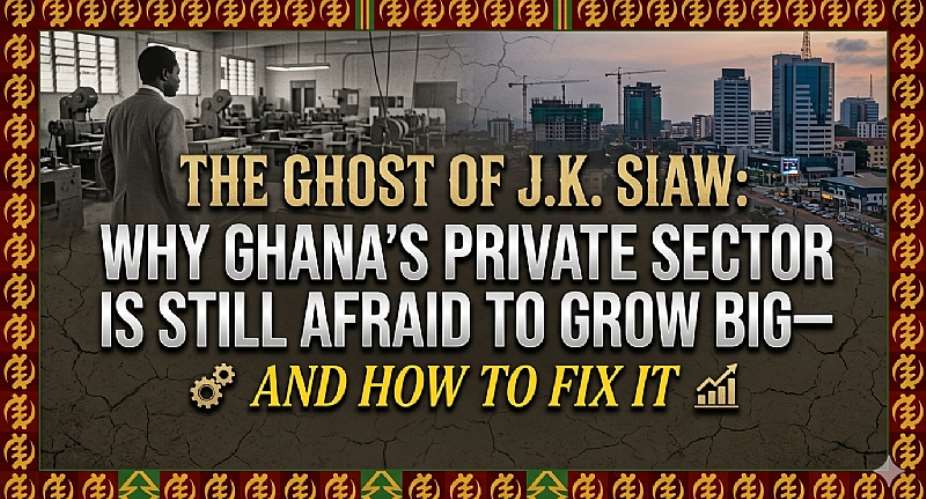
Resetting Ghana’s Sovereign Capital: From Historical Persecution to the 24-Hour Economic Shield
The systematic targeting of indigenous assets during Ghana’s military regimes remains a deeply agonizing chapter in our national history. Decades later, the economic scars remain visible as local businesses continue to struggle against foreign conglomerates. While the establishment of the National Reconciliation Commission (NRC) in 2002 offered a glimmer of hope for corporate healing, its inability to fully restore the empires of pioneers like J.K. Siaw and B.A. Mensah left a legacy of unfulfilled justice. Today, the battlefield for local enterprise has shifted from military coups to aggressive regulatory policing. As the Ghana Revenue Authority (GRA) pursues massive revenue collection targets, the agency faces an existential test. It must transform its aggressive compliance drives into a predictable, transparent ecosystem that protects the vulnerable private sector from administrative overreach.
Had these harsh historical actions not occurred, Ghana would likely have emerged as West Africa’s first fully self-sustaining industrial powerhouse. The arbitrary asset seizures under the AFRC and PNDC regimes did not just collapse individual companies; they broke the back of indigenous capital accumulation, altered Ghana's socio-economic trajectory, and stifled a culture of aggressive, generational wealth creation.
The Historical Trauma and the Failures of Retrospective Justice
If pioneers like J.K. Siaw (Tata Brewery Ltd) and B.A. Mensah (International Tobacco Ghana Ltd) had been protected rather than persecuted, Ghana's industrial landscape would have transformed significantly. Tata Brewery, which had already secured export rights to eight West African nations by 1976, would have organically evolved into an African beverage conglomerate, mimicking the global expansion of companies like Nigeria's Dangote Group. Similarly, B.A. Mensah’s Leaf Development Company would have served as a blueprint for the structural transformation of Ghanaian agriculture, creating advanced rural value-addition systems.
East Asian economies built their industrial revolutions on state-backed family conglomerates (Chaebols in Korea, Keiretsus in Japan). Ghana was on the verge of developing its own version. Preserving these empires would have fostered a mature private equity ecosystem, allowing local tycoons to fund heavy industries like steel, tech manufacturing, and automobiles, while anchoring the Ghana Stock Exchange.
Instead, the destruction of these business empires severely fractured Ghana's social fabric. International Tobacco Ghana alone employed over 14,000 Ghanaians at its peak. The collapse of such massive payrolls caused immediate generational poverty. Maintaining these businesses would have created a robust, highly skilled industrial middle class, drastically mitigating youth underemployment and rural-urban drift. Furthermore, local industrialists treated their workforces as extended families, providing dedicated health clinics, free transit, and funding public infrastructure like the Akwaseho Hospital long before Corporate Social Responsibility (CSR) became a buzzword.
The 2002 National Reconciliation Commission (NRC) attempted to address these wounds, but ultimately failed to restore these corporate empires due to fundamental structural constraints:
- Lack of Executive Enforceability: Recommendations were non-binding advisory notes, which state institutions routinely delayed or ignored.
- Irreversible Asset Disposal: Confiscated assets had already been stripped, liquidated, or absorbed by foreign multinationals, making physical restitution impossible.
- Nominal Financial Compensation: Payouts failed to account for inflation, decades of lost revenue, or the vast generational market share destroyed.
- Absence of Institutional Guardrails: The NRC focused heavily on retroactive healing rather than passing binding legislation to permanently strip regulatory bodies of punitive overreach powers.
The Modern Parallel: Shifting from Guns to Regulatory Audits
The historical lessons of the NRC serve as an urgent warning for modern institutions. When regulatory enforcement mimics the aggressive posture of bygone military regimes, the macroeconomic fallout remains identically destructive. The most casualty of historical regulatory aggression was investor confidence, sending a chilling message to generations of Ghanaians: do not grow too big, or the state will take it.
To break this historical cycle of self-sabotage, President John Dramani Mahama’s "Resetting Ghana" agenda and the newly legislated 24-Hour Economy framework present a vital opportunity to transition the state from a historical predator of indigenous wealth into its legal shield.
1. Structural Reforms via the Resetting Agenda
To prevent the administrative overreach of bodies like the GRA from mimicking past military-era asset stripping, the reform agenda prioritizes explicit institutional and tax overhauls:
- Eliminating Bureaucratic Warfare: Dismantling overlapping agency mandates and confusing administrative procedures that drain productive time from local businesses.
- Structured Private-Sector Partnerships: Shifting the relationship between the state and local business from ceremonial dialogue to a formalized State-Business Partnership Framework built on trust and policy consistency.
- Fiscal and Customs Protections: Allowing factories registered under the 24-hour program to import essential machinery and manufacturing equipment completely duty- and tax-free to prevent punitive import regimes from strangling local operations.
- De-escalation of Tax Enforcement: Replacing aggressive, unpredictable compliance drives with structured, transparent digital monitoring to provide enterprises with long-term fiscal predictability.
2. The 24-Hour Economy as a Shield for Indigenous Capital
Rather than using state mechanisms to constrict local business growth, the 24-Hour Economy Authority operates as a defense mechanism for local businesses, using targeted incentives to help indigenous firms build the scale needed to withstand foreign competition:
- The Shift System as a Growth Catalyst: Anchored by the "MAKE 24" and "BUILD 24" pillars overseen by the newly formed 24-Hour Economy Authority, companies are encouraged to transition to a three-shift production model, transforming fragile operations into high-output manufacturers.
- Mitigating Operational Overheads: To de-risk round-the-clock operations, the government reduces electricity tariffs for participating local factories during off-peak hours, while funding dedicated street lighting and continuous public policing along major commercial transit corridors.
- Import Substitution and Sovereign Capital: By focusing heavily on agro-processing, pharmaceuticals, and manufacturing, the policy establishes a protective buffer around Ghanaian firms, helping to stabilize the national currency and protect local industries from volatile foreign exchange shocks.
Sectoral Insulation and the Local Content Reform Framework
Modern policy moves away from broad rhetorical protections, instead using targeted statutory instruments to shield vulnerable, capital-intensive sectors from foreign dominance and predatory administrative enforcement:
- Extractive & Mining Services: Direct insulation mechanisms include the mandated transition of surface mining to 100% wholly-owned Ghanaian firms to prevent value flight and foreign control of mine operations.
- Downstream Energy & Support Services: Enforcement includes the exclusionary reservation of upstream oil and gas support services for Indigenous Ghanaian Companies (IGCs).
- Mandated Local Off-Take: Under the "MAKE 24" protocol, foreign firms operating in Ghana must source intermediate inputs from the Minerals Commission’s 50-item Local Procurement List, which includes locally manufactured grinding media, explosives, and civil works.
Dismantling the Fronting Syndicate
Historically, foreign entities bypassed local ownership caps through "fronting"—using Ghanaian citizens as legal figureheads while retaining real equity and repatriating 100% of the profits. The updated Local Content Reform Framework targets this practice directly through two pillars:
- Strict Equity Audits: To qualify for reserved state contracts or tax relief under the 24-hour economy, an IGC must prove 100% equity ownership by Ghanaian citizens, removing the loophole of indirect holding companies.
- Criminalizing the Fronting Syndicate: Fronting is treated as an economic crime. Both the foreign company and the complicit Ghanaian citizens face severe financial penalties and mandatory prison sentences. The Minerals Commission and Petroleum Commission track corporate ownership data in real-time via digital beneficial ownership registries before issuing or renewing operational licenses.
Furthermore, to prevent local firms from failing due to lack of capital, the Petroleum Commission's Local Content Fund provides concessionary working capital loans to IGCs, allowing local businesses to purchase heavy machinery and scale up to three shifts without relying on high-interest commercial bank loans.
The statutory operational guarantees provided by the 24-Hour Economy Authority Bill transform the state-business relationship. By codifying tax structures and providing regulatory predictability, it ensures that local businesses running night shifts are protected from arbitrary, unexpected tax audits or sudden administrative shutdowns. Ghana is finally moving toward an ecosystem where indigenous capital is treated as a national asset to be protected, ensuring that the corporate tragedies of the past remain firmly in the pages of history.
✍️ Retired Senior Citizen
For and on behalf of all Senior Citizens of the Republic of Ghana 🇬🇭
Teshie-Nungua
[email protected]


 NDC's ‘New Economy’ is not different from the already new economy Ghanaians are ...
 Minority demands accountability for 24-Hour Economy before rollout of New Econom...
 EOCO, Lands Commission values Wontumi’s frozen Tema property
 Ghana Water Limited arrests 4,395 over alleged water theft
 Peki SHS final-year student dies after colleague pushed him to the wall during d...
 The New Economy is a scam, a rebrand of failed 24-hour economy – Oppong Nkrumah
 Ghana announces discovery of new oil and gas deposits
 No prima facie case in petition against Justice Pwamang – Presidency
 Mother invokes generational curse on daughter during heated verbal exchange
 SA evacuation: OSP must not allow media pressure to dictate investigations – Bra...


