




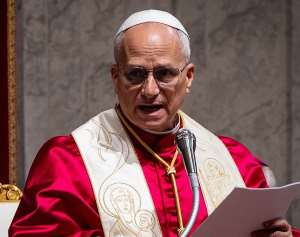
First US-born pope acknowledges Vatican's centuries-long legitimization of the slave trade, calling it a "wound in Christian memory"
VATICAN CITY Pope Leo XIV has issued a historic apology for the Catholic Church's direct role in enabling and legitimizing the transatlantic slave trade, making him the first pope to ever publicly acknowledge and formally apologize for the part played by his predecessors in granting European colonial powers the authority to enslave people.
The apology marks a significant departure from previous papal expressions of remorse: while past popes had apologized for the role of Christians in the slave trade, no pope had ever publicly acknowledged, much less apologized for, the role that the popes themselves played in giving European sovereigns explicit authority to subjugate and enslave "infidels."
The apology was delivered as part of Leo's eagerly awaited first encyclical, Magnifica Humanitas Latin for "Magnificent Humanity" published on Monday, May 25, the 135th anniversary of the promulgation of Pope Leo XIII's landmark labour document, Rerum Novarum.
The encyclical's primary focus, however, is the sweeping challenge posed by artificial intelligence to human dignity, labour, warfare, and social justice.
A Wound in Christian Memory
Leo called the Vatican's record on slavery "a wound in Christian memory," delivering the apology within a manifesto about safeguarding humanity in an era of increasing reliance on artificial intelligence. He raised the transatlantic slave trade in relation to what he described as the new forms of slavery and colonialism being fuelled by the digital revolution including the unregulated labour required to procure the rare minerals needed for AI chips.
In doing so, he responded to decades of calls by Black American Catholics, activists and scholars for the Holy See to atone for its own role in the colonial-era trade in human beings.
The personal dimension of the apology carries considerable weight. History's first US-born pope comes from a family history that includes both enslaved people and slave owners. The acknowledgement was therefore as much personal as institutional.
In the encyclical, Leo wrote plainly of the Church's historical complicity. "Already in the early modern period, the Apostolic See of Rome, responding to the requests of sovereigns, intervened several times in order to regulate and legitimize forms of subjugation, and, in certain cases, including the enslavement of 'infidels,'" he wrote.
In 1452, for example, Pope Nicholas V issued the papal bull Dum Diversas, which gave the Portuguese king and his successors the right "to invade, conquer, fight and subjugate" and take all possessions including land of "Saracens, and pagans, and other infidels, and enemies of the name of Christ" anywhere.
Despite the Church's consistent affirmation of universal human dignity, "it took eighteen centuries for its full incompatibility with slavery to be explicitly recognized," Leo wrote. "For this, in the name of the Church, I sincerely ask for pardon."
It was not until 1839 that Pope Gregory XVI called the slave trade "inhuman" and "unworthy of the Christian name." St. John Paul II had previously apologized for the role of Christians in slavery in speeches in Cameroon and Senegal, and the Vatican published a statement in 2023 repudiating the "Doctrine of Discovery" used to justify slavery by Church authorities. But Leo's apology goes further it specifically implicates the institution of the papacy itself.
AI, Regulation, and New Forms of Slavery
The slavery apology, though historic, forms only one thread in a much broader tapestry. Magnifica Humanitas has been eagerly awaited ever since history's first US-born pope announced days after his election that he considered AI to be the biggest challenge facing humanity today. In the document, Leo denounced the "culture of power" driving the AI race, especially in developing ever more sophisticated methods of remote warfare.
The pope condemned outright the surrendering of combat decisions to AI systems, writing that "it is not permissible to entrust lethal or otherwise irreversible decisions to artificial systems."
Leo warned against "new forms of slavery," highlighting the trail of human and environmental exploitation behind AI from models training on copyrighted material to the extraction of rare minerals used in AI hardware.
On the economy of work and profit, the Pope was equally direct. "The pursuit of greater profits cannot justify choices that systematically sacrifice jobs, because the human person is an end, not a means, and the economic order must remain subordinate to human dignity and the common good," he wrote.
The encyclical reaffirmed the Church's firm condemnation of every form of slavery, trafficking and commoditization of persons, stressing that to fail to react or to tolerate grave violations of human dignity is to become complicit in them.
Rerum Novarum for the Digital Age
Magnifica Humanitas thus becomes the latest chapter in a century-long tradition of popes adapting Rerum Novarum to the social questions of their times, often dwelling on the dignity of work for human flourishing.
The encyclical was presented at the Vatican alongside senior Church officials and leading AI experts. The decision to include Anthropic at the Vatican launch was criticized by some who considered it a papal stamp of approval of the AI firm.
Leo's demand for robust AI regulation sets up another potential flashpoint between the American pope and the Trump administration, which has worked aggressively to deregulate AI development.
For Black Catholics, scholars of colonial history, and human rights advocates across Africa and the diaspora, however, Monday's apology carries a meaning that transcends technology policy. It is the first time the chair of St. Peter has looked directly into the machinery of colonial oppression and acknowledged that the Vatican was not merely a bystander but, at times, an architect.
Mustapha Bature Sallama.
Medical/ Science Communicator,
Private Investigator, Criminal investigation and Intelligence Analysis.
International Conflict Management and Peace Building.USIP
[email protected]
+233-555-275-880

 How eight 'A's WASSCE graduate from Wesley Girls killed by speeding motorcycle w...
 GTEC freezes new PhD admissions nationwide pending audit of doctoral programmes
 NATO faces sovereignty dilemma as militaries rely on private tech, AI
 Afenyo-Markin demands answers over poor water quality in Central Region
 Mahama says Mayweather’s Ghana visit will boost tourism, boxing
 Police to develop human rights manual to strengthen professionalism and public t...
 How Korle Bu surgeons fixed back man's penis cut off whiles attempting to sit on...
 German President to visit Ghana for talks on trade and skills development
 Madina Court remands man over alleged GH¢18,500 theft from girlfriend
 Akufo-Addo left Mahama govt GH¢680bn debt bill for 2027-2030 — Isaac Adongo


