




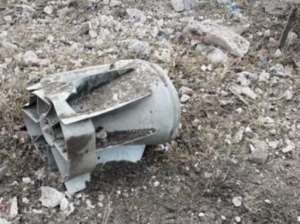
The weapon is Soviet in design, precise in its imprecision, and banned under international law for all nations that have chosen to be bound by that law. In the skies over the Timbuktu region of Mali, it has been deployed against one of the world's most impoverished and conflict-ravaged landscapes. And the only aircraft in Mali capable of carrying it belongs to Russia's Africa Corps.
The RBK-500 cluster bomb razovaya bombovaya kasseta, meaning "one-use bombing cartridge" in Russian has arrived in the Sahel, and with it, a new chapter in the accountability crisis surrounding Mali's military junta and its Kremlin-aligned partners.
The Anatomy of the Weapon
To understand what is alleged to have fallen on the Gargando area of the Timbuktu region, it is necessary to understand what the RBK-500 ShOAB-0.5 actually is.
This cluster bomb combines a cut-down RBK-500 dispenser with 565 ShOAB-0.5 bomblets the ShOAB designation most likely standing for sharikaya oskolochnaya aviatsionnaya bomba, meaning "round fragmentation bomb." The RBK-500 is generally deployed from high-speed attack aircraft and is designed to withstand the high-g forces experienced by fighters maneuvering in battlespace.
Each individual bomblet is a sphere, roughly the size of a tennis ball, weighing half a kilogram. The ShOAB-0.5M is a high-explosive anti-personnel weapon armed by centrifugal force. Once it leaves its container, the airflow acts on flutes around the submunition, imparting a spin which arms the fuze. As it impacts the ground, the spinning stops, triggering the detonation. On detonation, each ShOAB-0.5M disperses approximately 304 steel balls.
The mathematics of this weapon bears stating plainly. A single RBK-500 dropping its full complement of 565 spheres releases at the moment of detonation 171,960 steel fragmentation balls across a dispersal pattern whose size can be adjusted depending on the altitude of release and fuze timing. The sub munitions fall from the RBK-500 in a characteristic pattern and detonate in a distinctive "bagel" shape. At least two of these bombs are normally dropped in quick succession to ensure better coverage. The weapon is considered highly effective against personnel and soft targets.
"Soft targets" is the military euphemism. In the context of Mali's Timbuktu region, where Gargando sits amid communities of Tuareg and Fulani pastoralists, fishing communities, and market traders who have been caught between jihadist armed groups and military counterinsurgency operations for over a decade, soft targets have names, families, and livestock they depend on for survival.
Russian state-aligned media confirmed in May 2026 that the Russian Africa Corps has begun using RBK-500 cluster bombs against enemy forces in Mali an admission, framed as a military achievement that simultaneously confirms the deployment of a weapon class whose use against civilian-populated areas would constitute a war crime under the Rome Statute.
The Platform: Only One Aircraft Can Do This
The significance of the Su-24's role cannot be overstated. In the inventory of the Malian air force and Africa Corps combined, it is the sole fixed-wing strike aircraft with the payload capacity and hard point configuration to carry the RBK-500. When an RBK-500 is used in Mali, there is precisely one candidate for the aircraft that dropped it.
The Sukhoi Su-24 Fencer is a Soviet-era supersonic bomber developed in the 1960s and first flown in 1967. Designed for long-range, all-weather interdiction missions, it became one of the Soviet Union's primary ground attack platforms during the Cold War and remains in operational service with Russia, Ukraine and several export customers. The Su-24 is among the confirmed delivery platforms for the RBK-500 ShOAB-0.5, alongside the Su-17, Su-22, Su-25 and Su-34.
Russia has deployed Su-24s in multiple theatres where the Africa Corps or its predecessor Wagner Group have operated, most notably in Syria, where the weapon system was previously documented. In the Syrian theatre, photographs taken by local people showing the remnants of an RBK-500 series bomb and its payload of ShOAB-0.5 sub munitions were documented during operations around Aleppo that caused at least 20,000 people to flee towards the Turkish border. (nih)
The pattern Su-24 delivers RBK-500 over densely populated or civilian-adjacent areas, denials follow is being reproduced in Mali with what appears to be the same playbook.
Gargando: A Name That Should Not Be Forgotten
Rights groups in early April 2026 accused the Malian military and Africa Corps of summary executions during late-March operations in the Goundam, Bintagoungou and Gargando areas of the Timbuktu region. The cluster bomb allegations in the Gargando area arrive in this context: not as an isolated accusation, but as part of a documented pattern of operations in the Timbuktu region in which civilian populations have been repeatedly harmed.
The Global Centre for the Responsibility to protect has formally documented that the Malian Armed Forces and Russian state-controlled Africa Corps have perpetrated possible war crimes and crimes against humanity, including summary executions, indiscriminate airstrikes, rape and sexual violence, pillaging and torture against civilians. Many of the victims have been ethnic Fulani, a community long conflated by security forces with jihadist fighters a conflation that rights groups describe as the pretext for ethnic targeting.
Malian refugees in Mauritania have shared with aid workers and news sources accounts of abuses by Africa Corps, including indiscriminate killings, abductions, sexual violence and torture.
The Gargando area sits within the broader Timbuktu region one of the most remote, most conflict-affected, and most information-restricted parts of Mali. The junta in Bamako has expelled international journalists, restricted the movements of humanitarian organizations, and shut down independent media.
In that environment, cluster bomb use against civilian populations in remote areas can occur with near-total impunity: no witnesses capable of publishing testimony, no forensic investigators, and no independent military observers.
A Weapon the World Has Already Condemned
In 2010, the Convention on Cluster Munitions entered into force, prohibiting the use, transfer, and stockpiling of cluster munitions that disperse explosive sub munitions weighing less than 20 kilograms. This would include the RBK-500 when loaded with ShOAB-0.5 sub munitions. However, neither Russia nor Mali has ever ratified the Convention, removing the formal treaty prohibition though not the moral or customary international law obligations that apply to all parties to armed conflict.
The Convention currently has 112 states parties. Russia is not among them. Mali is not among them. The Africa Corps, as a direct arm of the Russian Ministry of Defence since it replaced Wagner in 2024, operates under Russian military command meaning the decision to use RBK-500 cluster bombs in Mali is, in the most direct legal sense, a decision made in Moscow.
The humanitarian argument against cluster munitions is not abstract. Their defining characteristic wide dispersal of sub munitions across large areas, with significant rates of failure to detonate on impact ensures civilian harm long after the immediate military operation. Failed sub munitions become de facto landmines, killing and maiming civilians, farmers and children for years or decades after the conflict in which they were used.
In Laos, cluster munitions dropped during the Vietnam War era continue to kill people today. In Lebanon, Israeli cluster munitions use in 2006 left an estimated one million unexploded sub munitions across the south of the country.
In the Timbuktu region where Gargando's communities grow millet and sorghum on marginal land, herd cattle across vast pastoral territories, and already live with the constant threat of jihadist violence and military operations the introduction of cluster munitions into the conflict environment carries a humanitarian cost that will be measured in casualties not yet recorded, on dates not yet arrived.
The Accountability Vacuum
The limits of Russian support have been exposed by the hasty retreat of 400 Africa Corps mercenaries from Kidal following the coordinated JNIM-FLA offensive of April 25-26, 2026. Precious Russian equipment has been left in rebel hands, including mine-resistant vehicles. The retreat generated a sense of betrayal among junta figures, with some pushing to further diversify relationships beyond Moscow, including with Turkey.
Yet even this humiliation has not produced accountability for civilian harm. Russia has framed the April attacks as a Western imperialist operation against Sahelian sovereignty. The Africa Corps released statements claiming, without evidence, that Ukrainian and European mercenaries participated.
On April 28, the Russian Ministry of Defence released footage of airstrikes carried out by Russian personnel, claiming that at least 305 militants had been killed in recent strikes. (Global Partnership for Sustainable Development Data) Casualty counts of fighters, of civilians remain entirely in the hands of the parties carrying out the operations.
The UN Office for the Coordination of Humanitarian Affairs recorded 3,737security incidents resulting in 9,362 deaths across the Central Sahel between January and December 2025. Behind each of those deaths is a specific act of violence, a specific weapon, a specific decision. The RBK-500 allegation in Gargando is, in this context, not an exceptional claim but a specific data point in a pattern of mass harm that the international community has been unable or unwilling to address.
OHCHR documented hundreds of extrajudicial executions, arbitrary arrests and detentions and enforced disappearances by all parties in 2025, with UN experts asserting that the enforced disappearances may constitute crimes against humanity.
The International Criminal Court has an existing mandate in Mali. What it does not have, in the current political environment, is the investigative access, the cooperation of the Malian junta, or the political backing of the Security Council members Russia holding a permanent veto among them that would be necessary to translate documented allegations into prosecutions.
The Sphere That Armed Itself
The ShOAB-0.5 arms itself in flight. Airflow spins the sphere; the spin arms the fuze; impact detonates the charge; 304 steel balls disperse outward from the point of detonation, each capable of killing or severely injuring anyone within its radius.
Multiply that by 565 spheres per bomb. Multiply by the number of bombs dropped in the Gargando operations. Multiply by the rate of submunition failure to detonate estimated between 5% and 40% depending on soil conditions, submunition condition and impact angle and you have a contaminated landscape that will kill again, on days when no aircraft is in the sky.
This is what is alleged to have been used in the Timbuktu region. This is what only the Africa Corps Su-24 can carry. And this is what a world that has largely turned its attention elsewhere from Mali's unfolding catastrophe has, so far, failed to name with the clarity the evidence demands.
The bomb arms itself in the air. The accountability must begin on the ground.
Mustapha Bature Sallama.
Medical/ Science Communicator,
Private Investigator, Criminal investigation and Intelligence Analysis.
International Conflict Management and Peace Building.USIP
[email protected]
+233-555-275-880


 Ghana Must Reset — Not Just In Words, But In Deeds!
 OSP must publish findings on alleged sale of diplomatic passports – Larry Dogbe
 2027 Budget: 'Adwuma no wɔ he?’ – Sammi Awuku demands answers on Mahama's youth ...
 SA evacuation: OSP must punish those who took hotel money while evacuees slept i...
 Ghana, Slovakia consider visa waiver deal for diplomatic, service passport holde...
 World Cup visa scandal: OSP must not end at announcement of probe – Ekow Assafua...
 SA evacuation: I’m convinced OSP will find nothing untoward after probe – Batagl...
 'If by close of today Erastus Asare Donkor fails to come and apology we will cur...
 SA Evacuation: If Ablakwa wanted Ibrahim Mahama’s GH¢16m, he wouldn’t make it pu...
 Ato Forson explains why gov’t won’t borrow to finance New Economy Programme


