




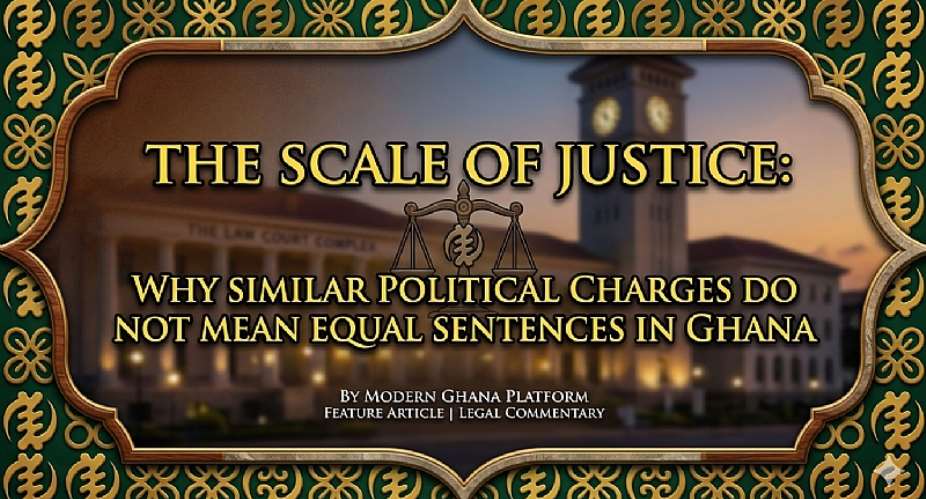
ACCRA, GHANA — The recent legal battles involving political figures from both sides of the aisle have thrown Ghana’s statutory criminal laws and the impartiality of our judiciary into a massive national media storm. The conversation reached a boiling point when National Democratic Congress (NDC) branch organizer Ibrahim Mohamed was convicted and handed a cumulative 10-year prison sentence. Now, the legal spotlight has swung sharply onto the New Patriotic Party (NPP). Kwame Baffoe, popularly known as Abronye DC, the NPP Bono Regional Chairman, was remanded into police custody by the Accra Circuit Court after pleading not guilty to charges of offensive conduct and publishing false news.
To the general public, both cases appear identical because they share the same toxic headlines of fake news and political mudslinging. Many Ghanaians are asking a critical question: Will the law hand down the exact same punishment to Abronye?
To the untrained eye, identical charges should yield identical prison terms. However, analyzing Ghana's statutory laws shows that the judicial system does not operate on a one-size-fits-all formula. Understanding how judges calculate sentences is vital to maintaining public trust in the judiciary, ensuring that partisan emotions do not cloud legal realities, and recognizing that equal application of the law does not guarantee equal sentences.
Understanding the Legal Framework: Specific Sections of Act 29
To understand why these cases are legally distinct, we must look directly at the specific statutory provisions of the Criminal Offences Act, 1960 (Act 29) under which both men were charged:
- Section 208(1) — Publication of False News: This section explicitly criminalizes the publication or reproduction of any statement, rumor, or report which is likely to cause fear and alarm to the public or disturb the public peace. It is legally categorized as a misdemeanor. The legal standard for a conviction requires proving that the accused knew the statement was fabricated and distributed it with malicious intent to disrupt public stability.
- Section 207(1) — Offensive Conduct Conducive to the Breach of Peace: This provision targets anyone who uses threatening, abusive, or insulting words or behavior in any public place with the intent to provoke a breach of the peace, or whereby a breach of the peace is likely to be occasioned.
- Section 74 — Threat of Harm (The Deciding Factor): This is where Ibrahim Mohamed’s case legally separated from Abronye's. Mohamed was hit with a third, heavy charge under Section 74 for threatening physical harm to citizens, yielding a 4-year consecutive sentence. By contrast, Abronye’s charges center on derogatory personal remarks directed at a sitting judge. While highly offensive, verbal insults regarding a judge's political bias do not carry the same legal weight as threats of physical violence against human life under Act 29.
- Cumulative vs. Concurrent Sentences: Ibrahim Mohamed’s 10-year term is a cumulative (consecutive) total of three separate sentences added together (3 years + 4 years + 3 years). For future cases, a judge can rule that sentences run concurrently (at the same time), meaning the offender only serves the length of the single longest count.
- Judicial Discretion in Misdemeanors: Because Sections 207 and 208 are misdemeanors, Circuit Court judges hold massive legal flexibility. If convicted, a judge is fully empowered to skip prison entirely, choosing instead to issue a financial fine, a short term of community service, or a strict bond to keep the peace.
- The Scale of Public Harm: A court will always measure the real-world impact of the false news. Fabrications that risk inciting mass riots, national panic, or community violence are punished far more severely than reckless political commentary or insults targeted at individuals.
The Dangerous Escalation of Political Party Responses
Rather than letting the Accra Circuit Court handle these matters through standard due process, the leadership of both major political parties has reacted with aggressive rhetoric that threatens the integrity of our judicial system:
- NPP Leadership Overreach: Following the court's decision to deny Abronye bail out of concern that he would commit further offenses, certain party leaders launched aggressive verbal assaults. Public statements have attacked the presiding judge, with some political legal actors claiming they would "continue to disrespect" the court over what they claimed was a wrong interpretation of bail laws.
- The Institutional Pushback: This aggressive political rhetoric triggered an immediate defense of the judiciary. The Ghana Bar Association (GBA) has previously issued strong warnings against public attacks on sitting judges, describing such behavior as highly unprofessional, unethical, and a direct threat to the rule of law.
- The NDC Counter-Narrative: On the other side, NDC commentators have weaponized Ibrahim Mohamed's 10-year sentence as a political yardstick. They demand that Abronye face the exact same prison sentence to prove that the judiciary is not biased toward the ruling government. This relentless political scorekeeping completely ignores the foundational differences in the underlying police evidence.
Key Recommendations and Suggestions
To safeguard the independence of the Ghanaian judiciary and prevent the media space from decomposing into legal anarchy, the following structural changes are urgently needed:
- Cease Direct Attacks on Presiding Judges: Political leaders must immediately stop making personal threats against judges. Challenging a bad ruling must be done through formal legal appeals to the High Court, not through hostile press conferences or public declarations of disrespect.
- Re-evaluate the Use of Criminal Charges for Speech: Parliament's Constitutional and Legal Committee should review the continued use of Sections 207 and 208 for political commentary. Many legal experts argue that civil remedies like defamation lawsuits are far more appropriate for dealing with reputational disputes and insults than using state security resources to jail political opponents.
- Enforce Strict Bail Laws Independently: The courts must strictly follow the statutory guidelines for bail without succumbing to external political pressure. Denying or granting bail must be based entirely on flight risks and evidentiary requirements, rather than the political status of the individual standing in the dock.
- Universal Political Accountability: Political party executives must hold their own communicators accountable. If a regional chairman or branch organizer crosses the line into publishing fabricated, harmful news, their party should actively condemn the behavior instead of acting as if no offense has been committed.
- Invest in Citizen Legal Literacy: Media houses, civil society organizations, and the National Commission for Civic Education (NCCE) must proactively educate the public on the Criminal Offences Act to prevent citizens from being misled by partisan narratives.
Conclusion
The law cannot be twisted to satisfy the political appetites of the NDC or the NPP. While the temptation to compare Ibrahim Mohamed's 10-year cumulative sentence to Abronye’s current legal battle is high among commentators, the statutory realities of Act 29 dictate that every case must be decided on its own merits. Demanding an automatic 10-year sentence for political symmetry is just as unlawful as dangerous public declarations of disrespect toward a sitting judge.
The beauty of Ghana's judicial system lies in its ability to look beyond political titles and weigh the specific gravity, intent, and danger of every individual action. For Ghana's democracy to survive this turbulent period, our political leaders must retreat from the courtroom gates. They must allow the Accra Circuit Court to interpret Act 29 independently, and accept that true justice is blind to party colors.
✍️ Retired Senior Citizen
For and on behalf of all Senior Citizens of the Republic of Ghana 🇬🇭
Teshie-Nungua
[email protected]


 Wee smokers invade Swedru Methodist Basic School, turn classrooms into hideouts ...
 Otumfuo approved the date for my father’s funeral — Adwoa Safo
 Akofena is embarrassing the family, destroying our late father's legacy – Adwoa ...
 Illegal chainsaw operators shoot reforestation worker at Abesewa Forest
 ICS heads to Supreme Court to ban dog and cat slaughter, consumption in Ghana
 “Where are the 800,000 jobs?" — Patrick Boamah questions govt
 Patrick Boamah alleges several procurement breaches in Ato Forson’s constituency...
 Adu-Boahene Trial: GH¢49.1m from National Signals Bureau account – Prosecution ...
 32 more Ghanaians return from South Africa
 “I warned you several times" — Otumfuo destools 110-year-old chief of Kenyase No...

