




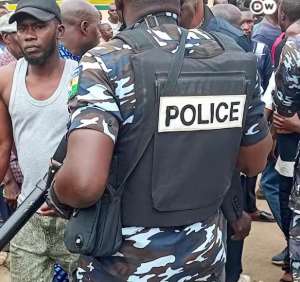
The pre-dawn assault on a Special Forces training facility in Yobe State killing officers hours before a landmark US-Nigeria joint strike eliminated ISIS's global second-in-command lays bare the undiminished lethality of the Lake Chad insurgency.
They were killed in darkness, in the middle of training that was supposed to make them better equipped to face exactly this kind of enemy. At approximately 1:15 a.m. on the morning of Thursday, May 8, 2026, suspected Islamist militants swarmed the Nigerian Army Special Forces School in Buni Yadi, Gujba Local Government Area of Yobe State, striking simultaneously from multiple directions in a carefully pre-planned assault.
When the gunfire died down and the Nigerian Army personnel had repelled the attackers, seventeen police officers lay dead trainees who had come to one of the military's most fortified training institutions to sharpen their counter-terrorism skills, only to become the insurgency's latest victims.
The Nigeria Police Force confirmed the deaths on Saturday, May 16, in a statement by Force Public Relations Officer Anthony Okon Placid, a Deputy Commissioner of Police. The attack occurred at the Nigerian Army Special Forces School, where the officers were undergoing specialized counter-terrorism and tactical training.
Several Nigerian Army personnel also lost their lives in the engagement, though the military did not immediately disclose an exact figure for its own casualties. What is certain is that the attack on Buni Yadi was not a random act of insurgent opportunism. It was, by every operational marker, a deliberate, intelligence-backed strike on one of the most symbolically significant targets available: a school designed to produce the very soldiers and officers meant to defeat the jihadist enterprise.
A Town That Has Bled Before
Buni Yadi is not an unfamiliar name in the grim catalogue of the northeastern Nigerian insurgency. In February 2014, Boko Haram descended on the Federal Government College in the same town, massacring at least 59 male students burning some alive in their dormitories, shooting those who fled into the surrounding bush. Girls were abducted. Every building on the school compound was razed to the ground.
That atrocity, which preceded by weeks the internationally infamous Chibok kidnapping, announced to the world the murderous ambition of an insurgency that Nigerian authorities had initially dismissed as a manageable local disturbance.
More than a decade later, the same corridor in Yobe State remains a theatre of death. The Nigerian Army Special Forces School was established in part as a counterweight to the insurgency's dominance in the region a hub of elite tactical training positioned in the very geography where the threat is most acute.
That the militants were able to identify the facility, marshal sufficient numbers and firepower, and execute a coordinated multi-directional assault against it speaks to an intelligence and operational capacity that ought to disturb policymakers in Abuja.
The Attack: What We Know
According to the police statement, the attack was launched in the earliest hours of May 8 a time chosen, as has been a consistent tactical preference among insurgent groups in the Lake Chad Basin, to exploit the degraded alertness and mobility of defenders in deep darkness. The facility was struck from multiple directions simultaneously at approximately 0115 hours.
Inspector-General of Police Olatunji Rilwan Disu described the fallen officers as courageous and dedicated personnel who demonstrated exceptional patriotism and commitment to national security. Yobe State Commissioner of Police Usman Kanfani Jibrin visited the facility on behalf of the Inspector-General, meeting with the school's commandant, Brigadier General A.C. Enuagu, and commending the surviving trainees for their resilience. He urged them to complete their programme in honour of their fallen colleagues.
No group has officially claimed responsibility for the attack. Nigerian security authorities have attributed it to Islamist militants consistent with the operational profile of either ISWAP or the remnants of Boko Haram both of which have historically targeted military and security infrastructure in Yobe State.
The Wider Storm: A Surge in Regional Violence
The Buni Yadi assault did not occur in isolation. It took place within a broader intensification of jihadist activity across the Lake Chad Basin a region that has, over the past 18 months, seen a revival in the operational tempo of both ISWAP and resurgent Boko Haram factions.
Just weeks before the Yobe attack, Boko Haram struck a Chadian military post on the island of Barka Tolorom in Lake Chad, killing at least 23 soldiers and wounding 26 others in another pre-dawn assault underscoring the geographic spread of a conflict that respects no national border.
Security analysts have pointed to a confluence of pressures explaining this resurgence: a deepening governance vacuum across the Basin, chronic underfunding of reintegration programmes that drive demobilized fighters back into the arms of armed groups, and the Lake Chad islands' role as a lucrative node in smuggling and taxation networks that sustain both ISWAP and Boko Haram financially.
According to security consultant Abiola Sadiq, the recent resurgence reflects not simply a military setback, but a deepening governance vacuum across the Lake Chad Basin.
Hours Later, a Different Strike and a Complicated Picture
The savage irony of the weekend's events was impossible to miss. In the same 24-hour window that saw seventeen Nigerian police trainees buried in Yobe, a joint US-Nigeria military operation in the Lake Chad Basin eliminated Abu-Bilal al-Minuki, described by US President Donald Trump and US Secretary of Defense Pete Hegseth as the global second-in-command of ISIS. Al-Minuki, a Nigerian national born in Borno State in 1982, had served since 2018 as the Lake Chad division commander under ISIS's General Directorate of Provinces, coordinating between ISIS's regional branches and managing financial flows, weapons development, drone capabilities, and cross-border insurgent logistics.
Nigerian President Bola Tinubu confirmed the operation, saying al-Minuki was killed alongside several of his lieutenants during a strike on his compound in the Lake Chad Basin. (PBS) Trump, for his part, declared that with al-Minuki's removal, ISIS's global operation was "greatly diminished."
The symbolism was double-edged. On one hand, eliminating al-Minuki was described by Malik Samuel, a senior researcher at Good Governance Africa, as potentially the first time a security agency had confirmed killing someone this high in the ranking of ISWAP. (PBS) On the other, the fact that seventeen trainees were slaughtered in Yobe hours before the strike was announced served as a reminder of the chasm between headline victories and ground realities.
Analysts warned that al-Minuki's death may accelerate rather than diminish violence in the near term, with intelligence reports already recording a surge in small-scale attacks and cross-border raids in the weeks following the strike, indicating that operational fragmentation has not diminished the groups' capacity to coordinate assaults.
The Structural Rot Beneath the Battlefield
What the Buni Yadi attack and the wider Lake Chad Basin crisis together reveal is not primarily a military problem, though its military dimensions are severe. The insurgency's durability rests on structural foundations that precision strikes and counter-terrorism operations cannot dismantle: entrenched poverty and unemployment that make armed groups viable as economic actors; a state presence in the northeast that remains thin, extractive, and associated for many communities more with human rights abuses than with protection; reintegration programmes that are chronically underfunded; and geographic realities that give insurgents near-permanent sanctuary in the Lake Chad islands.
ISWAP's rise to dominance within the insurgent ecosystem, culminating in the 2021 death of Boko Haram's Abubakar Shekau, did not end the conflict. Boko Haram's remnants have since rebounded under a new leader known as Bakura Doro. The result is not one insurgency but two competing jihadist franchises, each seeking to demonstrate operational relevance partly through attacks on the most visible symbols of state power.
A Special Forces training school is precisely such a symbol. The Buni Yadi attack was not merely a tactical strike; it was a message to the Nigerian state, to surviving trainees, to communities across Yobe and Borno that the insurgency retains the capacity to reach inside the military's own institutions and extract a blood toll.
Abuja's Accountability Deficit
The official responses have followed a now-familiar script: expressions of grief, pledges of solidarity, assurances of ongoing joint operations to bring perpetrators to justice. What was notably absent was any honest accounting of how a coordinated multi-directional assault on a military school the kind of facility that, by definition, should be among the most robustly defended in the country was possible.
Were intelligence warnings ignored or unavailable? What was the state of perimeter security? Have the structural vulnerabilities been addressed in the aftermath? These questions matter beyond the immediate grief, because the answers will determine whether the next cohort of trainees faces the same fate.
Nigeria's northeastern security crisis has now entered its eighteenth year, claiming over 35,000 lives and displacing approximately two million people.
That it continues to do so that attackers can still strike a Special Forces training facility in 2026 is an indictment not only of the jihadists' resilience, but of the depth of the governance and security failures that have sustained their enterprise for nearly two decades.
Seventeen Names We Should Remember
In the official communications of the past week, the seventeen dead police officers have remained nameless referred to collectively as fallen heroes, martyrs, dedicated professionals. They deserve more than that. They were human beings who chose, in one of the most dangerous parts of one of the world's most dangerous regions, to undertake specialized training to confront a threat that has terrorized their communities for nearly two decades. They arrived at the Nigerian Army Special Forces School in Buni Yadi not as passive victims but as active participants in the long, grinding work of trying to make their country safer. They were killed for that commitment, in the dead of a May night, by the very forces they had come to learn to defeat.
Their deaths demand something harder than grief: honest reckoning with why, after eighteen years and tens of thousands of dead, the insurgency that killed them remains capable of striking at will in the heart of a military training compound and what Abuja intends to do, structurally and politically, to make it otherwise.
Mustapha Bature Sallama.
Medical/ Science Communicator,
Private Investigator, Criminal investigation and Intelligence Analysis.
International Conflict Management and Peace Building.USIP
[email protected]
+233-555-275-880


 New road rules: Police explain tyre age, tint, parking rules ahead of October 1 ...
 Circle phone dealer murder: Suspect allegedly sold victim’s iPhone 12 for GH¢100...
 Police arrest three suspects over kidnapping, murder of Circle phone dealer
 Adipa residents tell gov’t to halt Agbogbloshie waste transfer
 Mahama says listing 10 state-owned enterprises will curb political interference
 Ghana Jollof saga: Baffour Awuah sues Blakk Rasta, Akwatia MP over alleged false...
 6,079 promoted teachers processed and paid — Controller clarifies
 “We need payment, not meetings” – Striking teacher unions tells Education Minist...
 NPP challenges GH¢2,650 cocoa producer price for 2026/27 season
 Mahama explains why 'humiliating' US, Ghana health deal was thrown out with spee...


