




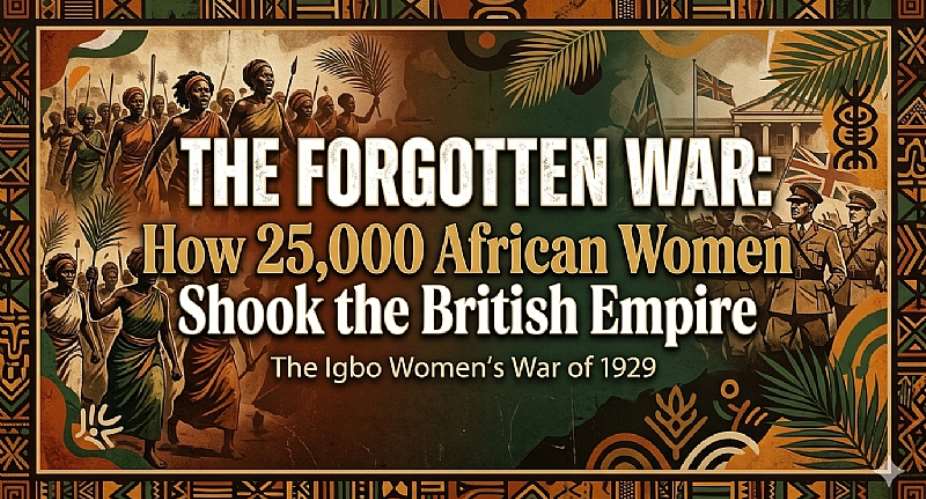
History books often paint African anti-colonial resistance as a male-dominated battlefield, but in November 1929, the British Empire was brought to its knees by an army it never saw coming: market women.
In a staggering display of defiance, over 25,000 Nigerian women launched the Aba Women’s War, a brilliant, strategically engineered revolt that shattered the foundations of colonial rule in West Africa. Blinded by racism and patriarchy, British administrators dismissed these women as politically irrelevant—completely missing the fact that local market networks were operating as the covert intelligence, financial, and tactical headquarters of a full-scale revolution. While the colonizers arrogantly labeled the uprising a chaotic "riot," the reality was far more terrifying for the empire. Armed with sophisticated cultural networks and unbreakable solidarity, these unsung heroines weaponized the economy, outsmarted British troops, and proved that the fiercest defenders of African liberty have always been the women in the marketplace.
As Ghanaians, our national consciousness is deeply rooted in stories of fierce anti-colonial resistance. We rightly celebrate the legendary Nana Yaa Asantewaa, who led the Ashanti Empire against British aggression in 1900. Yet, just across the Gulf of Guinea in 1929, another monumental chapter of West African defiance was written by the collective power of everyday market women. In November of that year, more than 25,000 Nigerian women organized a massive, highly strategic revolt known historically as the Aba Women’s War. Armed with nothing but traditional songs, palm fronds, and unmatched organizational discipline, these women brought the mighty British administrative machinery to a grinding halt. This article explores how an invisible network of market queens outsmarted colonial officers, dismantled oppressive institutions, and left an indelible masterclass in collective resistance that continues to inspire African grassroots activism today.
The Spark: Unjust Taxes and Corrupt Leaders
The revolt was a direct response to systematic economic oppression and the destruction of traditional governance systems:
- The Census Trap: In late 1929, the British colonial administration ordered a census to count women, their domestic animals, and their property.
- Illegal Taxation: The women immediately recognized this count as a precursor to direct income taxation—an economic burden never traditionally imposed on women in southeastern Nigeria.
- The Abusive Warrant Chiefs: The British had replaced traditional, decentralized governance with artificial local leaders called Warrant Chiefs. These men ruthlessly abused their power, extorting the local population, seizing property, and stripping women of their ancestral political authority.
The "Invisible" Market Communication Network
The British completely underestimated the intelligence networks of African women. The resistance was organized rapidly across vast distances through highly sophisticated, traditional mechanisms:
- The Market Grid System: The region operated on a strict four-day market rotation cycle (Eke, Orie, Afor, Nkwo). News and protest strategies discussed at one market were carried by traders to different regional markets the next day, creating an exponential, unstoppable information loop.
- The Palm Frond "Chain Mail": To mobilize the masses, leaders sent out Omu (young palm fronds) to neighboring villages. In local culture, a palm leaf signified an emergency summons and guaranteed safe passage to the bearer. Every woman who received a leaf was duty-bound to copy the message and pass it along.
- Coded Songs and Attire: Market women used song and dress as tools of tactical alignment. To signal that they had left peace behind and were entering a state of war (Ogu Umunwanyi), they wore short loincloths, smeared their faces with ash, and bound their heads with ferns.
- Financial Sponsoring: The wealthier, elite market queens financed the entire logistics of the war, providing food, water, and shelter for thousands of protesters who traveled long distances to join the frontlines.
The Commanders of the Movement
The British colonial administration tried to downplay the movement as a chaotic, unorganized "riot". In reality, it was steered by highly tactical community leaders:
- Nwanyeruwa of Oloko (The Spark): An elderly widow who was approached by a British census taker and ordered to count her household. She famously refused, asking him, "Was your widowed mother counted?" She immediately brought news of the confrontation to a local women's assembly, igniting the match that blew up the empire's plans.
- The Oloko Triumvirate (Ikonnia, Nwannedia, and Nwugo): These three prominent market leaders took operational command once Nwanyeruwa brought the news. They drafted the strategy to boycott British goods, shut down regional markets, and successfully mobilized a crowd of over 10,000 women to surround the Oloko Native Court.
- Mary Okezie: As an educated teacher, Okezie played a crucial role in the aftermath. She meticulously documented the atrocities committed by British troops and submitted formal grievances, ensuring the women's voices were heard directly by investigators.
- Madam Adiaha-Edem: A highly successful merchant who led the Ibibio women protesters in Ikot Abasi, organizing thousands to shut down coastal palm-oil trading hubs and bravely facing down British military lines.
Psychological Warfare: Songs and Chants That Broke British Morale
The primary weapon of the women was a traditional form of public shaming known as "Sitting on a Man." Thousands of women would converge outside a corrupt official's home or office at night, using devastating psychological warfare:
- Satirical Ridicule: The women sang loudly through the night, clapping and dancing while chanting explicit, satirical songs that mocked the manhood, hygiene, and morals of the British officers and Warrant Chiefs.
- Exposing Corruption: The lyrics exposed the financial crimes and bribes taken by the officials, destroying their social standing and authority in front of their communities.
- Atmosphere of Terror: Thousands of painted faces lit by torches, shouting in unison and rhythmically pounding on walls, created an intensely suffocating atmosphere that completely paralyzed the morale of the colonial officers, driving many to resign out of sheer fear.
Sister Hood of Resistance: Aba Women vs. Ghana's Yaa Asantewaa
For Ghanaian readers, the parallels between the 1929 Aba Women’s War and the 1900 War of the Golden Stool are striking. Both events highlight the foundational role of women in defending African sovereignty, yet their tactical executions differed sharply:
- Monarchical vs. Grassroots Leadership: Nana Yaa Asantewaa led from the top down as the Queen Mother of Ejisu, rallying traditional military chiefs using her royal stature. Conversely, the Aba Women’s War was a horizontal, decentralized movement led by everyday market women who rose organically without royal or state authority.
- Military Warfare vs. Civil Disobedience: Yaa Asantewaa waged a conventional, armed guerrilla war using guns and fortifications. The Aba women utilized strategic non-violent civil disobedience, economic boycotts, and psychological warfare—proving that an empire can be crippled without firing a single shot.
- Defending the Sacred vs. Protecting the Economic: While Yaa Asantewaa fought to protect the spiritual soul of the Ashanti nation—the Golden Stool—the Aba women fought to protect their bodily and financial autonomy against predatory colonial taxation.
- The Resulting Legacy: Both campaigns achieved critical goals. Yaa Asantewaa successfully prevented the British from desecrating the Golden Stool, while the Aba women entirely dismantled the Warrant Chief system. Together, they prove that West African women have historically been the fiercest guardians of liberty.
The 1930 Commission of Inquiry: Words from the Frontlines
Terrified by the scale of the uprising, British colonial troops eventually opened fire on the unarmed crowds, tragically killing over 50 women and wounding dozens more. Forced to address the international scandal, the colonial government established an official inquiry in 1930. The testimonies recorded from the market women left no doubt about their clarity of purpose:
"Our grievances are that the land is changed... We have no money. If the white man wants us to pay tax, he should look for where we can get money before asking us. We have no places to get money from."
— Nwanyeruwa of Oloko, testifying on the economic chokehold of colonial policies.
The sheer unity and collective leadership of the women utterly baffled the British commissioners, who desperately searched for male puppet masters behind the scenes. The women's responses were uncompromising:
"We had no leader. We all came together because of the trouble that had come upon us. If any woman was killed, it was a loss to all of us."
— An unnamed woman leader, testifying to the Commission on the horizontal nature of their solidarity.
The Commission's final report was an embarrassing admission of failure for the British Empire, concluding that the uprising was not a random, primitive "riot," but a direct, sophisticated response to the corruption of the Warrant Chiefs and a total lack of British understanding regarding African women's traditional political power.
The Aba Women’s War of 1929 stands as a timeless reminder that African women have always been at the forefront of political strategy, economic resilience, and liberation. For us in Ghana, this history serves as a powerful mirror. It teaches us that true power does not always reside in conventional weapons, but in the unwavering unity, cultural alignment, and grassroots organization of a determined people.
- Power in Unity: The movement succeeded because women set aside ethnic differences, uniting across multiple groups to fight a common oppressor.
- Economic Leverage: By controlling the markets, they controlled the economy, proving that financial independence is an absolute prerequisite for political bargaining power.
- Protecting the Vulnerable: The war began because women refused to let widows, orphans, and poor farmers be crushed by unfair taxes.
- A Lesson for Today: The legacy of 1929 challenges modern African youth and civil society platforms, like Modern Ghana, to actively question bad governance and use innovative, collective action to hold leadership accountable.
For and on behalf of all Senior Citizens of the Republic of Ghana 🇬🇭
Teshie-Nungua
[email protected]


 Wee smokers invade Swedru Methodist Basic School, turn classrooms into hideouts ...
 Otumfuo approved the date for my father’s funeral — Adwoa Safo
 Akofena is embarrassing the family, destroying our late father's legacy – Adwoa ...
 Illegal chainsaw operators shoot reforestation worker at Abesewa Forest
 ICS heads to Supreme Court to ban dog and cat slaughter, consumption in Ghana
 “Where are the 800,000 jobs?" — Patrick Boamah questions govt
 Patrick Boamah alleges several procurement breaches in Ato Forson’s constituency...
 Adu-Boahene Trial: GH¢49.1m from National Signals Bureau account – Prosecution ...
 32 more Ghanaians return from South Africa
 “I warned you several times" — Otumfuo destools 110-year-old chief of Kenyase No...

