





In many communities across Ghana’s Northern and Volta regions, climate change is no longer a distant conversation. It is already affecting farms, rivers, fishing activities, food production, and household livelihoods. Farmers are struggling with unpredictable rainfall patterns, prolonged droughts, floods, soil degradation, and declining harvests. Yet for many people living on the frontline of the climate crisis, access to reliable climate information remains limited.
That reality became clear through findings from the Strengthening Investments in Gender-Responsive Climate Adaptation (SIGRA) project, implemented with support from Farm Radio International. Before the start of its climate radio campaign, communities were surveyed to assess their understanding of climate change and adaptation practices. The results painted a worrying picture.
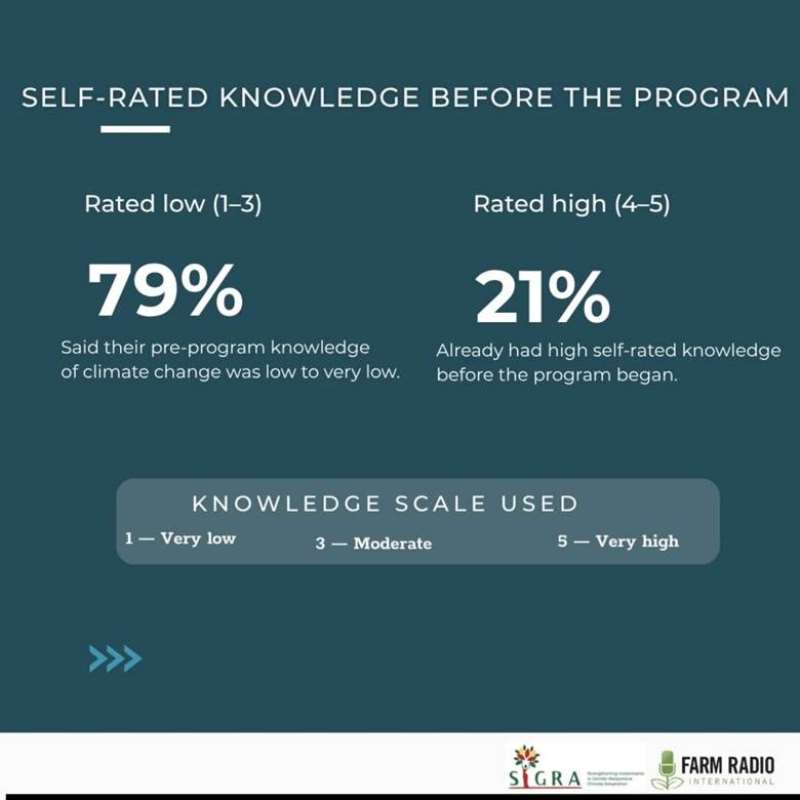
An overwhelming 79% of respondents rated their knowledge of climate change between very low and low. Only 21% believed they already had high knowledge about climate change before the program began.
The findings revealed more than statistics. They exposed a serious information gap affecting vulnerable communities already battling the harsh impacts of climate change. In many rural areas, people are experiencing environmental changes every day, but they often lack the knowledge needed to understand what is happening, why it is happening, and how to respond effectively.
For women farmers especially, the challenge is even greater. Many depend heavily on rain-fed agriculture for survival, yet they have limited access to climate education, early warning systems, and adaptation resources. Without information, climate resilience becomes difficult.
This is where community radio becomes powerful.
Through the SIGRA climate awareness campaign, radio is being used not just as a communication tool, but as a lifeline for education and empowerment. By broadcasting climate-related discussions in local languages, communities can better understand changing weather patterns, sustainable farming methods, disaster preparedness, and climate adaptation strategies that directly affect their daily lives.
The campaign is helping to transform awareness into action. Farmers are learning about climate-smart agriculture. Women are gaining confidence to participate in climate discussions and decision-making. Communities are beginning to see climate change not as an invisible force, but as a challenge that can be managed through knowledge, preparedness, and collective action.
The survey findings also send a strong message to policymakers, development partners, and environmental organizations: climate adaptation efforts must prioritize information accessibility. Infrastructure alone cannot build resilience. People must first understand the crisis they are facing.
As Ghana continues to confront rising temperatures, coastal erosion, flooding, and changing rainfall patterns, investing in climate education and local communication systems will be critical. The voices reaching communities through radio today could shape the resilience of future generations tomorrow.
Because before communities can adapt to climate change, they must first understand it.


 September 29: Cedi finishes day selling at GHS12.20 on forex market, GHS11.67 on...
 ‘We’ll explore another constitutional option for narcotics probe’ – Minority on ...
 Speaker Bagbin adjourns Parliament indefinitely after rejecting narcotics probe ...
 Food Buffer Stock seeks stronger liquidity buffer despite record GH¢91.7 million...
 Ex NAFCO Boss trial: Court adjourns trial to hear application for return of seiz...
 Bagbin backs Mahama’s call for national dialogue on social media insults
 National conversation should not become an exercise in suppressing dissent — Bag...
 ‘Don’t reward only bitter tongues, it encourages others to copy’ – Bagbin tells ...
 We have cut cost of capital by more than half since Mahama took office – Ato For...


