




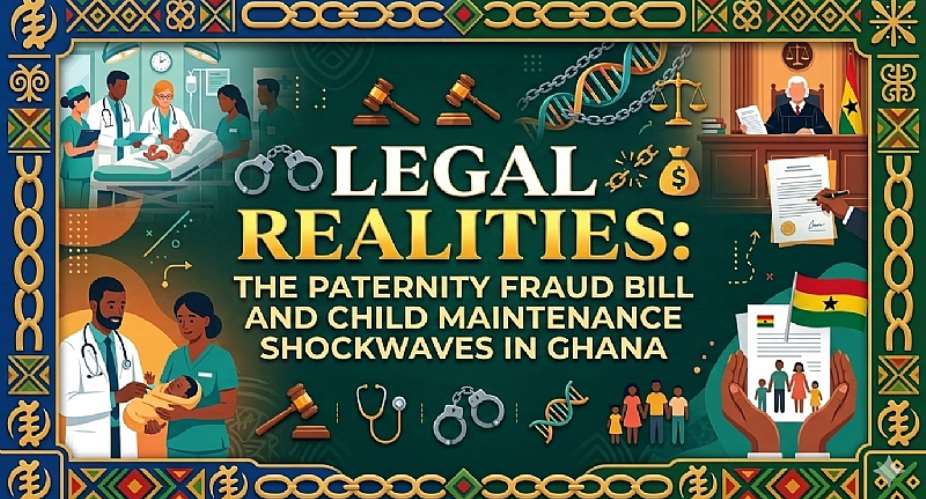
Ghana’s foundational family structure is facing unprecedented legal and emotional strains. Viral social media narratives depicting extreme marital infidelity, combined with a rising tide of verified paternity disputes, have shifted public focus from online debate into the halls of Parliament. At the center of this storm is the Paternity Fraud (Criminalisation) Bill, introduced by Gomoa Central MP Hon. Kwame Asare Obeng.
While advocates push for scientific accountability at birth to curb deceptive parenting practices, legal analysts warn that reactionary laws risk undermining the long-term protection of children. In parallel, single mothers and non-custodial fathers increasingly clash within Family Courts over the enforcement of Child Maintenance. A stitch in time saves nine; Ghana requires a balanced, deeply informed socio-legal strategy that enforces parental truth without destroying the vital financial safety nets that preserve a child's right to life, shelter, and education.
1. The Paternity Fraud Bill: Separating Fact From Hype
The public discourse on local media portals has magnified several misconceptions regarding what this legislative draft actually intends to do:
- Criminalization of Intentional Deceit: The proposed framework targets the civil and criminal boundaries of parentage. It seeks to prosecute individuals who knowingly misrepresent a child's biological lineage to gain financial upkeep, marital security, or inheritance.
- No Mandatory At-Birth Testing: Contrary to persistent rumors, the bill does not impose an automatic, state-enforced DNA screening mandate before a newborn can receive an official birth certificate or naming ceremony.
- The Threshold of Intention: Under Section 132 of the Criminal Offences Act (which handles defrauding by false pretenses), the prosecution must prove a deliberate intent to deceive. The bill protects mothers who hold a genuine, honest belief regarding a partner's paternity from facing wrongful prosecution.
2. Current Ghanaian Family Law: The Financial Consequences
Under Section 47 of the Children's Act, 1998 (Act 560), any person legally recognized as a parent or guardian is under an absolute statutory duty to supply the necessities of health, life, shelter, and education. The financial and legal mechanisms operate through distinct parameters:
- The Scope of Child Maintenance: In Ghanaian jurisprudence, child support is formally termed "maintenance". A custodial parent can file for a maintenance order through the Department of Social Welfare or directly via a Family Court. This application can proceed independently, regardless of whether the parents were ever legally married or are seeking a divorce.
- Assessment of Means: Family Courts do not apply arbitrary flat rates. When calculating monthly maintenance obligations (ranging from hundreds to thousands of Ghana Cedis), the court evaluates the standard of living of the child, the specific healthcare or tuition needs, and the documented income or financial means of both parties.
- The "No Income" Fallacy: Under prevailing family law precedents, a non-custodial parent cannot evade maintenance obligations by claiming unemployment. The law dictates that as long as the parent consumes resources to survive, they must proportionally provide for their biological offspring.
3. The Legal Shockwave: Proving Non-Paternity in Court
When a DNA paternity test returns negative after years of financial support, it triggers major complications under existing Ghanaian statutory frameworks:
- Enforcement of Past Obligations: Historically, the law heavily favored the presumption of legitimacy for children born within a valid marriage to protect family cohesion. If a man establishes via DNA that he is not the biological father, the Family Court will immediately revoke his future maintenance obligations.
- The Recovery of Financial Losses: Reclaiming years of paid school fees, medical expenses, and monthly stipends remains a complex legal challenge. Victims of paternity fraud cannot easily secure automatic state refunds. Instead, they must launch a civil tort action for deceit or fraudulent misrepresentation to claim quantifiable damages for financial loss and emotional trauma.
- Criminal Sanctions for Non-Compliance: Neglecting an active court-mandated maintenance order is a criminal offense under Act 560. If a father stops paying maintenance without a formal court order revoking his paternity status, the state can garnish his wages, seize movable assets, or pursue imprisonment.
Recommendations for Modern Ghanaian Stakeholders
- To the Judiciaries and Family Courts: Streamline civil procedures to allow for rapid, fast-tracked paternity disestablishment hearings once conclusive, accredited DNA evidence is presented, minimizing prolonged financial liabilities for non-biological parties.
- To Social Welfare and Legal Aid Agencies: Expand public education on the specific mechanisms of Act 560. This will ensure that custodial mothers understand their legal rights while informing fathers of the correct processes required to challenge maintenance orders safely without breaking the law.
- To Healthcare Administrators: Reinforce the strict implementation of matching barcode band systems and electronic verification safeguards in delivery rooms to fully insulate families from the devastating consequences of accidental infant switches.
A Urgent Call to Action for Parliament
The path forward demands clear legislative clarity, not emotional hyperbole on social media timelines. Parliament must treat the Paternity Fraud Bill with rigorous care to ensure it addresses fraud while protecting children from losing their support structures overnight.
Our Strategic Call to Action:
- Refuse Blanket DNA Mandates: Lawmakers must reject any attempt to make DNA testing a mandatory, state-enforced hurdle for birth registrations or hospital discharges, as this would overwhelm local healthcare systems.
- Establish Civil Rectification Tracks: The Children’s Act should be amended to outline clear pathways for civil restitution, enabling individuals to claim direct financial damages through the courts if fraudulent misrepresentation is scientifically proven.
- Prioritize Child Welfare: The state must guarantee that when a father legally disestablishes paternity, the Department of Social Welfare steps in immediately to trace the biological father, ensuring the child’s access to basic necessities is never compromised.
We must act decisively to protect the financial and structural stability of Ghanaian families. Let us fix the roof while the sun is shining—a stitch in time saves nine.
✍️ Retired Senior Citizen
For and on behalf of all Senior Citizens of the Republic of Ghana 🇬🇭
Teshie-Nungua
[email protected]


 Wee smokers invade Swedru Methodist Basic School, turn classrooms into hideouts ...
 Otumfuo approved the date for my father’s funeral — Adwoa Safo
 Akofena is embarrassing the family, destroying our late father's legacy – Adwoa ...
 Illegal chainsaw operators shoot reforestation worker at Abesewa Forest
 ICS heads to Supreme Court to ban dog and cat slaughter, consumption in Ghana
 “Where are the 800,000 jobs?" — Patrick Boamah questions govt
 Patrick Boamah alleges several procurement breaches in Ato Forson’s constituency...
 Adu-Boahene Trial: GH¢49.1m from National Signals Bureau account – Prosecution ...
 32 more Ghanaians return from South Africa
 “I warned you several times" — Otumfuo destools 110-year-old chief of Kenyase No...

